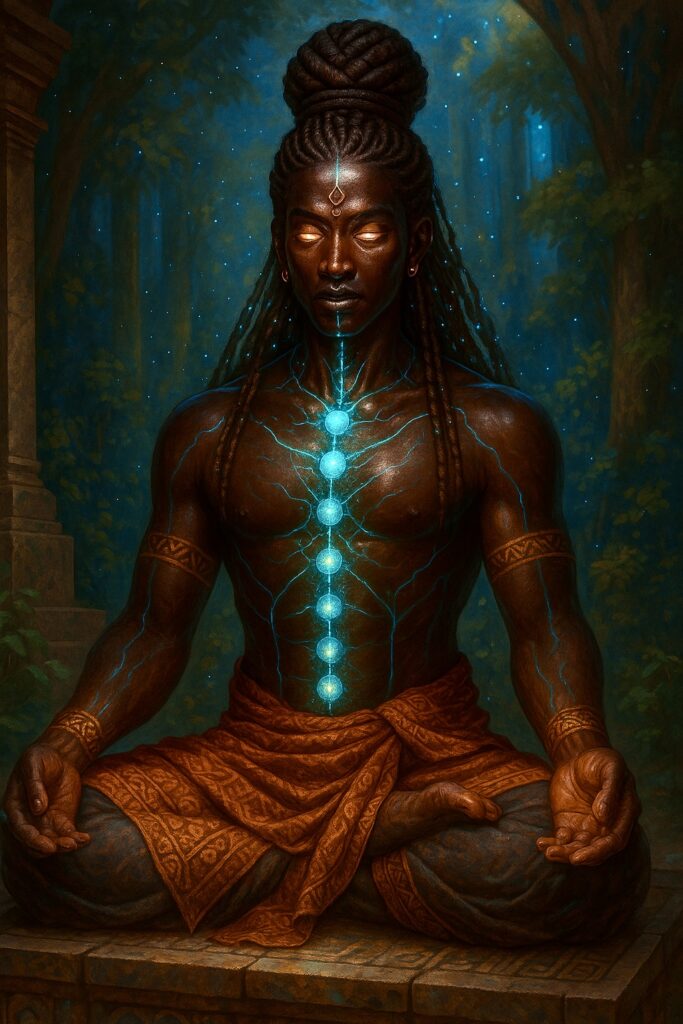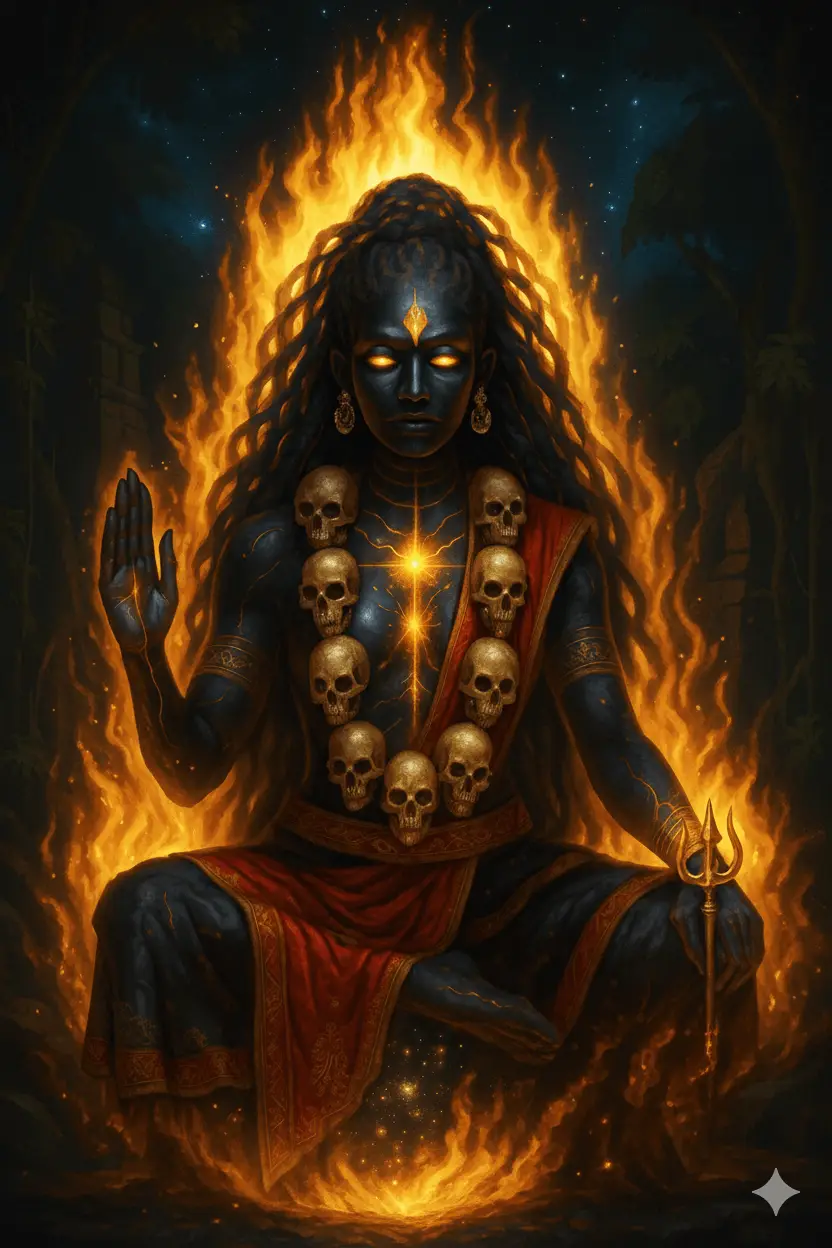


In the architecture of the cosmos and the inner landscape of the spiritual seeker, certain thresholds require a sentinel whose very nature is uncompromising truth. Within the sacred taxonomy of the Ashta Bhairavas: the eight fierce manifestations of Lord Shiva that govern time, space, and the dissolution of ego: the fourth form stands as the embodiment of righteous, unyielding force: Krodha Bhairava.
Often mistranslated or misunderstood through the lens of ordinary emotional reactivity, Krodha here does not signify human anger, resentment, or volatile passion. It denotes divine wrath (divya-krodha): the spontaneous, immaculate fire that rises solely to obliterate adharma and restore cosmic equilibrium. Stationed as the guardian of the Nairutya Kona (the southwest direction), Krodha Bhairava protects the sacred precincts of the practitioner's consciousness from incoming spiritual debris, karmic turbulence, and energetic decay.
To understand Krodha Bhairava is to understand the precise mechanics of spiritual defense, the nature of divine judgment, and the profound alchemy through which fierce energy transforms into absolute clarity.
The Iconography and Esoteric Anatomy of Krodha Bhairava
The visual transmission of Krodha Bhairava encodes deep metaphysical truths. He is traditionally depicted with a complexion resembling deep indigo, dark blue, or smoky quartz (dhumra varna), reflecting the inscrutable depths of space and the silent power that precedes creation and follows dissolution. His form is three-eyed, ablaze with an inner vision that pierces through the illusions of time and materiality.

He is mounted upon Garuda, the divine eagle of supreme vigilance and swift spiritual ascent. Unlike terrestrial mounts that wander in duality, Garuda traverses the boundless ether, symbolizing the capacity of Krodha Bhairava’s energy to soar above petty mundane conflicts and strike at the root of spiritual stagnation. His eternal consort is Vaishnavi Matrika, aligning his fierce protective force directly with the sustaining, preservation-oriented essence of Vishnu tattva.
In his four primary hands, Krodha Bhairava wields specific weapons (ayudhas) that serve as internal instruments for the upasaka (practitioner):
- The Shankha (Conch): The conch is the primordial declaration of dharma. When blown, it shatters the fog of confusion within the practitioner's mind, establishing an unshakeable clarity of intent (sankalpa). Much like the resounding blast of the Panchajanya before the battle of Kurukshetra, the shankha in Krodha Bhairava's hand is a fearless, uncompromising announcement of truth, cutting through hesitation and doubt.
- The Sudarshana Chakra (Discus): The discus represents 360-degree vision: the capacity to perceive any situation, person, or event from every conceivable angle simultaneously. Traditional esoteric wisdom dictates that true judgment or decisive action is only valid when born from total, unobstructed vision. Passing judgment from a place of limited perception creates binding negative karma; the Sudarshana aspect ensures that action arises from absolute wholeness.
- The Gada (Mace): The heavy mace represents the power of stambhana: the capacity to instantly stun or arrest negative momentum. When adversarial forces, internal delusions, or external karmic pressures attempt to overwhelm the practitioner, the gada halts their progress, freezing confusion in its tracks so that higher awareness can take command.
- The Patra (Skull Cup): The skull cup represents the containment and transcendence of individual ego. In deep meditation, Krodha Bhairava uses the patra to draw out and consume the incessant chatter of the seeker's mind, inducing a state of pristine stillness (shunya). Out of this cultivated emptiness, spontaneous, intuitive divine guidance emerges.
Divine Anger Versus Human Emotional Reactivity
To approach Krodha Bhairava is to confront a radical redefinition of wrath. Human anger is almost invariably tethered to the ego: it arises from wounded pride, thwarted desires, territorial defense, or a sense of personal offense. It lingers, festers, and weaves complex webs of resentment over years.
Divine anger (divya-krodha), by contrast, is completely impersonal. It is an automatic, flawless reflex of cosmic order: much like a lightning storm clearing a heavy, stagnant atmosphere. It arises spontaneously when adharma manifests, serves its precise restorative function, and then vanishes instantly, leaving behind absolute peace and equanimity. There is no vengeance, no accumulation of emotional baggage, and no malice.

The classical mythology of Shiva and Andhakasura illustrates this synthesis of fierce justice and boundless compassion. When Andhakasura, blinded by ignorance and ego, challenged the divine order, Shiva impaled him on His trishula. Yet, the moment the demon surrendered, realizing the vanity of his rebellion, Shiva's wrath melted instantly into grace, transforming Andhakasura into a revered gana (attendant deity). Here, krodha (wrath) and karuna (compassion) operate as two hands of the same infinite consciousness. The sadhaka who invokes Krodha Bhairava learns to embody this same non-reactive firmness: acting with absolute resolve in the world while remaining inwardly untouched by hatred or turbulence.
Guarding the Nairutya Kona and Preserving the Vishnu Tattva
In traditional Vastu Shastra and esoteric temple architecture, the southwest direction: known as Nairutya Kona: is governed by Nirriti and is traditionally understood as the quadrant from which heavy, regressive, or disruptive influences tend to approach a dwelling or a subtle energetic field.
Krodha Bhairava is stationed precisely at this vulnerable corner. As a guardian of the southwest, he acts as an impenetrable energetic shield. His presence prevents the leakage of vital spiritual energy and repels subtle intrusions that seek to compromise the integrity of the seeker's practice. Furthermore, in advanced astrological remediation, devotion to Krodha Bhairava is known to temper and harmonize severe afflictions of Saturn (Shani), particularly when Saturnian karma manifests as stagnation, chronic delay, or unyielding sorrow.
In certain rare and profound lineage traditions (sadhana paddhatis), Krodha Bhairava is elevated from the fourth position to the very head of the Ashta Bhairavas. This placement emphasizes a foundational truth: before higher mystical ecstasies or subtle refinements can be sustained, the practitioner must first anchor the Vishnu tattva: stabilizing dharma, sealing the energetic leaks in the southwest corner of the psyche, and establishing an unshakeable moral and spiritual foundation. Without this structural integrity, any soaring spiritual ambition collapses under the weight of unintegrated inner shadows.
The Path of Uncompromising Integration
Engaging with Krodha Bhairava requires stepping beyond comfortable, sanitized spiritualities that seek to bypass the fierce realities of existence. Tantra, in its authentic transmission, does not shrink from the raw powers of the cosmos; it confronts them, purifies them, and integrates them into the realization of non-duality.

When the practitioner meditates upon Krodha Bhairava, chanting the sacred formulae with discipline and reverence, the internal landscape undergoes a quiet revolution. Inner hesitation dissolves. The fog of doubt is blown away by the conch. The 360-degree vision of the Sudarshana cuts through self-deception. The mind is emptied, and the fierce guardian stands watch at the gates of awareness: ensuring that only truth, clarity, and devotion enter the sanctuary of the soul.
To walk this path is to realize that true peace is not the absence of power, but the mastery of it. In the heart of divine wrath lies the ultimate preservation of grace.
Explore our curated archives and deepen your understanding of sacred embodiment through our offerings and teachings.