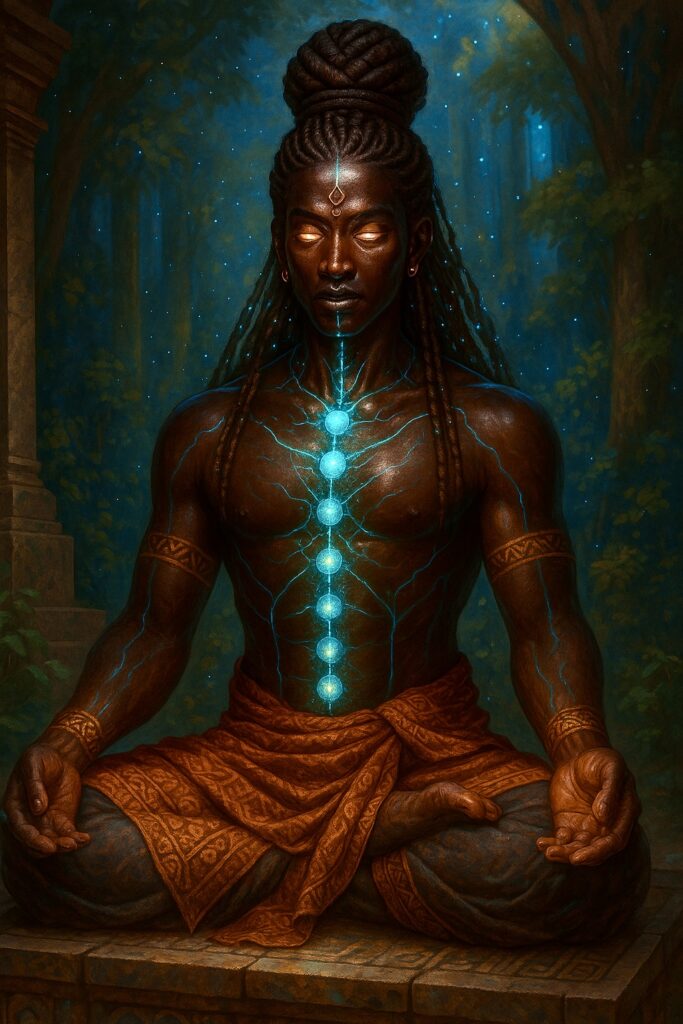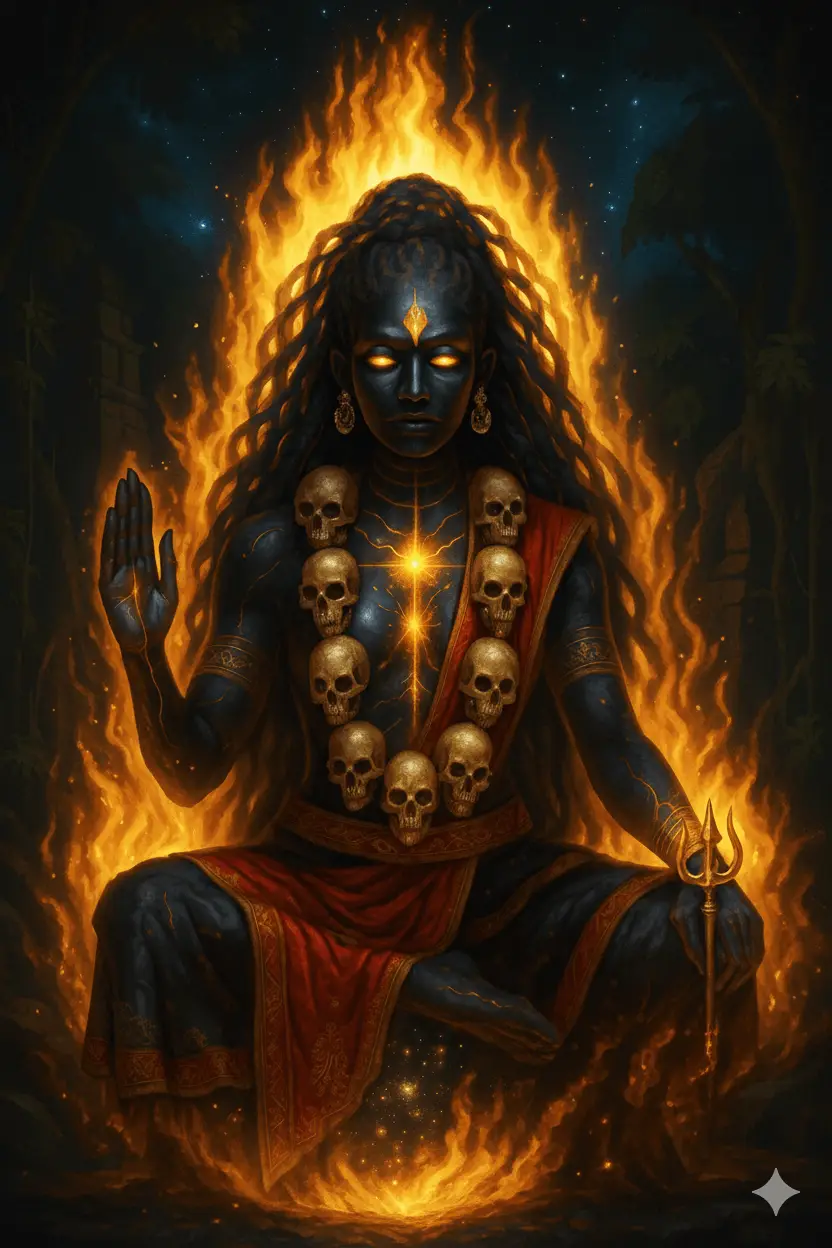


In the grand architecture of creation, human authority and ambition are continually weighed against forces far older and vaster than any earthly empire. When we observe the rise and fall of political movements, institutional corruption, and the violent clashes of power, we are witnessing more than mere sociology. We are watching a cosmic drama unfold: a sacred choreography governed by the eternal interplay between Surya, the blazing source of solar authority, and Shani, the relentless arbiter of karmic time, all unfolding within the inscrutable gaze of Mahakala.
To understand why power so often collapses under its own weight, and why movements swell beyond the control of those who initiated them, we must look past the superficial noise of contemporary events. We must return to the traditional foundations of cosmology, where every political shift, ethical crisis, and societal upheaval is recognized as a reflection of deeper spiritual laws.
Nimitas: Reading the Script of Mahakala
In traditional spiritual science, nothing in creation occurs by random coincidence. Nature constantly speaks through nimitas: omens, portents, and subtle environmental signatures that act as the visible script of Mahakala, the Lord of Time and dissolution.
When human consciousness is trapped in emotional reactivity and partisan narratives, these signs go entirely unnoticed. People become so intoxicated by ideological victories or panicked by sudden defeats that they mistake the ripple for the ocean. However, the practitioner who cultivates stillness steps back from this emotional vortex. By detaching from the immediate drama, one begins to perceive how events are arranged on a subtle plane long before they manifest in the physical realm. Mahakala writes the script step by step, and those anchored in awareness can discern the unfolding of destiny without needing to fight every phantom shadow on the political stage.
The Surya–Shani Paradox: The Blind Spot of the Sovereign
At the heart of every power structure lies a fundamental vulnerability: the inability of authority to perceive its own shadow. This universal dynamic is illuminated in the classical myth of Surya (the Sun) and his son Shani (Saturn).
Surya represents the apex of self-expression, ego, sovereign governance, and dazzling illumination. He is the atmakaraka, the divine witness of the soul. Yet, in the mythic account, Shani is born from Surya’s shadow-wife, Chhaya. When Shani opens his eyes for the first time and directs his gaze toward his father, the Sun’s brilliance dims, and Surya recoils, failing to fully recognize the dark, austere child as his own.
This myth encodes a profound astrological and spiritual truth: the light that sees everything still possesses a blind spot in its own household. Surya identifies entirely with radiance, success, and authority, remaining utterly blind to the human cost, the ignored populations, the silenced dissent, and the subterranean grief generated by its own policies.
Shani emerges directly from that blind spot. As the embodiment of time, limitation, justice, and suffering, Saturn represents all those whom power has overlooked or oppressed. When Shani’s gaze falls upon Surya, the arrogance of absolute authority is brought to a screeching halt. The myth reminds us that whatever an individual, a ruler, or an institution refuses to acknowledge in the shadows will eventually return as a formidable karmic challenge. Brilliance without humility inevitably creates the very conditions of its own downfall.

Rahu and the Uncontrollable Swallowing of Light
While Saturn tests authority through delay and consequence, another celestial force operates on a scale of exponential acceleration: Rahu. In traditional jyotish, Rahu represents obsessive desire, mass psychological contagion, illusion, and sudden, disruptive expansion.
When Rahu achieves massive potency in the collective field, it possesses the capacity to swallow both Surya (consciousness) and Chandra (the emotional foundation of society). History demonstrates that once a movement fueled by Rahu gathers sufficient momentum, neither the established authority of Surya nor the raw physical force of Mars can suppress it.
Power structures frequently make the fatal mistake of responding to mass unrest with mere coercion, failing to realize that force only feeds the shadow. A movement born from collective resentment or distorted ideological hunger cannot be bludgeoned into submission; it must run its karmic course until the illusion exhausts itself. The devatas permit these tidal waves of disruption precisely to dismantle rigid structures that have lost their alignment with truth.
Dharma, Ethics, and the Purifying Gaze of the Devatas
True dharma is never merely performative. Wearing sacred attire, repeating devotional phrases, or utilizing traditional vocabulary counts for nothing if the foundation of fundamental ethics is absent. In the traditional hierarchy of cosmic principles, Brihaspati (Jupiter) represents the Guru of ethics, law, and higher wisdom upon which true societal and spiritual order rests.
When institutional corruption, hypocrisy, and moral decay penetrate even the most sacred temples of society, the devatas themselves instigate a process of purification. This explains why moments of profound crisis often coincide with the unmasking of long-hidden institutional corruption. These exposures are not accidents; they are divine interventions designed to cleanse the vessel of tradition.
Ultimately, the spiritual seeker must recognize that allegiance to any political party, transient ideology, or human personality is a dangerous delusion. The supreme devotion must always be directed toward the devata: the living divine intelligence that transcends human categories. The devatas operate with a vast, panoramic vision that humans cannot fathom, perpetually dismantling corrupt structures to ensure the ultimate preservation of dharma.

Sadhana, Eclipses, and the Sanctuary Within

Periods of intense celestial and societal friction: such as major eclipses: are not times for superficial engagement or outer posturing. They represent highly potent energetic windows for interiorized practice (sadhana). For the dedicated seeker walking the path of fierce transformation, such as the invocation of Tara or Durga, these moments offer an unparalleled opportunity to pierce through the veils of illusion.
When the outer world is consumed by the friction between arrogant power and karmic justice, the wise practitioner withdraws inward. By anchoring awareness in the sacred ground of the body and the silence of the inner witness, one steps outside the machinery of time.
Civil disagreement and robust debate have their place, but spiritual integrity requires that we refuse to be dragged down into the mire of online vitriol, disrespect, and ideological fanaticism. The teachings are cast outward like seeds; those whose hearts are ripe will receive them, while the restless and undisciplined will pass by. In the end, true liberation is found not by controlling the shifting shadows of the political realm, but by aligning oneself irrevocably with the unchanging light of the inner divine.
To explore how these ancient principles of embodied awareness and spiritual integration apply to your own daily walk, read our guide on how to integrate authentic tantra into daily life.