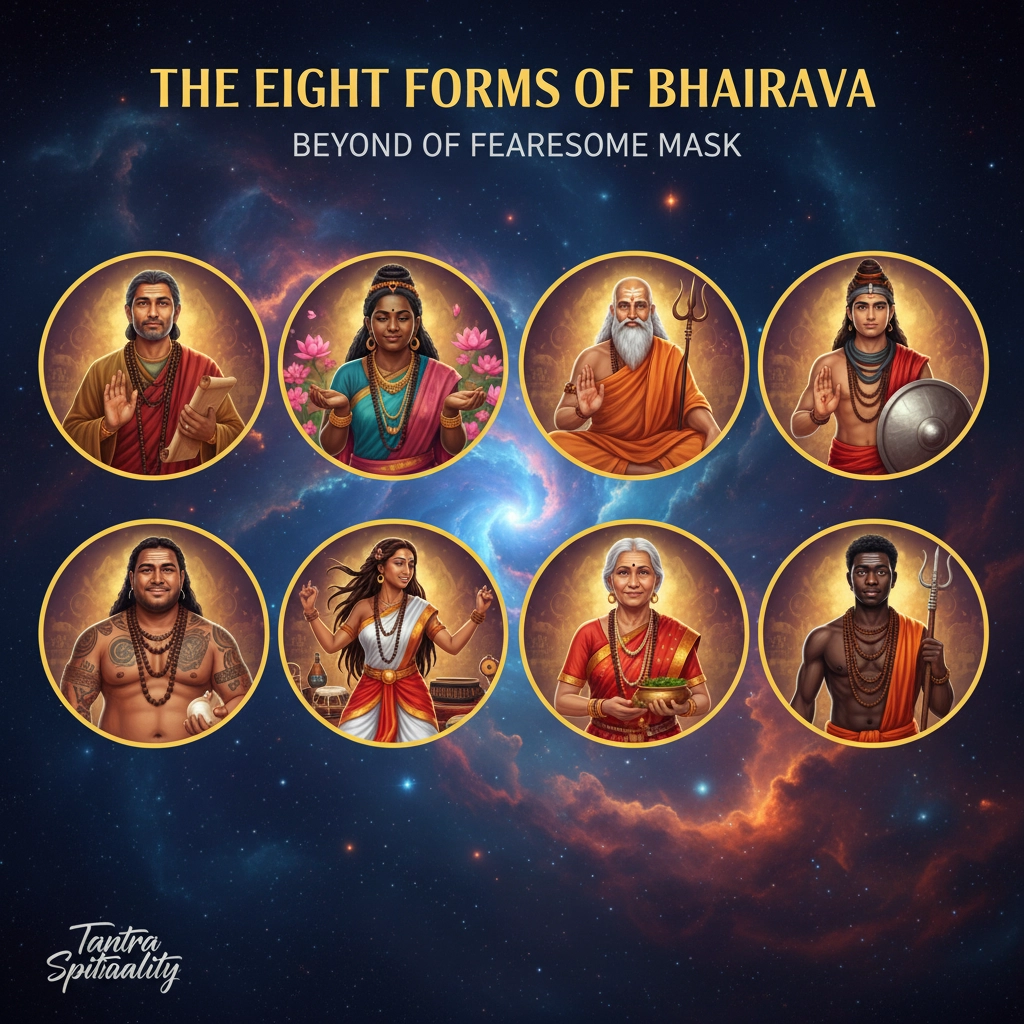
Among the eight forms of Bhairava, Unmatta Bhairava is one of the most distinctive. His name is often translated as “mad,” but Sanskrit contains many words for madness, and unmatta carries a particular meaning. It indicates intoxication, frenzy, or a condition in which a person is possessed by another force.
That force may arise from an intoxicant, from an avesham of energy, or from an occult influence. The ordinary senses no longer govern the person. The usual process of thinking does not function in the ordinary way. The individual has come under the grasp of another kind of shakti. This condition is known as unmattavastha.
Unmatta Bhairava is not the lord of ordinary confusion. He is the lord of divine madness: the state in which a person becomes so engrossed in the devata that the material world loses its authority. The mind becomes single-pointedly connected to, searching for, and finally held by something higher than itself. From that absorption comes bliss and great joy.
The Frenzy of the Divine Forces
This condition is not unknown in the history of religion. Within Hindu Dharma, many ascetics, saints, and spiritual figures have been considered mad by those around them. Society often calls anything that deviates from the ordinary “madness.”
Yet there is a deeper kind of deviation: an extreme absorption in the divine. This is the intoxicating madness represented by Unmatta Bhairava.
One story from the Mohana Tantra traditions describes a moment during the Devasura Sangrama when some of the Matrika Shaktis became confused about which side they were fighting for. They had been engaged in constant battle and constant striving. The frenzy had become so complete that they had forgotten the original goal.
This is the nature of frenzy. A person may become so engrossed in an act that the purpose behind it disappears. It is as though something takes possession of the individual and makes them continue, even when they no longer remember why they began.
At that moment, Shiva produced an ocean of intoxication from within himself. A small portion of that power, even a single breath of it, could cause one to lose one’s sense of direction and sense of self. From this ocean of intoxication arose a being who was intoxication from top to bottom. The core of bliss was present throughout his entire being.
That being was Unmatta Bhairava.
His first act was to reorient the mental direction of the Matrika Shaktis. He restored their understanding of where they stood and what they were doing. This story gives the upasaka a direct indication of the energy contained within this form: Unmatta Bhairava governs intoxication, but he also governs its direction.

The Form of Unmatta Bhairava
Unlike several other forms of Bhairava, Unmatta Bhairava is shweta, fair or white in complexion. A mild intoxicating smile rests upon his face. He holds four weapons, including a kapala, a shield-like weapon, and a javelin-like weapon that he throws in certain iconographies.
He is associated with the Ishana swarupa of Sadashiva. Within him is a blissful intoxication. He is always in that condition, but he is not merely intoxicated. He can create and govern intoxications.
These conditions do not always arise from physical substances. They may also come through psychological states, illness, or any condition that deviates from the normal. Unmatta Bhairava has the power to redirect such conditions toward a more positive outcome.
For this reason, his worship is considered beneficial for psychological difficulties, weaknesses, habits that one cannot break, and the confusion that prevents a person from understanding the direction of life. During an existential crisis, one may become uncertain about whether to go left or right. Questions arise about identity, the self, and what remains unchanged within a person as circumstances shift.
Unmatta Bhairava can guide the confused individual toward the right direction. His upasana and seva, when correctly performed, can also help remove depression and other mental disturbances.
The Western Direction and the Discipline of Shani
Unmatta Bhairava governs the western direction and has control over the graha Shani. Psychological conditions may sometimes arise through combinations involving Saturn and other grahas, including the Moon and Mercury. Such matters should not be reduced to a single statement or applied without knowledge of Jyotish, but Saturn does have a role in certain forms of psychological difficulty.
Unmatta Bhairava’s upasana can also bring discipline to the mind by addressing the difficult effects of Saturn.
One way Saturn reveals its weakness is through a person’s inability to complete work. There may be laziness, postponement, or a repeated tendency to lose strength midway through an undertaking. A person begins with zeal, then loses inspiration and shifts to something else. The work remains unfinished, excuses multiply, and guilt follows.
That thought process (“I will do this,” followed by the inability to carry it through) may indicate that Saturn is not beneficial for the upasaka. The blessings of Unmatta Bhairava can help bring these tendencies into order.
But these blessings are not obtained through a single gesture. Bowing before Unmatta Bhairava or chanting one mala does not immediately produce the complete result. His worship demands depth, continuity, and the strengthening of the vessel that receives his power.
Vamachara and the Power of Focus
Unmatta Bhairava upasana eventually leads toward vamachara. Almost all Bhairava upasanas require, if they are to become fully potent, at least the offering of karan. A sattvik form of worship may be performed, but the energy will not necessarily reach the extent at which Bhairava shakti manifests in its full glory.
The Pancha Tattva offered to Bhagavati and to the forms of Devi produces a specific energy in the mind and body of the upasaka. It creates an intoxicating effect, as though a force or shakti outside oneself has taken possession.
In that state, the mind becomes like a horse moving with blinkers on both sides: you cannot see left, you cannot see right, and your attention is fixed upon one thing. You lose track of time, place, and environment. The mind becomes less distracted and extremely focused, but in a mad and frenzied manner.
This is what Unmatta Bhairava does and governs. The most important point is that he governs it in a beneficial way.
Not all madness is divine. Some forms are psychological conditions, the result of difficult grahas, problems connected to the pitrus, or other spiritual causes. Unmatta Bhairava distinguishes divine madness from the madness that arises as a karmic reaction to past action. He reduces the negative form of unmattata and increases the positive form: complete submergence into divine intoxication.
The Horse and the Speed of Bhairava
The horse is one of the vahanas of Unmatta Bhairava. It indicates the speed of his action. Bhairava himself is swift, but Unmatta Bhairava is even faster.
Whenever a deity has a horse as a vahana, the rishis are indicating that speed is a characteristic of that devata. The horse represents fast and royal movement. Unmatta Bhairava responds with extreme pace.
His worship can remove confusion, addictions, and psychological weakness. At higher stages, it also protects the upasaka from abhichara-related kriyas and other harmful forces. Any astra directed toward the upasaka may be broken down by the power of Unmatta Bhairava.
But this does not happen on the first day. It occurs only at higher stages, when Unmatta shakti has entered and possessed the soul of the upasaka.

Beyond the Ordinary Format
Bhairava is Shiva who comes down to this plane. Because he is present here, he comes quickly. Somebody takes one step toward Bhairava, and Bhairava takes two steps toward you.
He is also a god of truth and reality as it is. He has very little maya around him. Maya is not only material attachment. It may also be attachment to a spiritual format: a set of rituals, offerings, rules, and familiar conditions to which one becomes accustomed.
A person may have a set life, with family, work, friends, comfort, and ordinary happiness. There is nothing wrong with such a life. But attachment to remaining exactly in that state (not moving too quickly, not moving too slowly, and not allowing anything to change) is itself maya.
Bhairava eventually takes one outside of formats.
This is seen in the story of Daksha Yagna, when Shiva cuts off the head of Daksha. Daksha means one who is expert: expert in ritual, expert in established forms. Bhairava breaks through the fixed order when that order becomes an obstacle to consciousness.
Dharma is circular. At one level of consciousness, certain rules must be followed because they create the greatest sustenance. When consciousness changes, the dharmic rules also change. This is why the Avadhuta, whose consciousness is liberated from everything, does not follow the ordinary rules of dharma.
Advaitam enters. Oneness is seen. The rules of purity and impurity begin to break down. This transcendence belongs to Bhairava.
In Unmatta Bhairava, transcendence takes the form of frenzy. The upasaka becomes so engrossed in divine madness that ordinary rules of worship and society are transgressed. All Bhairavas cause transgression, but Unmatta does so through divine madness. There is no karmic repercussion to that breaking of rules when it arises from the genuine power of Bhairava. The normal condition is overturned, and new portals open in the mind and body.
Karan, Kappar Seva, and the Strong Adhara
Offering karan to Unmatta Bhairava is both a practical act and a symbolic gesture. Bhairava is associated with intoxicating offerings, and in Unmatta’s case, Kappar Seva becomes especially important. The upasaka offers karan in a kappara, and the offering creates an immediate sense of intoxication in Unmatta Bhairava.
When it is offered with genuine bhakti, without trying to be clever or over-smart, it brings blessings. Bhairava receives the offering and returns bliss, which may express itself through material benefit, psychological strength, and mental happiness.
Yet the upasaka must possess a strong adhara, a vessel capable of holding the energy. This frenzy resembles the avesham rituals found throughout India, including those connected with Skanda. The soul, mind, and body are gripped as if something has taken possession.
If the adhara is weak, the upasaka may be disturbed or disoriented. A mentor is therefore important. If no mentor is available, the upasaka must continue japa and sadhana religiously for years. Each repetition of the mantra changes the adhara and strengthens it so that it can hold greater power.
If the upasaka cannot yet handle the shakti, Unmatta Bhairava withdraws it. When the vessel is prepared, however, the experience is profoundly blissful.

Varahi and Unmatta Bhairavi
Among the Matrika Shaktis, Unmatta Bhairava is connected with Varahi. Varahi is powerful in removing abhichara-related kriyas. At the highest level, her worship requires offerings of the Pancha Tattva. Her worship is especially effective at night, and the deeper the night, the better the results. Her homas are potent in destroying black magic.
Some texts also speak of Unmatta Bhairavi as the Bhairavi of Unmatta Bhairava. Traditions differ. In one understanding, Unmatta Bhairava guards the Varahi Shakti, as every Shakti has a consort who also serves as guardian. In another, Varahi is regarded as the consort of Unmatta Bhairava.
Varahi worship is not something into which one should jump without preparation. The worship itself may be simple, but the upasaka must know what to do and must have the ability to perform it properly, step by step.
The eight Bhairavas are ultimately projections of Kala Bhairava. The essential Bhairava tattva remains one, while the activities, personalities, qualities, and mantras differ.
Bhairava is the god of reality, truth, and Satyam. Truth has many dimensions and facets, and each dimension is governed by one aspect of Bhairava. These become the Ashta Bhairavas.
Jai Kamakhya. Jai Matara. Jai Bhairava.