Unlearn to Relearn
Before approaching this form, set aside what you think you already know about Ganapati. If you sit with the lens of comparison, matching this teaching against what someone else has said, the essence is lost. In tantra, information is perceived and shared from one particular aspect.
Many beautiful teachings about Ganapati are already available. Many great sadhakas have spoken about his forms. Yet of Ucchishta Ganapati, very few of even the greatest saints have spoken. Very few who know what this swarupa exactly is.
When we hear the name Ganapati, we usually remember a beautiful elephant, or Bala Ganapati: a small child with an elephant head who removes obstacles. He is invoked before and after an auspicious puja vidhana. He is Vidya Ganapati, Bhagavan of wisdom, and the devata whose vigraha stands near the entrance of many homes and temples.
This is already a clue.
Ganapati is a threshold deity. Before entering, before beginning, before crossing, before understanding something new, and before entering any path, whether vamachara, dakshina, or kaula: Ganapati is invoked. Even in the most familiar understanding, Ganapati already stands in the doorway.
The Obstacle Within
Tantra takes this doorway deeper by asking: what is the greatest obstacle?
The greatest obstacle is not outside you. It is the division within consciousness:
- pure and impure
- sacred and profane
- acceptable and unacceptable
- desirable and undesirable
- fear and freedom
- Shiva and Shakti
- self and other
When the greatest obstacle is not outside you, the familiar Ganapati begins to transform. The form must be seen from another perspective.
Vidyakara’s Boon
There was an asura named Vidyakara who performed intense tapas to Brahma. When Brahma appeared, Vidyakara asked for immortality. Brahma confirmed that such a boon could not be given.
Vidyakara then took a strategic step. He asked that his killer should be neither man nor animal, neither human nor animal, and should use no kind of weapon.
Then he added the condition that surprised even Brahma: the one who killed him should be in the middle of rati-kriya, the divine act of union.
Brahma paused, and then granted the boon.
Vidyakara began creating turbulence throughout the lokas. He believed that no devata could trouble him. His strategy rested on the conviction that when any human being, or any life in existence, is in the midst of that divine process, they do not think about the next minute, the next sequence, or the next action.
When the devatas saw his asuric nature spreading everywhere, they went to Shiva and Parvati. Ganapati came forward and said that he would take care of the problem.
The devatas invoked Prakriti. Through her divine intervention, Maha Ganapati took this swarupa. Some call her Neela Saraswati. She too was present in that oneness, in that union.
Their union became the key to Vidyakara’s destruction.
No weapon was used. No man or animal killed him. When the divine union occurred between Ganapati and Neela Saraswati, the radiance of that swarupa, and simply the glance of it, brought about his destruction.
This is the shakti-yukta form of Ucchishta Ganapati.
What Ucchishta Means
The word ucchishta carries the idea of what remains, what is left over. It refers to what conventional, conscious ritual purity leaves outside itself. Whatever remains around that purity.
This is precisely why the form becomes important in tantra. Sadhana here is something different.
Ucchishta Ganapati does not merely ask, “Can you remove your obstacles?” He asks a more uncomfortable question:
What have you rejected?
Especially in Shree Vidya, before beginning sadhana, this swarupa is invoked. What have you rejected in your life? What have you called impure? What have you pushed away from consciousness? What are you afraid to look at? What have you separated as sacred, and why have you called this sacred and that non-sacred?
That is where the tantra journey begins. This has been beautifully expressed in the kaula path.

The Doorway Between Pure and Impure
Ucchishta Ganapati is traditionally recognized as a tantric manifestation of Ganapati, associated with the ucchishta stream and appearing within tantric ritual and iconography.
This swarupa is uncomfortable because it confronts a category. Human beings ordinarily distinguish between purity and impurity. But this does not mean that tantra simply glorifies impurity. Tantra does not glorify everything. That is not the secret.
The deeper question is this:
If consciousness is ultimately one, where did the absolute division between pure and impure come from?
Between pure and impure there is a doorway. The devata who stands at that doorway is Ucchishta Ganapati.
Imagine two shores. One shore is ordinary consciousness. The other is recognition: recognition of consciousness and awareness. On one shore is duality; on the other, non-duality. On one shore is fear; on the other, for the sadhaka who arrives there, there is nothing called fear.
Between these shores is a crossing. That crossing is called tirtha.
Now ask: what if the devata himself becomes that crossing?
Ganapati already stands at the threshold. In Ucchishta Ganapati, he stands at an even more mysterious threshold: the crossing between ordinary sacredness and deeper tantric recognition of consciousness.
This is why the word anatva was written. What lies beyond the crossing?
Bhairava Reveals the Secret
The traditional Ganapati Ashtottara Shata Namavali presents a direct clue. Its dialogue does not begin with ordinary devotees. It begins with Maha Bhairava speaking to Maha Bhairavi.
Bhairava says: listen to my secret. He then reveals the thousand names of Ganapati. In the Ucchishta Ganapati Ashtottara Shata Namavali, Bhairava is speaking to Bhairavi and revealing the secret of himself through the names of Ganapati.
Pause here.
Bhairava is revealing the secret of Ganapati to Devi. The relationship is no longer simply devotee and Ganapati. It is not the ordinary human arrangement of father, mother, and son. The revelation takes place within the Bhairava and Bhairavi framework.
This is the first clue.
The second clue is that Bhairava praises Ganapati. He describes how obstacles arise and how they are freed through praise of Ganapati. It is said that even one who does this once in an entire lifetime will have obstacles removed.
This is not spoken by an ordinary being. Bhairava himself speaks it: the Shiva swarupa. He says that by the grace of Ganapati, he became one of the swarupas of Shiva Bhairava and became known as Asurantaka, the destroyer of that asura.
He then praises Ganapati with a thousand names.
The one understood as Bhairava (the fierce swarupa of Shiva, arising from the third eye and coming to teach a lesson to the creator) is himself speaking about the power of Ganapati. Ganapati’s grace is connected with the destruction of obstacles even at the level of the cosmos.
This is not a hierarchy. Tantra shows that the same supreme reality can reveal itself through different doors.
Dvatrimshad Bhairava Nayaka
The fifty-eighth name in this tradition is given as:
Dvatrimshad Bhairava Nayaka Namaha
Dvatrimshad means thirty-two. Bhairava refers to the manifestations of Bhairava. Nayaka means leader or guide.
The salutation is to the leader of the thirty-two-fold manifestation of Bhairava.
This is the key.
Ucchishta Ganapati is not merely the remover of obstacles or the granter of siddhi. In this name, he stands in direct relationship with Bhairava-tattva. The formation and configuration of the Bhairava swarupas.
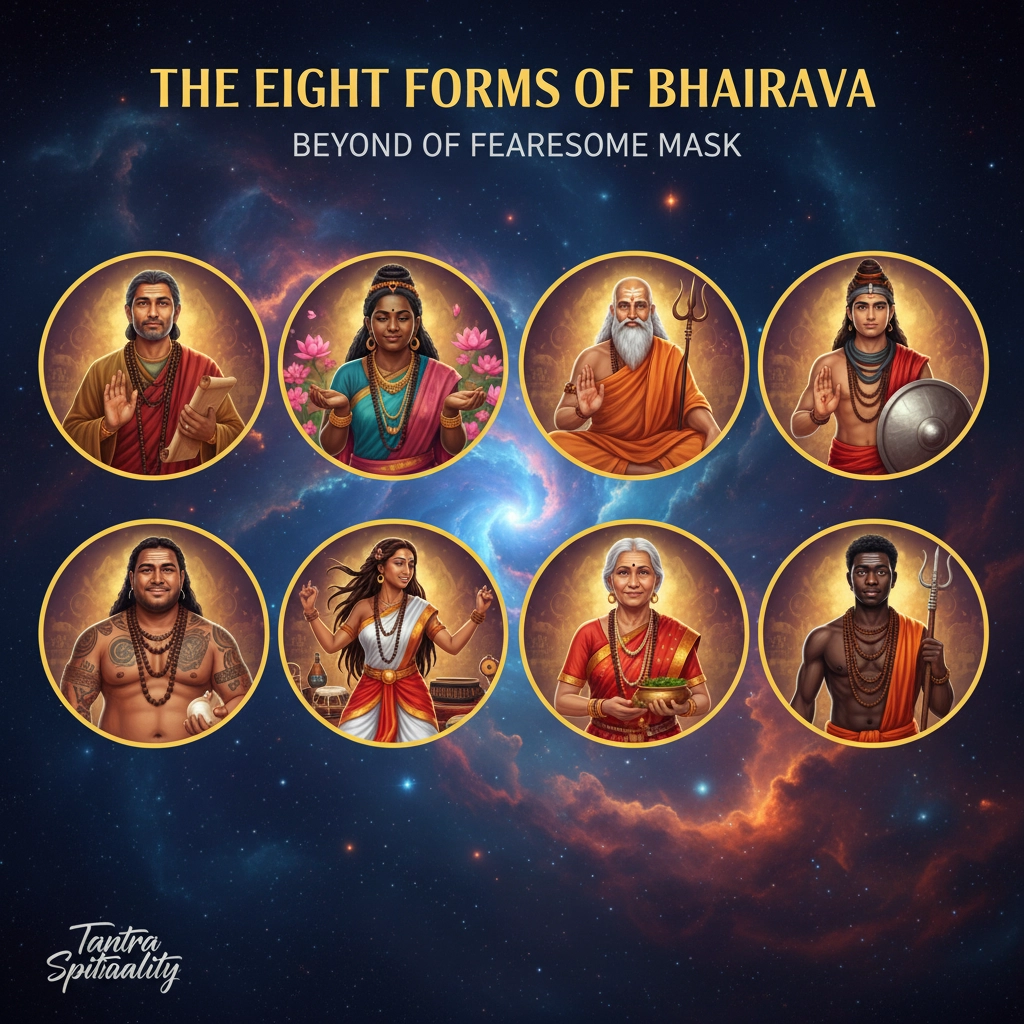
Bhairava is not only Kala. There are one hundred and eight swarupas of Bhairava, and that is only what has been documented. In the Bhairava Tantra and Bhairava Agama, there is also the teaching of the thirty-two Bhairava Nayakas.
The famous Bhairava Tantras comprise sixty-four tantras in the Trika and Kaula traditions. These are arranged through eight groups, each containing eight:
- Bhairavashtaka
- Yamalashtaka
- Matashtaka
- Mangalashtaka
- Chakrashtaka
- Bhuruvashtaka
- Vagashtaka
- Shilashtaka
Together, these form the sixty-four Bhairava Tantras. In the Kaula tradition, they are connected to the yoginis. Each yogini has taught one particular Bhairava and disclosed one particular tradition of tantra.
The first branch is Bhairavashtaka. Bhairavashtakam is not merely a hymn. It is a complete tantra in which the eight sub-branches are connected. The forms associated with it include Swacchanda, Chandrabhairava, Krodha, Unmatta, Asitanga, Kapalisha, and others.
The thirty-two forms reveal a deeper arrangement. Nayaka means the leader, the guide. The presence of Bhairava is therefore meaningful. Ganapati appears with the wider quality of Bhairavatva: protection, awareness, guidance, and movement beyond the obstacle of limitation.

Ganapati Bhairava
In the Brihad Bhairava Tantra, the ninety-third name of Bhairava is Ganapati Bhairava because he carries that tattva.
This does not mean that Ucchishta Ganapati is simply one of the Bhairavas. The meaning is more subtle.
Ganapati is a form, a tattva. Ucchishta Ganapati is a doorway through which the tattva becomes accessible to the sadhaka.
From the Kaula perspective, this becomes even more significant. Ganapati is already within the Kaula mandala. Ganapati Panchanga connects mantra, yantra, dhyana, Maha Ganapati Kavacha, Sahasranama, and Stotra. In the Devi Rahasya, Ganapati himself is said to be invoked before approaching Devi.
These are stages: mantra, yantra, dhyana, kavacha, and stotra. The material is presented through Bhairava’s revelation of Kaula practice.
Once one enters the Kaula, the language changes. We speak of Bhairava and Bhairavi. We recognize that there is no difference between Shiva and Shakti. The movement is toward non-duality.
The Doorway You Declared Forbidden
Ordinary Ganapati takes you to the doorway.
Ucchishta Ganapati asks you to cross the doorway that your own mind has declared forbidden.
He confronts divisions, boundaries, and assumptions. He is an extraordinary tantric symbol of crossing.
Imagine a seeker approaching Ganapati and saying, “Bhagavan, remove my obstacles.”
Ganapati asks, “Which obstacles?”
The seeker points to the circumstances of life. Ganapati says no.
The seeker points to another person and says, “He is my enemy.” Again Ganapati says no.
The seeker points to personal failures. Again Ganapati says no.
Then Ganapati asks: what if the obstacle is the mind that keeps dividing reality into this and that?
At the threshold, the seeker discovers something terrifying and beautiful: there was never another shore. The tirtha was always within. The presence waiting beyond the crossing was none other than Bhairava.
Bhairava is not a persona here. Bhairava is a tattva, a principle. Ganapati is a form. Ucchishta is a tantric doorway. Kaula is a method of seeing.
This is why the teaching is a gupta vakya, a secret utterance. The secret is not hidden because someone refuses to tell you. It is hidden because the ordinary eye does not know where to look, and the ordinary ear does not know what it wants to hear.
What Remains
What remains after every identity has been removed?
What remains after fear and attachment have been examined? What remains after the distinction between sacred and profane has been exhausted? What remains when the mind has exhausted the category?
Consciousness remains.
The deepest contemplative reading of ucchishta is that which remains when the false division has been exhausted.
This also corrects the opening question. The question was whether Bhairava is hidden behind Ucchishta Ganapati. But Bhairava is not hidden behind Ganapati.
Bhairava is revealed through Ganapati.
The elephant face is not a mask. It is a mudra of revelation. The form is given to the seeker who approaches in order to connect with the tattva.
Ucchishta Ganapati is the deepest tantric manifestation of Ganapati, associated with crossing the conventional boundaries of father, mother, son, daughter, and brother. His Shakti invokes Prakriti, and through that union the swarupa appears.
Bhairavatva is not merely anger, destruction, or a terrifying form. It is not a person. The deeper tantric understanding of Bhairava points toward limitless consciousness, not imprisoned by conceptual boundaries.
Understand your boundaries: good, bad, ugly. Where exactly do you stand?
Bhairava is recognized where those boundaries no longer hold consciousness captive.
This teaching has traditionally been kept secret because it is a crossing of duality. People remain on one shore. Unless that shore dissolves, one cannot understand tantra, Bhairava, Ganapati, or this particular swarupa of Ucchishta Ganapati.
This is an interpretation offered for your own discernment. What you have heard must be contemplated, digested, and understood within your own sadhana.
Om Maha Ganapataye Namah