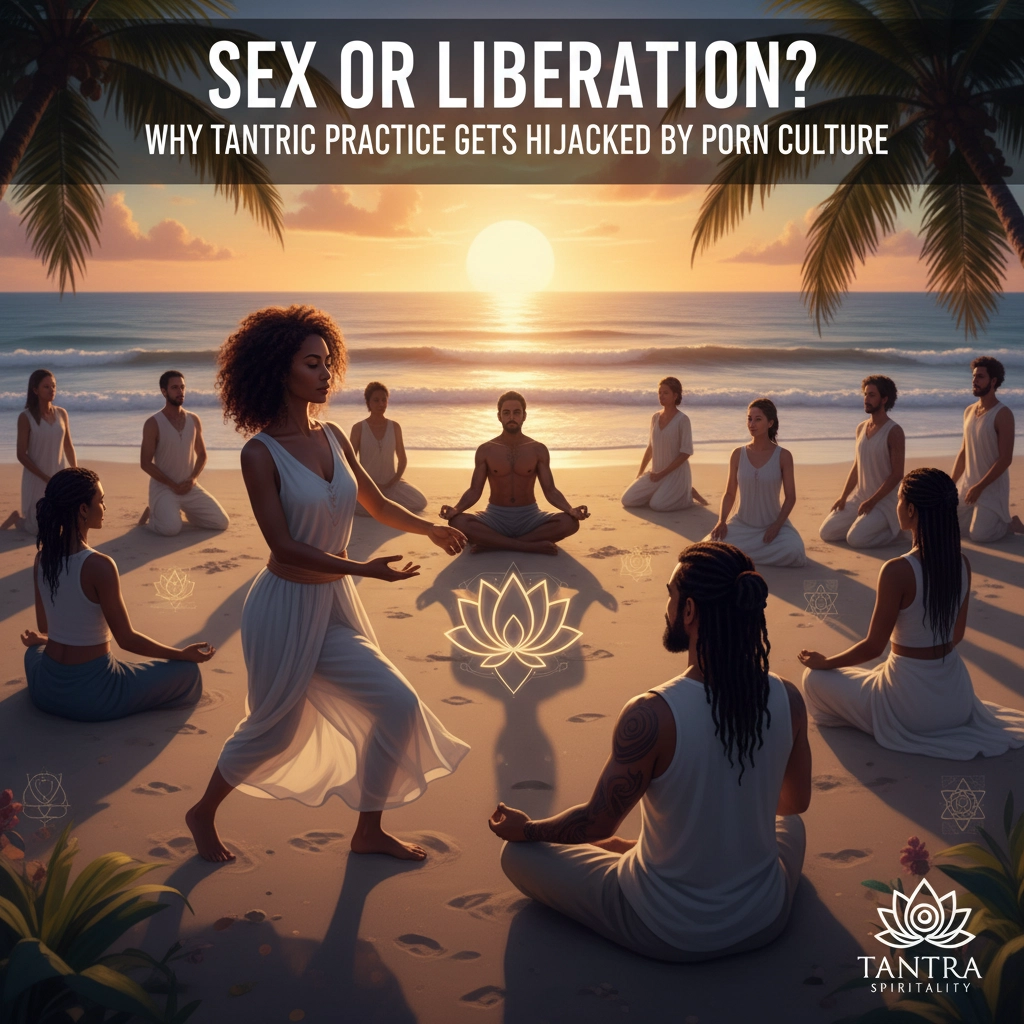
When most people hear the word "Tantra," their minds go straight to bedroom gymnastics and exotic positions. But what if I told you that's kind of like confusing a movie screen with the actual movie playing on it? This misunderstanding is exactly what tantric yogi Nishant (Nish) addresses in his illuminating conversation about the true heart of tantric spirituality, and trust me, it's way more profound than what Western pop culture has sold us.
The Great Tantra Mix-Up
Let's clear something up right from the start. Tantra isn't about wild nights and contortionist feats. At its core, tantric spirituality is about ritual practices (called Puja) and deeply internalized meditation. Yes, some forms explore sacred sexuality, but that's just one small branch of a massive, ancient tree.
Think of it this way: if Tantra were a restaurant, the West has been obsessing over the appetizer while completely missing the twelve-course meal. The real practice is about connecting with something deeper, your true nature, the unchanging witness within you that exists beyond the temporary dramas of daily life.

The Movie Screen: An Analogy That Changes Everything
Here's where Nish's teaching gets really interesting. Imagine you're sitting in a movie theater. There's the screen, blank, unchanging, just pure white surface. Then there's the movie itself, full of drama, action, romance, tragedy. The movie changes constantly. Characters come and go. Plots twist and turn. But the screen? It stays exactly the same.
In tantric yoga and meditation practices, you are the screen. Your thoughts, emotions, experiences, even your body, these are all the movie. They're temporary, constantly shifting, playing out across the surface of your awareness. But your true nature, your pure consciousness? That's the unchanging screen.
Nish also uses another beautiful metaphor: imagine a crystal near a rose. The crystal appears pink, reflecting the rose's color. But move the rose away, and the crystal returns to its clear, transparent nature. Your pure spirit is like that crystal, it temporarily takes on the colors and shapes of your experiences, but it remains fundamentally unchanged, pure, and clear.
The Plot Twist: What Yoga Actually Was
Ready for a history lesson that might blow your mind? The yoga we know today, with all those downward dogs, sun salutations, and warrior poses, is actually a relatively recent invention. The original yoga, dating back thousands of years, was purely meditative.
Breathing practices (pranayama) and seated meditation were the OG yoga toolkit. The physical postures we call Hatha Yoga? Those came much later, developed as a way to prepare the body for long periods of seated meditation. And the Sun Salutation sequence that's become synonymous with modern yoga? That was created in the early 20th century, practically yesterday in the timeline of yoga history.
This isn't meant to diminish your vinyasa practice. Rather, it's an invitation to see it in context. The physical postures were always meant to serve the deeper meditative work, not replace it. They're the appetizer, remember? The main course is the inward journey.

Energy Flows, You Watch: The Art of Being a Witness
Here's a concept that might feel a bit strange at first but stick with me: in tantric healing and practice, there's this understanding that energy (called Prakriti) moves on its own. Nature does its thing. Your body breathes whether you think about it or not. Your heart beats. Cells regenerate. Thoughts arise and dissolve.
Your job? Simply to witness it all.
Nish emphasizes this beautifully: you don't need to control everything. You don't need to force or manipulate. When you learn to step back and observe, to become the screen rather than getting lost in the movie, something magical happens. You start to experience a profound peace that doesn't depend on circumstances.
This is different from dissociation or checking out. It's actually the opposite, it's being so present that you can see clearly without getting tangled up in the drama. You're not avoiding the movie; you're just remembering you're not actually trapped inside it.
One Truth, Many Paths
The Rig Veda, one of humanity's oldest texts, contains a line that's been quoted for millennia: "Truth is one, paths are many." This idea runs through the teachings of great spiritual leaders like Ramakrishna and his student Swami Vivekananda, who brought yoga philosophy to the West in the late 1800s.
What does this mean for your practice? It means tantra spirituality isn't about converting to a specific belief system. It's about recognizing the universal truths that appear across cultures, religions, and spiritual traditions. Whether you're Christian, Muslim, Buddhist, atheist, or anything else, the practice of witnessing your thoughts, connecting with your breath, and recognizing your unchanging nature is available to you.
This universality is actually one of tantra's great gifts. It doesn't ask you to reject your current beliefs, it invites you to go deeper into the direct experience beneath all beliefs.

Practical Magic: Two Things You Can Start Today
Okay, enough philosophy. Let's get practical. What can you actually do to begin this journey back to the heart of tantric yoga?
First: Work with Your Breath
Your breathing is the most accessible bridge between your conscious mind and your deeper nature. When your mind is racing, your breath is shallow and quick. When you're calm, your breath is slow and deep. But here's the cool part: it works both ways. Change your breath, and you change your mind.
Try this right now: breathe in slowly for a count of four. Hold gently for two. Breathe out for a count of six. Repeat five times. Notice what happens to your mental chatter. This simple practice is ancient breathing technique meeting modern nervous system science: and it works.
Don't make it complicated. Just breathe. Notice your breath throughout the day. When you're stressed, return to it. When you're happy, notice how it feels. Your breath is always available, always bringing you back to the present moment, always reminding you of the screen beneath the movie.
Second: Find Your Sangha
Sangha is a beautiful Sanskrit word meaning "community": specifically, a community of practitioners walking a similar path. While solo practice is valuable, there's something irreplaceable about gathering with others who share your intention to grow, heal, and wake up.
This doesn't mean you need to join a monastery or commit to daily chanting (though if that calls to you, great!). It might mean taking a weekly meditation class, joining an online group exploring tantric healing, or simply finding one friend who wants to sit together in silence once a week.
The tantric journey can feel lonely sometimes, especially when you're swimming against the current of a culture that's constantly telling you to do more, be more, achieve more. A good sangha reminds you that the path of coming home to yourself is well-worn and that you're not walking it alone.

Coming Home to the Screen
At the end of the day, the heart of tantric yoga is about remembering what you've always been but perhaps forgot. You're not the changing content of your life: you're the awareness in which it all appears. You're not the movie; you're the screen.
This isn't about transcending your humanity or floating off into some blissed-out dissociation. It's about being so fully present in your life that you can engage with it wholeheartedly while simultaneously remembering your deeper nature. It's about holding both: the movie and the screen, the crystal and the rose, the changing and the unchanging.
The practices are simple: breathe, observe, connect with community, and return again and again to the question, "Who is watching?" Not as an intellectual exercise, but as a living inquiry that gradually transforms how you move through the world.
If you're curious to explore more about tantric spirituality and healing practices, remember that the journey is just that: a journey. There's no rush, no finish line, no perfect way to do it. Just your breath, your willingness to look inward, and perhaps a community to support you along the way.
The movie will keep playing. Characters will come and go. Drama will unfold. But maybe, just maybe, you'll start to remember: you were always the screen.