Walk through any city in India and you'll see something remarkable: Shiva is everywhere. From elaborate temple complexes to simple roadside lingams, from royal palaces to humble village shrines. Rich merchants and poor laborers alike offer flowers to Shiva. Brahmins and non-Brahmins both serve as priests in major Shaiva temples, especially in the South.
This isn't an accident. Shiva stands as India's most democratized deity: accessible to all, regardless of caste, status, or background. And nowhere is this universal accessibility more philosophically grounded than in Kashmir Shaivism, a tradition that emerged not just for spiritual elites, but as a path anyone could walk.
Kashmir Shaivism: Philosophy for Everyone
Unlike many spiritual traditions that remained confined to specific castes or communities, Kashmir Shaivism developed as an inclusive philosophy. When the great master Vasugupta received the Shiva Sutras around 825 CE, he wasn't creating an exclusive club for Brahmins. He was opening a doorway for genuine seekers, regardless of their birth.
This inclusivity runs deep in the tradition. Major Shaiva lineages in Tamil temples are held by non-Brahmins. The philosophy itself emphasizes direct experience over ritual purity or social status. What matters isn't your caste: it's your capacity for recognition, your willingness to vibrate with the living energy of consciousness itself.

Spanda: The Sacred Vibration
At the heart of Kashmir Shaivism lies a profound secret: everything is vibration. The tradition calls this spanda: not just any vibration, but "vibrationless-vibration," a stable movement that pulses through all existence.
Think of it this way: your heart beats, your breath flows, your thoughts arise and dissolve. But beneath all this movement lies a deeper stillness that contains and enables every pulse. This is spanda: the dynamic stillness of Shiva himself.
The Spanda Karikas, composed by Vasugupta and developed by his student Bhatta Kallata, reveal how this principle operates. The universe isn't a dead machine grinding through predetermined patterns. It's alive, pulsing with divine awareness, and that same awareness pulses within you.
When you feel truly alive: watching a sunrise, holding a loved one, creating something beautiful: you're touching spanda. That moment when time seems to stop yet everything feels vibrantly present? That's the vibrationless-vibration at work.
Pratyabhijna: The Path of Recognition
The second pillar of Kashmir Shaivism is Pratyabhijna, literally "recognition." This isn't about learning something new: it's about recognizing what you've always been but forgot.
Utpaladeva first systematized this approach around 925 CE, but it was Abhinavagupta who truly brought it to life a century later. The basic insight is startling in its simplicity: you are not separate from the divine consciousness you seek. You never were.
The problem isn't that you lack divine nature. The problem is you don't recognize it. You've become convinced you're a limited individual struggling in a hostile universe. Pratyabhijna says: wake up. You are Shiva pretending to be bound.
This recognition happens through a living guru: not necessarily a person, but any authentic transmission of awakened awareness. The guru's role is to help you see what's already obvious: your own unlimited nature.

Abhinavagupta: The Master Synthesizer
No discussion of Kashmir Shaivism is complete without honoring Abhinavagupta (975-1025 CE), perhaps the most brilliant philosopher-practitioner the tradition produced. He didn't just study these teachings: he lived them completely.
Abhinavagupta synthesized multiple streams of Shaiva thought into a coherent vision. He showed how Spanda and Pratyabhijna work together, how ritual and philosophy unite, how the individual and universal collapse into one seamless awareness.
His masterwork, the Tantraloka, remains one of the most comprehensive spiritual texts ever written. But his genius lay in making the complex simple. He took esoteric practices available only to initiates and created accessible pathways for sincere seekers.
Under Abhinavagupta's guidance, his student Kshemaraja wrote the Pratyabhijna-hridayam (The Heart of Recognition): a condensed manual that anyone could study and practice.
The World is Real, Not Illusion
Here's where Kashmir Shaivism differs radically from other Indian philosophies: the world is real. This tradition doesn't ask you to reject the universe as maya (illusion). Instead, it invites you to recognize the universe as lila: divine play.
Your body isn't a prison to escape. Your emotions aren't obstacles to transcend. Your relationships aren't distractions from the spiritual path. Everything: absolutely everything: is Shiva's creative expression.
This means your ordinary life becomes your spiritual practice. Working, loving, creating, even struggling: all of it can become conscious participation in divine activity. You don't need to retreat from the world to find God. You need to recognize God in and as the world.

A Story of Recognition
The tradition teaches through stories, not just concepts. Here's a classic tale that illustrates the recognition process:
A king's son gets lost in the forest as a child and grows up among simple villagers, believing himself to be a peasant. He works hard, struggles with poverty, and dreams of someday meeting royalty.
Years later, the royal court discovers him. They don't need to make him a prince: he already is one. They only need to help him recognize his true identity. The moment recognition dawns, everything changes. Not because he becomes different, but because he realizes what he's always been.
This is exactly how spiritual awakening works in Kashmir Shaivism. You're not becoming enlightened. You're recognizing your inherent enlightenment. The suffering comes from mistaken identity, not from lacking divine nature.
The Five Powers of Shiva
Kashmir Shaivism describes five fundamental powers (shaktis) through which Shiva manifests reality:
Chit-shakti (Consciousness): Pure awareness itself
Ananda-shakti (Bliss): The joy of being
Iccha-shakti (Will): Creative intention
Jnana-shakti (Knowledge): Illuminating wisdom
Kriya-shakti (Action): The power to manifest
These aren't separate from you: they're your essential nature. When you feel deeply aware, joyful, purposeful, wise, and creative, you're expressing these five powers. The practice involves learning to identify with these capacities rather than with your limitations.
Multiple Forms, One Reality
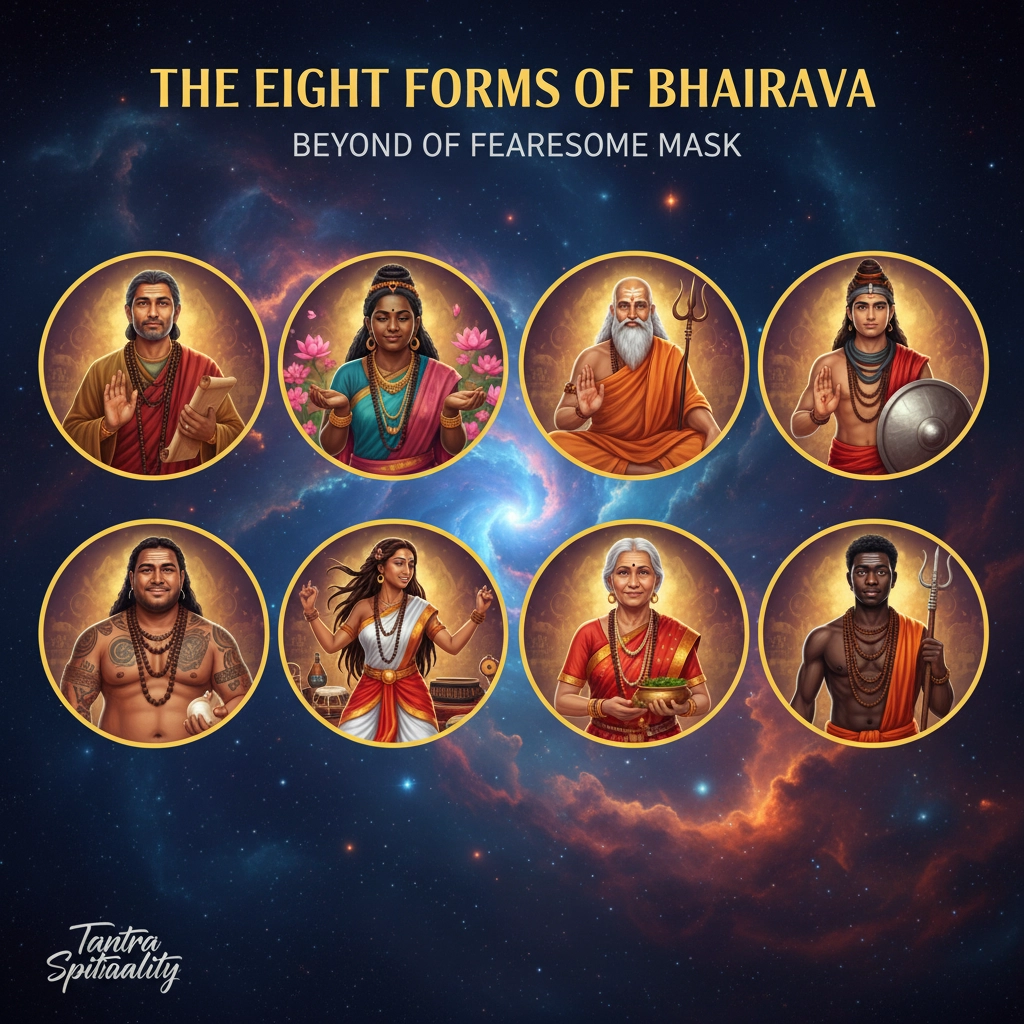
The tradition recognizes Shiva in multiple forms: Shambhu, Shankara, Rudra, Bhairava: but all point to the same reality: consciousness aware of itself. Some forms emphasize the transcendent aspect, others the fierce transformative energy, still others the playful creative force.
This multiplicity reflects the richness of divine expression, not confusion about divine nature. Just as water appears as ice, liquid, and vapor while remaining H2O, Shiva appears in countless forms while remaining pure consciousness.

Living the Teaching Today
Kashmir Shaivism isn't museum piece: it's a living transmission. The principles of Spanda and Pratyabhijna work as powerfully today as they did a thousand years ago.
Start simple: Notice the pause between breaths. Feel the aliveness in your body right now. Recognize awareness itself: not the contents of awareness, but the space in which all experience appears.
When you're walking, feel the spanda: the vibrant aliveness moving through your steps. When you're listening to music, recognize the consciousness that receives every note. When you're loving someone, know yourself as the love that flows through you, not just the person feeling loving.
The democratization of Shiva worship that we see across India reflects this deeper truth: divine consciousness doesn't belong to any elite group. It's your birthright, accessible right here, right now, exactly as you are.
Kashmir Shaivism's greatest gift isn't complex philosophy: it's the simple recognition that what you seek, you already are. The vibration of consciousness pulsing through these words right now? That's Shiva. The awareness reading these words? Also Shiva.
You don't need to become anything other than what you are. You only need to recognize what you are.
That recognition changes everything, while changing nothing at all.