If you’ve spent any time in spiritual circles, you’ve probably heard the phrase, "The world is an illusion."
It’s a staple of many Eastern philosophies, particularly Advaita Vedanta. The idea is that this physical reality: the trees, the cars, the bills, the messy emotions: is Mithya, a sort of secondary or false reality. The goal, in that framework, is usually to look past the world to find the "real" truth of pure spirit.
But there is another path. One that doesn’t ask you to look away from life, but rather to look deeper into it.
In the tradition of Kashmir Shaivism (also known as Trika), the world isn’t a mistake or a trick. It’s not an illusion you need to escape. Instead, the world is seen as a real, vibrant, and divine expression of consciousness itself.
This isn't just a philosophical debate; it changes everything about how you live, how you practice, and how you relate to your own body. Let’s dive into why the world is actually "real" and how the art of recognition can change your life.
Shiva, Shakti, and the Triad of Reality
In Kashmir Shaivism, reality is described through a "Triad." This is why it’s called Trika. To understand why the world isn’t an illusion, we have to look at these three components:
- Shiva (Pure Awareness): This is the silent, unchanging background of everything. It’s the "space" in which everything happens.
- Shakti (Creative Power): This is Shiva’s own energy. It’s the movement, the vibration, and the manifestation.
- Nara (The Individual Self): This is you and me: the localized point of consciousness experiencing the world.
The genius of this system is that these three aren't separate. Shiva and Shakti are like fire and heat; you can’t have one without the other. If Shiva is the ocean, Shakti is the waves. If the waves are real, the ocean is real.
This is a massive departure from the "world is an illusion" crowd. If the world is made of Shakti, and Shakti is the divine power of Shiva, then the world is divine. Your morning coffee, the rain on your windshield, and even your difficult feelings are all "flavors" of the same divine awareness.

The Problem with "Pop-Tantra" vs. Authentic Depth
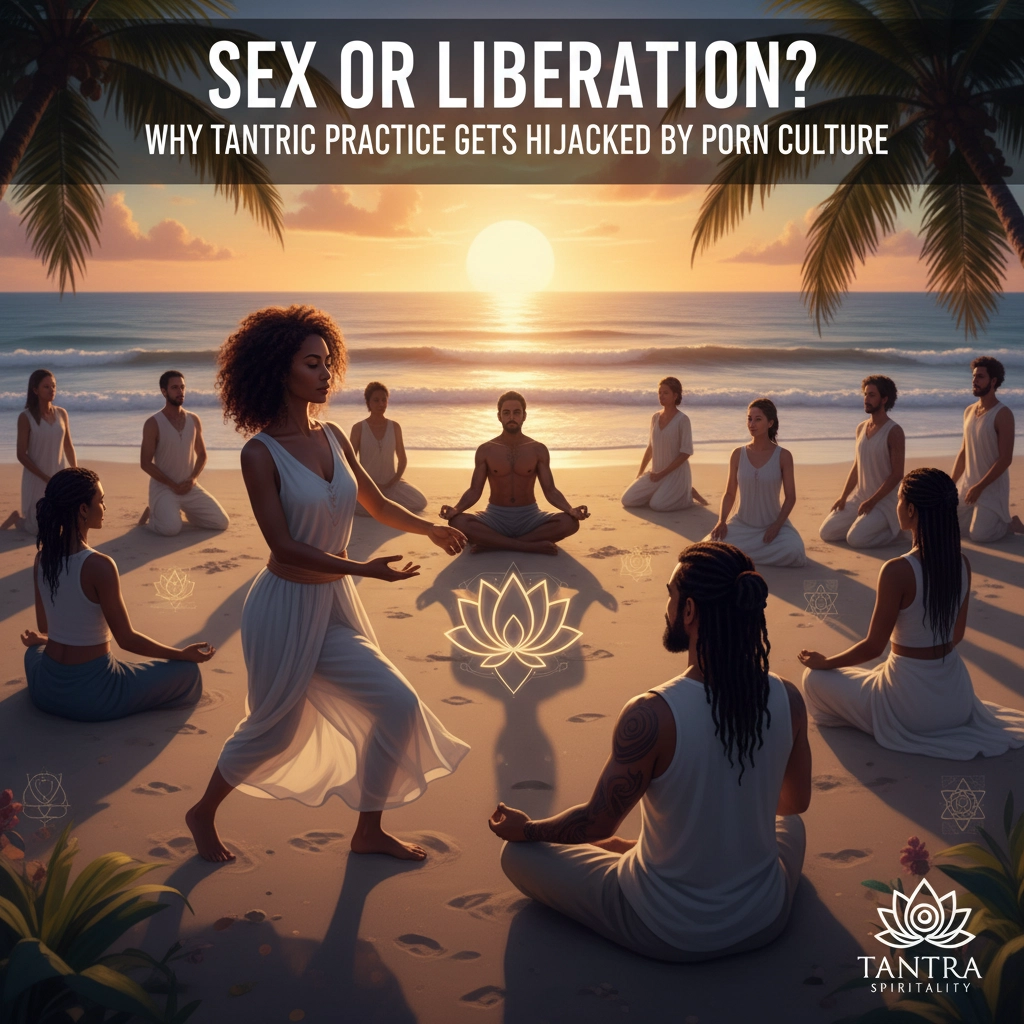
Before we go further, we have to address a common misunderstanding. A lot of people today hear the word "Tantra" and immediately think of "sacred sex" workshops or neon-lit retreats. This "pop-tantra" often misses the actual philosophical engine that makes the practice work.
Real Tantra isn't about chasing peak experiences or "hacking" your nervous system for pleasure. It’s a sophisticated system of metaphysics designed to help you recognize your true nature in the middle of everyday life. When we ignore the roots: the teachings of masters like Abhinavagupta or the insights found in the Shiva Sutras: we end up with a shallow version of the practice that doesn’t actually lead to lasting transformation.
If you've ever wondered about the difference, check out our guide on authentic tantra vs. pop tantra. Understanding the depth of Kashmir Shaivism is the first step in moving beyond the hype.
Pratyabhijna: The Art of Recognition
The core "practice" in this tradition is called Pratyabhijna, which translates to "Recognition."
Think about it this way: Imagine you are walking down the street and you see someone who looks familiar. You squint, you look closer, and suddenly it hits you: it’s an old friend from childhood. You didn't become their friend in that moment; you were always their friend. You just recognized what was already true.
Kashmir Shaivism says that enlightenment is exactly like that. You aren’t trying to "attain" a state of godhood. You aren’t trying to build a bridge to the divine. You are the divine. You’ve just forgotten.
The goal is to recognize that you were never separate from Shiva. The individual self (Nara) is just Shiva choosing to experience life through a specific, limited lens. When you recognize this, the world stops being a prison and starts being a playground.
The Lucid Dream Analogy
One of the most powerful ways to understand this is the "Lucid Dream" analogy.
When you are having a normal dream at night, you think the characters and the scenery are separate from you. You might be scared of a monster or chasing a goal. But the moment you become "lucid": the moment you realize you are dreaming: the entire experience shifts.
In a lucid dream:
- You realize you are the dreamer.
- You realize you are the dream itself.
- You realize you are every character in the dream.
The dream doesn't disappear when you become lucid. The trees are still there, the sky is still blue, and the "you" in the dream is still walking around. But the quality of the experience changes completely. You realize that everything you see is made of your own mind.
Kashmir Shaivism suggests that life is exactly like this. To "wake up" isn't to leave the world; it's to realize that the world is a divine dream made of the very consciousness that is currently reading these words.

Grounding the Philosophy: The Body as Sacred Ground
Because the world is real and divine, your body is also real and divine.
In many other spiritual paths, the body is seen as a hindrance: something to be mastered, transcended, or ignored. In Trika, the body is the laboratory. It is the "sacred ground" where recognition happens.
This is why embodiment is so important. You can’t think your way into recognition; you have to feel it. This involves tuning into the Spanda (the divine vibration) that hums within every cell. When you sit in meditation or even just go for a walk, you aren't trying to leave your body; you are trying to inhabit it so fully that you recognize the infinite within the finite.
If you're looking for ways to actually practice this, we have a guide on how to integrate authentic tantra into daily life. It’s not about doing hours of complex rituals; it’s about a shift in perspective.
Why the "Illusion" Narrative Can Be Dangerous
You might ask, "What’s the harm in thinking the world is an illusion?"
While the "Mithya" perspective has its place in certain stages of development, if it’s misapplied, it can lead to spiritual bypassing. People use "it’s all an illusion" to avoid dealing with their trauma, their relationships, or their responsibilities to the world. It creates a sense of detachment that can feel cold and disconnected.
Kashmir Shaivism offers a more integrated approach. If the person standing in front of you is a real expression of the divine, you treat them differently. If the earth is sacred energy, you treat the environment differently. If your pain is a "contraction" of Shiva’s own heart, you meet it with compassion rather than trying to delete it.

Key References for the Curious
If this resonates with you and you want to dig deeper into the "source code" of these ideas, I highly recommend looking into the following:
- Abhinavagupta: The great philosopher-saint who synthesized the Trika system. His work is dense but incredibly profound.
- The Shiva Sutras: A collection of short aphorisms that are said to have been revealed to a sage to help people realize their divine nature.
- The Spanda Karikas: A text that focuses on the "divine vibration" or the pulse of life.
These aren't just dry academic texts. They are maps for the human experience. They remind us that there is no "secular" world and "spiritual" world. There is only one world, and it is entirely sacred.
How to Start Recognizing Right Now
You don’t need a mountain top or a fancy yoga mat to start the art of recognition. You can start exactly where you are.
- Notice the Awareness: In this moment, notice that you are aware. Not what you are aware of, but the fact of awareness itself. That is the "Shiva" aspect.
- Acknowledge the Appearance: Notice the colors, sounds, and sensations around you. These are not "fake." They are the "Shakti" aspect: the creative power of that awareness.
- Bridge the Gap: Realize that the awareness (you) and the appearance (the world) are not two different things. They are the same field of being.
This simple shift: moving from "I am a small person in a big, scary world" to "I am the awareness in which this entire world is appearing": is the heart of the Tantric journey.
If you’ve been feeling lost in the "workshop tourism" or the social media version of spirituality, it might be time to come back to the roots. Understanding the difference between authentic tantra and the workshop culture can help you find a path that is grounded in reality rather than hype.
The world is not an illusion. It is a masterpiece. And you are both the artist and the canvas.
Stay grounded, stay curious, and keep recognizing.