


We're living in the golden age of wellness culture, yet somehow we've never been more disconnected from our bodies. Everywhere you look, there's another app promising to hack your nervous system, another guru selling transcendence in a weekend workshop, another supplement claiming to shortcut your way to enlightenment.
But here's the thing: most of these trendy approaches are actually pulling us further away from what our souls are truly craving: genuine embodied connection.
If you've been feeling like something's missing from your spiritual practice, or if you're tired of wellness trends that leave you feeling more fragmented than whole, you're not alone. Let's explore how to get back to what actually works: honoring your body as the sacred gateway it truly is.
What embodied spirituality actually means (and why it matters)
Real embodied spirituality isn't just another wellness buzzword. It's based on a simple but revolutionary idea: your body and spirit aren't separate things that need to be managed or balanced: they're literally the same thing, growing and evolving together.

Think of your body as a living temple, not just a meat suit you're stuck with until you "ascend." Every breath, every sensation, every emotion that moves through you is spirit in motion. Your nervous system isn't something to hack or override: it's your direct line to divine wisdom.
This approach uses three core tools: presence (being fully here in your body), awareness (paying attention to what's actually happening inside you), and intention (aligning your actions with what matters most to you).
Contrast this with what I call "disembodied spirituality": the toxic approach that treats your body like an inconvenient obstacle to enlightenment. You know the type: teachers who dismiss emotions as "lower vibration," practices that encourage you to dissociate from difficult feelings, or any system that promises you can think your way out of being human.
The problem with "transcendence culture"
Here's what's happening in much of mainstream wellness culture right now: we're being sold transcendence without integration. Quick fixes without depth. Spiritual bypassing disguised as growth.
The warning signs are everywhere. Teachers who talk condescendingly about "the monkey mind" or your "flesh suit." Practices that treat emotions as mistakes rather than messengers. Systems that promise you can avoid your human experience if you just meditate hard enough or take the right supplements.
This isn't enlightenment: it's sophisticated dissociation. And it's particularly harmful for anyone who's experienced trauma, because it reinforces the very disconnection that trauma creates in the first place.
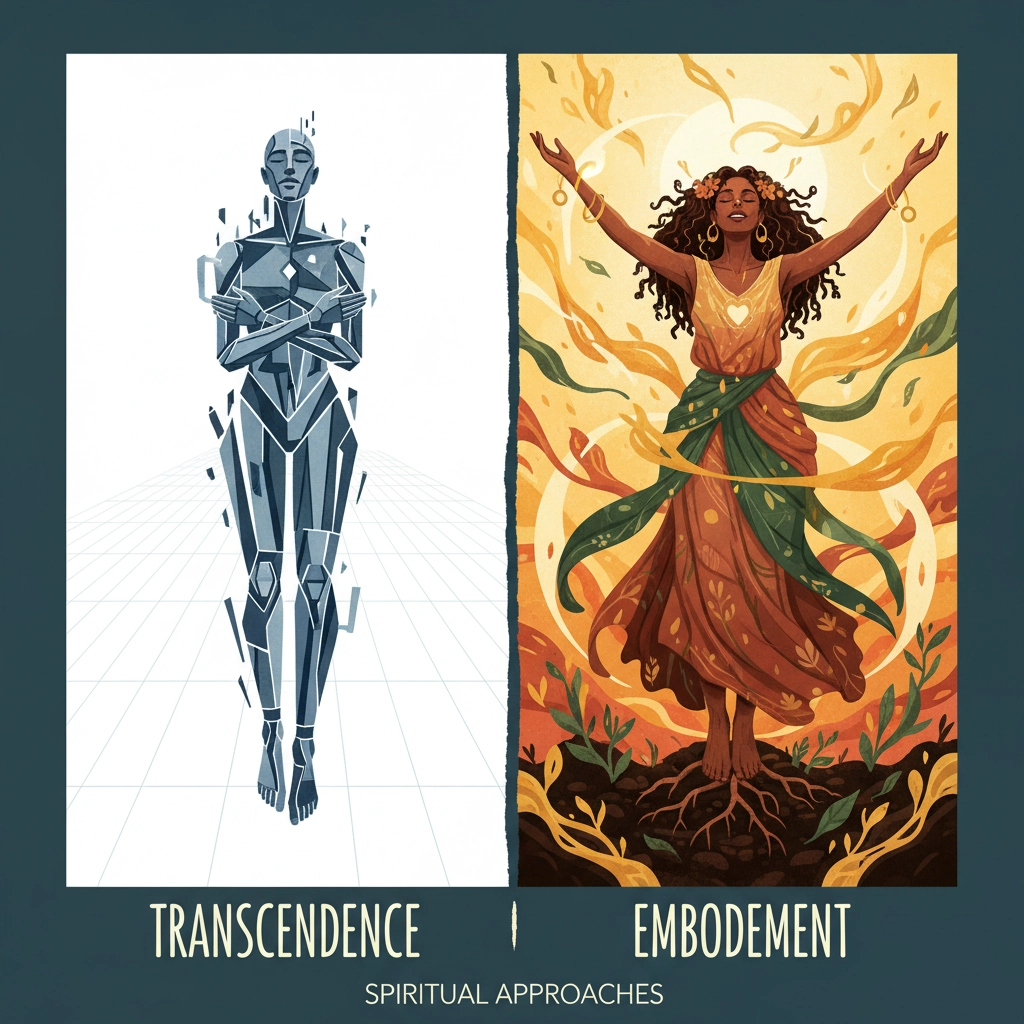
The most insidious part? This disembodied approach often comes wrapped in spiritual language that sounds profound but actually promotes emotional numbness. When teachers lack embodied empathy: when they can't feel their own pain: they can't truly help you with yours.
Getting back into your body: practical steps
So how do you reclaim authentic embodied spirituality in a culture that's constantly trying to pull you out of your body? Here are some concrete practices that actually work:
Start with your breath
Not the fancy pranayama techniques (though those have their place): just basic, conscious breathing. Put one hand on your chest, one on your belly, and spend five minutes a day just noticing what happens when you breathe. This isn't about changing anything; it's about coming home to the body you already have.
Learn the language of sensation
Most of us are fluent in thoughts and pretty good with emotions, but we're absolute beginners when it comes to sensation. Practice naming what you feel: tight, warm, buzzing, heavy, flowing. Your body is constantly giving you information: you just need to learn how to listen.
Embrace emotional wisdom
Instead of trying to transcend or manage your emotions, get curious about them. What is anger trying to tell you about your boundaries? What is grief revealing about what you've loved? Emotions aren't obstacles to spiritual growth: they're the raw material of it.

Make movement sacred
You don't need to be a yoga teacher or a dancer to make movement a spiritual practice. Walking, stretching, even doing dishes can become acts of embodied presence when you bring full attention to the sensations involved.
Integrating ancient wisdom with modern life
The beautiful thing about embodied spirituality is that it's not actually new: it's ancient wisdom that's been temporarily forgotten. Traditional practices like yoga, tai chi, and certain forms of meditation have always understood the body as sacred.
But here's where we need to be smart about integration. You can't just drop ancient practices into a modern lifestyle and expect them to work the same way. You need to translate the principles, not just copy the forms.
Daily micro-practices
Instead of trying to maintain a two-hour morning routine, focus on tiny moments of embodied awareness throughout your day. Feel your feet on the ground while waiting in line. Notice your breath while stuck in traffic. Use mundane moments as doorways back into your body.
Somatic attunement
As you become more attuned to your own body, you naturally become more attuned to everything around you: other people, natural rhythms, the subtle energies that most of us have learned to ignore. This isn't woo-woo; it's how humans are designed to operate when we're not constantly living in our heads.

Dealing with cultural resistance
Let's be honest: choosing embodied spirituality in a disembodied culture takes courage. You're going to encounter resistance, both from the culture around you and from parts of yourself that have learned to dissociate as a survival strategy.
The historical roots run deep. Many religious and spiritual traditions have taught us to see the body as corrupt, sinful, or at best a necessary evil to transcend. These attitudes don't disappear overnight just because you intellectually understand that they're harmful.
Finding your tribe
One of the most important things you can do is find community with others who understand that spirituality isn't about escaping the human experience: it's about diving deeper into it. This might mean seeking out somatic therapists, trauma-informed yoga teachers, or spiritual communities that honor both shadow and light.
Patience with the process
Reclaiming embodied spirituality isn't a quick fix (ironic, I know). It's a gradual process of building trust with your body after years or decades of disconnection. Be patient with yourself. Notice when you slip back into old patterns of trying to think your way through everything, and gently guide your attention back to sensation and breath.
The deeper invitation
Ultimately, reclaiming embodied spirituality isn't just about personal healing: though that's important. It's about remembering something we've collectively forgotten: that we're not separate from the world around us, and we're not separate from each other.
When you truly inhabit your body, you remember that you're part of the larger body of life itself. Your individual nervous system connects to the vast web of sensitivity that includes every living being. Your breath participates in the same rhythm that moves through forests and oceans.
This isn't metaphorical: it's literal. You are not a soul trapped in a body; you are a soul expressing as a body. And when you honor that truth, everything changes.
The path forward isn't about perfection or achieving some idealized state of embodiment. It's about showing up authentically to whatever's here right now: the pleasure and the pain, the expansion and the contraction, the messy, beautiful, completely human experience of being alive in a body on this earth.
Your body isn't the problem to be solved( it's the solution you've been looking for.)

