In the vast pantheon of Hindu and tantric spirituality, few divine feminine forces embody raw, transformative power quite like Karali. Known as the "Terrific One," this fierce goddess represents the primal fire that burns away illusion and transforms everything in its path. Far from being merely a destroyer, Karali is the divine mother who clears the way for spiritual rebirth through her intense, world-shaking energy.
The Divine Mother of Transformation
Karali, whose name literally translates to "the one with a terrifying appearance," is a yogini and divine mother (mātṛ) in Hindu mythology. But don't let the word "terrifying" fool you – in tantric tradition, what appears fierce often carries the most profound compassion. Karali's terrifying aspect isn't meant to frighten us away, but to shake us awake from the comfortable illusions that keep us spiritually asleep.
As one of the Mātṛkā-Śaktis – the powerful divine feminine forces that govern cosmic creation and destruction – Karali represents the necessary fire of transformation. She's the spiritual equivalent of a controlled burn in a forest, clearing away the dead undergrowth so new life can flourish.
Origins in Sacred Mythology
The most well-known story of Karali's emergence comes from the battle against the Andhaka demons. According to ancient texts like the Matsya Purāṇa, the great god Rudra created Karali for a specific and crucial purpose: to drink the blood of the Andhaka demons during their epic battle.
This isn't just a gory tale from ancient times – it's a profound spiritual metaphor. The Andhaka demons represent our inner darkness, our blind spots (andhaka literally means "blind"), and the negative patterns that feed on our spiritual energy. Karali's role in drinking their blood symbolizes her power to consume these destructive forces at their source, preventing them from regenerating and continuing to cause havoc in our lives.
When we invoke Karali's energy in our spiritual practice, we're calling upon this same force to consume our own inner demons – the fears, limiting beliefs, and unconscious patterns that keep us trapped in cycles of suffering.
One of Agni's Seven Flames
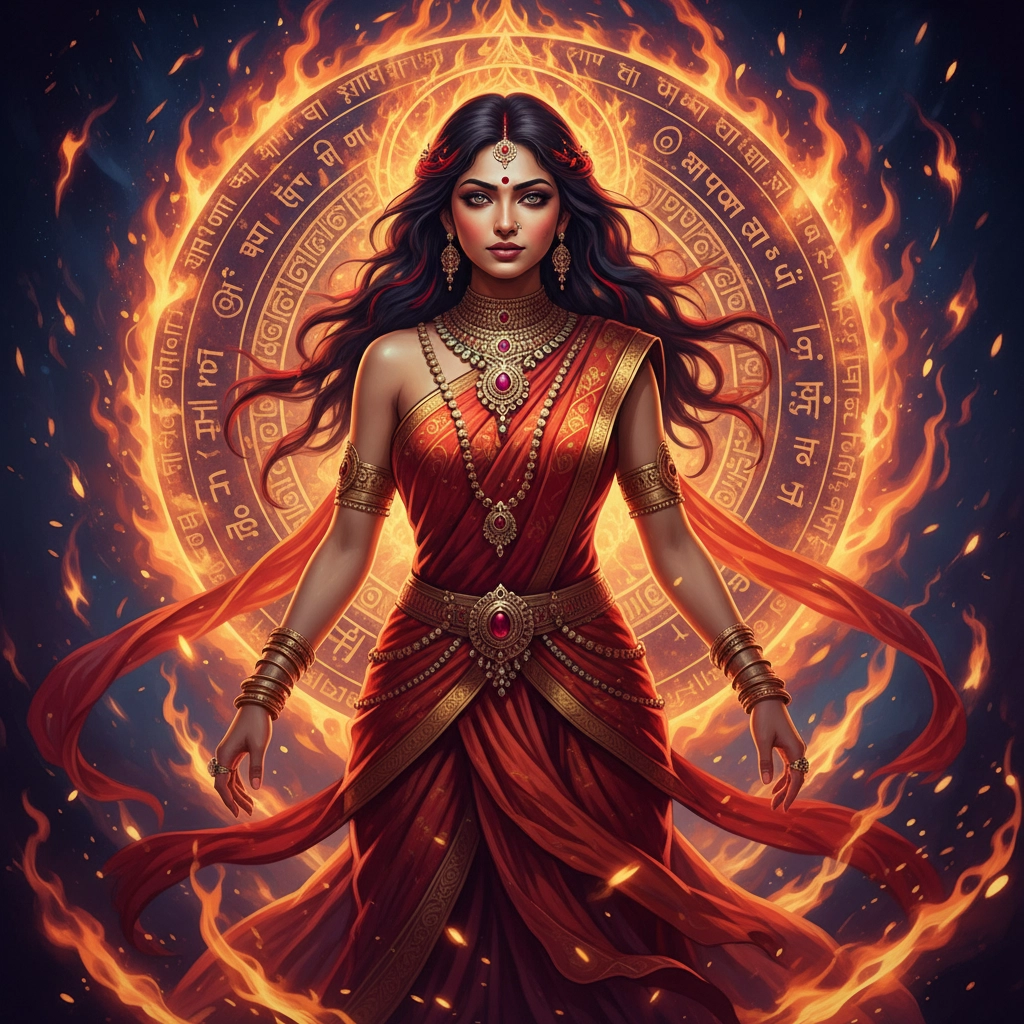
Karali holds another significant position in Hindu cosmology as one of Agni's seven flames. Agni, the fire god, represents the divine fire that exists in multiple forms – the fire of the sun, the fire in our hearth, the digestive fire in our bodies, and the fire of spiritual transformation.
As one of these seven flames, Karali specifically embodies the fire of spiritual purification. She's the flame that burns brightest when we're ready to release what no longer serves us. This fire isn't gentle – it's the intense heat that transforms coal into diamonds, that burns away everything false to reveal the truth beneath.

The Mahavidya Connection
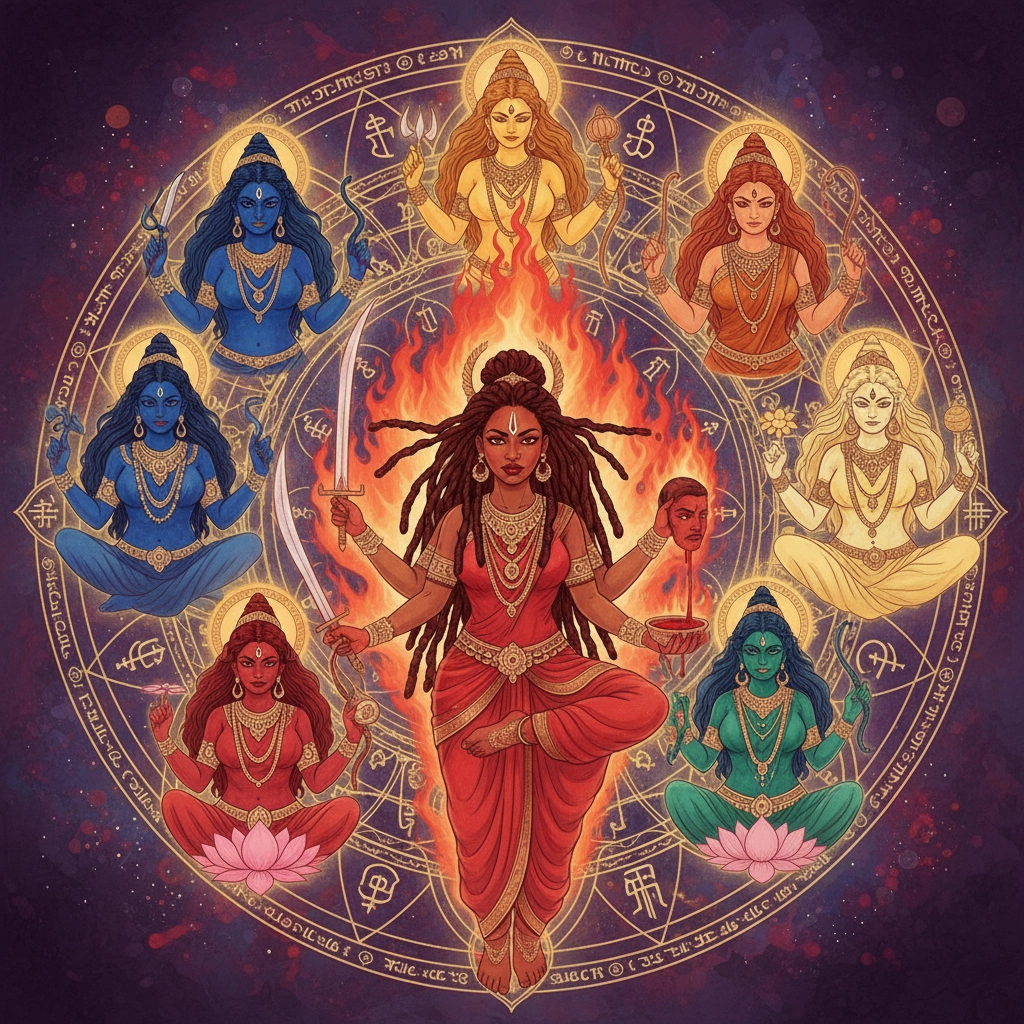
In tantric tradition, Karali is also recognized as one of the Mahavidyas – the great wisdom goddesses who each represent different aspects of divine knowledge and power. The Mahavidyas aren't just objects of worship; they're archetypal energies that we can cultivate within ourselves to access different types of spiritual wisdom and power.
Karali's wisdom is the knowledge that comes through destruction and renewal. She teaches us that sometimes, to reach our highest potential, we must be willing to let our current self die so our true self can be born. This isn't about physical death, but about the death of our ego-identifications, our attachments to outcomes, and our resistance to change.
Working with Karali's energy means becoming comfortable with the unknown, with the space between who we were and who we're becoming. She's the goddess who holds us in that liminal space of transformation, fierce in her protection of our growth process.
Symbolism and Spiritual Significance
Every aspect of Karali's appearance and mythology carries deep spiritual significance. Her fierce expression represents the intensity required for true transformation – spiritual growth isn't always a gentle process. Sometimes we need the fierce compassion that says "enough" to our self-destructive patterns.
Her association with blood-drinking speaks to her ability to transform the very life force that feeds our negative patterns. In tantric understanding, blood represents life force or prana. By "drinking" this energy, Karali transforms it from something that sustains our limitations into fuel for our spiritual growth.
The fact that she was specifically created by Rudra (Shiva in his fierce aspect) shows that destructive transformation is a divine quality, not something to be feared or avoided. Creation and destruction are two sides of the same cosmic dance, and Karali embodies the destruction that precedes every new creation.
Karali's Transformative Fire in Practice
So how do we practically work with Karali's energy in our spiritual lives? Unlike gentler goddess energies that we might invoke for peace or abundance, Karali is called upon when we're ready for major transformation and have the courage to face what needs to change.
Her energy is particularly powerful for:
Breaking through spiritual plateaus – When we feel stuck in our practice or life, Karali's fire can burn through the blockages keeping us trapped.
Releasing deep-seated fears – She specializes in consuming the fears that paralyze us, particularly our fear of our own power and potential.
Clearing ancestral patterns – Many of our limitations aren't even ours; they're inherited patterns from our family line. Karali's fire can burn through these generational chains.
Facing shadow work – She's an excellent ally when doing deep psychological and spiritual shadow work, helping us face and integrate our disowned aspects.
Major life transitions – During times of divorce, career change, spiritual awakening, or other major transitions, her energy supports the destruction of what was and the birth of what's becoming.
The Fierce Compassion of the Divine Feminine
What makes Karali particularly powerful is that her destruction always serves love. This is the fierce compassion of the divine feminine – love that's strong enough to say no to what diminishes us, even when that "what" is something we're attached to.
In our culture, we often misunderstand fierce feminine energy, seeing it as anger or aggression. But Karali represents something far more nuanced – the protective fierce love of a mother who will do whatever it takes to help her children grow into their full potential, even if it means challenging them or removing things that harm them.

Modern Relevance of Ancient Wisdom
In our current world, filled with distractions and comfortable numbing mechanisms, Karali's energy is more relevant than ever. We live in times that call for spiritual warriors – people willing to face reality directly and take responsibility for their own transformation.
Karali doesn't offer us the path of gradual, comfortable change. She offers us the path of radical transformation, of burning through our limitations in the fire of spiritual awakening. This isn't for everyone, and that's okay. But for those who feel called to deep, authentic transformation, she's an invaluable ally.
Beyond the Spiritual Realm
While our focus here has been on Karali's spiritual significance, it's worth noting that "Karali" appears in other contexts as well. It's an Armenian surname with its own rich history, and there are notable individuals who carry this name in various fields. There's even a village named Karali in Bulgaria. But in the context of tantric and spiritual work, it's the goddess Karali who offers us the most profound teachings about transformation and the sacred fire of spiritual awakening.
Working with Karali's energy isn't about becoming harsh or destructive ourselves. It's about developing the spiritual backbone to face truth directly, to release what no longer serves us, and to trust the process of transformation even when we can't see where it's leading. She teaches us that sometimes the greatest act of love – for ourselves and others – is to refuse to enable limitation and instead support the sometimes uncomfortable process of growth.
In the end, Karali reminds us that we are not meant to live small, limited lives. We are meant to burn brightly with the fire of our own authenticity, letting her transformative flame clear away everything that prevents us from shining our full light into the world.