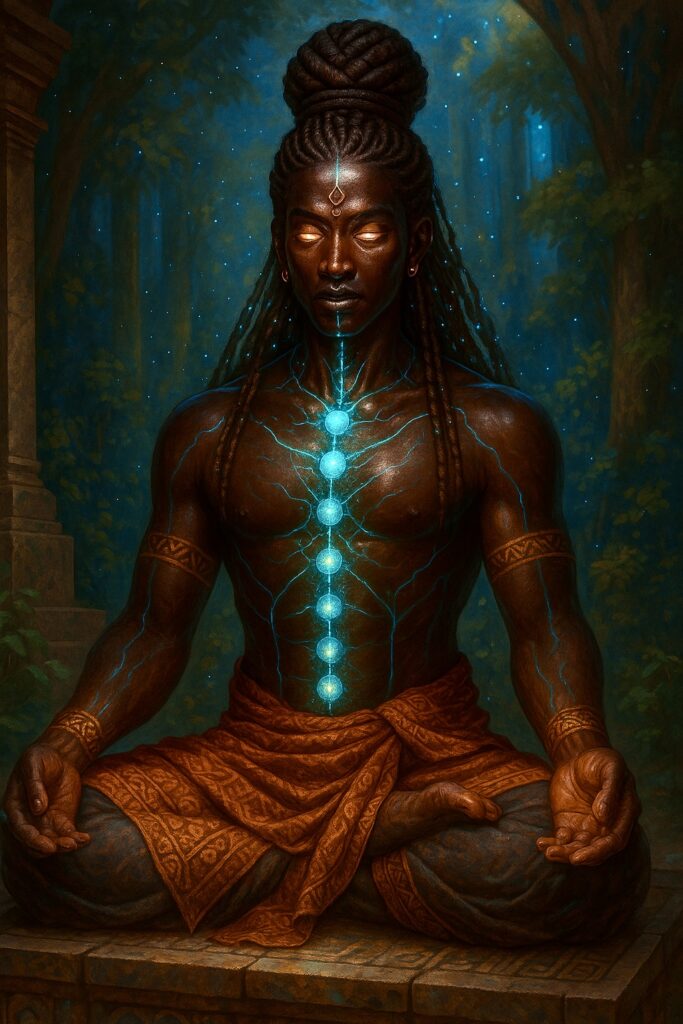


When most people hear the word "lingam," their minds immediately jump to one thing: penis worship. It's not their fault: centuries of colonial interpretation, combined with modern Western spiritual marketing, have reduced one of tantra's most profound symbols to something that would make Victorian scholars blush and contemporary seekers giggle uncomfortably.
But here's the thing: what if everything we think we know about masculine sexuality in tantra has been filtered through the very power structures that tantra was designed to transcend?
Let's take a step back and ask some uncomfortable questions. How did we get to a place where the lingam became either a shame-inducing taboo or a New Age sex toy? What happened to the original understanding that saw masculine energy as something far more nuanced than dominance or performance?
The Colonial Gaze: How We Lost the Plot
Picture this: British scholars in the 1800s encountering tantric texts and temple art for the first time. Imagine their reaction to seeing lingam-yoni iconography through the lens of Victorian sexual repression. They literally couldn't compute what they were seeing, so they did what colonizers do best: they projected their own hang-ups onto an entire spiritual tradition.

The result? Tantra got labeled as either primitive sex worship or dangerous occultism. The lingam, which had represented the creative principle of consciousness itself, became reduced to crude phallic symbolism in academic papers. This wasn't just misunderstanding: it was cultural violence disguised as scholarship.
Fast forward to today, and we've swung the pendulum in the opposite direction. Now the lingam gets marketed as tantric male enhancement or spiritual sex therapy. It's like taking a Stradivarius violin and using it as a tennis racket: sure, you're engaging with the object, but you're missing the entire point.
The colonial gaze taught us to see masculine sexuality through the lens of ownership, conquest, and performance. Even when we try to "liberate" ourselves from these ideas, we often end up reinforcing them. We've been trying to heal masculine sexuality using the same tools that wounded it in the first place.
What the Lingam Actually Represents
In authentic tantric understanding, the lingam isn't primarily about the physical male organ at all. It's what scholars call an "aniconic representation": a symbol that points beyond the physical to something ineffable. Think of it like this: a wedding ring isn't just jewelry; it represents an entire relationship, a commitment, a shared life. The lingam works similarly, but instead of representing human love, it represents cosmic creative consciousness.
The Sanskrit word "lingam" means "sign" or "mark": specifically, the sign that creative consciousness is ready to manifest new life. It also translates as "pillar of light," which gives us a completely different image than what most people imagine. We're talking about the principle of awareness itself taking form, not just biological function.
When paired with the yoni (often misunderstood as simply representing female genitalia), the lingam creates a symbol of cosmic balance. The yoni represents Shakti: the dynamic, creative energy of the universe. The lingam represents Shiva: pure consciousness, the witnessing awareness. Together, they symbolize the dance between energy and awareness that creates everything we experience.

This isn't abstract philosophy: it's pointing to something you can experience directly. When masculine sexuality is approached as an expression of consciousness rather than ego-driven performance, everything changes. The focus shifts from "getting something" to "offering something."
From Domination to Devotion: Rewiring Masculine Power
Here's where things get really interesting. Traditional tantric texts don't celebrate masculine power in the way we might expect. Instead, they consistently point toward surrender, devotion, and service as the highest expressions of masculine energy. The Shiva principle, while representing consciousness, is described as completely dependent on Shakti for any creative expression.
Think about that for a moment. In authentic tantra, masculine power is understood as fundamentally receptive and devotional. Shiva without Shakti is described as a corpse: conscious but utterly impotent. This is the opposite of the patriarchal masculinity that colonialism and capitalism have sold us.
This shift from domination to devotion isn't just philosophical: it's deeply practical. When men approach their sexuality as a form of devotional practice rather than conquest, the entire energy changes. Instead of trying to "perform" or "achieve," the focus becomes presence, sensitivity, and service.

Many modern men carry enormous shame and anxiety around their sexuality, often feeling like they have to prove something through sexual performance. The decolonized understanding of the lingam offers a completely different relationship: one where masculine sexual energy becomes a vehicle for spiritual communion rather than ego validation.
The Practice: Embodied Presence Over Performance
So what does this look like in practice? How do we move from colonized ideas of masculine sexuality to something more authentic?
First, it means getting curious about your relationship with sexual energy. Are you approaching it from a place of scarcity: trying to get something or prove something? Or can you approach it from abundance: having something to offer?
Traditional tantric practice emphasizes presence over performance. This might mean slowing down enough to actually feel what's happening in your body during intimate moments. It might mean learning to breathe consciously, to maintain eye contact, to stay emotionally available even when physical sensations become intense.
The goal isn't to become a better lover in the conventional sense. It's to use intimate connection as a doorway into expanded consciousness. When masculine sexuality is approached this way, it becomes a form of meditation, a way of offering devotion to the divine feminine principle.
This requires unlearning a lot of cultural programming. Most men have been taught to compartmentalize: to separate sexual energy from emotional intimacy, physical pleasure from spiritual practice. The tantric approach integrates all of these dimensions.
Vulnerability as Strength: A Revolutionary Concept
Perhaps the most revolutionary aspect of decolonizing masculine sexuality is embracing vulnerability as a form of power. In patriarchal culture, vulnerability is seen as weakness, especially for men. In authentic tantric culture, vulnerability is understood as the doorway to deeper intimacy and expanded consciousness.

When a man can approach his sexuality with genuine openness: acknowledging his insecurities, his tender spots, his deep longing for connection: something magical happens. The armor comes down, and real intimacy becomes possible. This isn't the performative vulnerability of sharing trauma stories; it's the moment-to-moment willingness to be seen and felt completely.
This kind of vulnerability requires tremendous courage, especially for men who have been socialized to always be in control. But it's precisely this willingness to let go of control that opens the door to transcendent experience. In tantric terms, when the ego-mind stops trying to manage the experience, Shiva consciousness can emerge naturally.
Integration: Living the Understanding
Understanding these concepts intellectually is one thing; integrating them into your lived experience is another entirely. Like learning to play a musical instrument, developing a decolonized relationship with masculine sexuality takes consistent, patient practice.
Start small. Notice when you're approaching intimate moments from ego rather than presence. Are you performing for approval? Trying to prove something? Using sexuality to avoid deeper feelings? Just noticing these patterns, without judgment, begins to create space for something different.
Practice breathing consciously during intimate moments. Most people hold their breath when intensity builds, which disconnects them from their body and their partner. Conscious breathing keeps you present and allows energy to move more freely through your system.

Experiment with slowing down. Our culture promotes fast, goal-oriented sexuality, but tantric practice is about savoring each moment, letting intimacy unfold naturally rather than rushing toward climax. This isn't about performance techniques: it's about presence techniques.
The path of decolonizing masculine sexuality isn't just personal healing; it's cultural transformation. Every man who learns to approach his sexuality with presence, devotion, and vulnerability creates ripple effects that touch everyone around him. This is how we begin to heal the wounded masculine on a collective level.
The lingam, properly understood, represents the possibility of masculine sexuality as a form of spiritual practice: not separate from consciousness, but as one of its most beautiful expressions. When we reclaim this understanding, we reclaim the possibility of intimate relationships that are truly transformative for everyone involved.
Ready to explore what authentic tantric practice might look like in your own life? The journey begins with presence, patience, and a willingness to unlearn everything you think you know about masculine power.