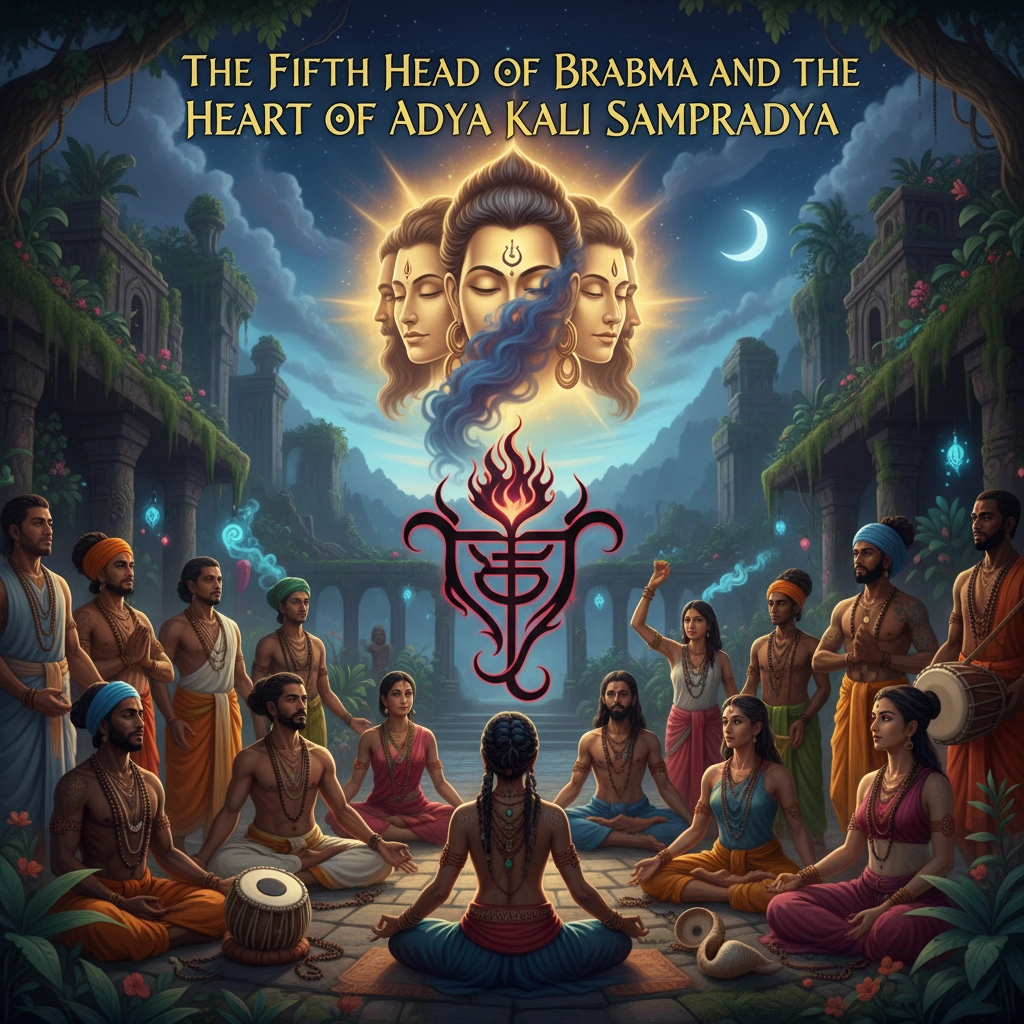
The Question of the Creator
“For what purpose was I revealed?”
This question was asked by Lord Brahma Himself. The Creator of Creation could not find the reason for His own existence. The answer to that question, and the place where He received it, are described in the third and twelfth Skandhas of the Srimad Devi Bhagavatam.
Once, Sage Narada asked Lord Brahma where the universe had come from.
Brahma answered that before existence there was only water everywhere: the causal ocean in which the Supreme Consciousness resided. From the navel of that Supreme Consciousness, a lotus appeared. From that lotus, Lord Brahma Himself was born.
There was one lone deity, one lotus, and endless water in every direction.
For ages, Brahma sat upon that lotus, contemplating the reason for His birth. At last, He thought that the lotus from which He had emerged must reveal His origin. If He could reach its root, perhaps He would understand why He existed.
He descended into the water and kept going down. A thousand years later, He returned empty-handed.
The One who was to create the entire Creation could not find the reason for His own being.
Then, within Him, a divine voice resounded:
“If you seek the answer, then perform austerities.”
Brahma became absorbed in austerities. At that time, Creation had not yet been formed. There was no world, no being, and no life. Even in that void, while Brahma remained absorbed in austerity, a lotus was born before Him.
Madhu, Kaitabh, and the Appearance of Rudra
From the ear-wax of Lord Vishnu, who was absorbed in yogic slumber, two demons appeared: Madhu and Kaitabh. Brahma saw them poised to devour Him.
He then praised Goddess Yogamaya, under whose influence Lord Vishnu was immersed in that slumber. Through Brahma’s praise, Yogamaya emerged from within Vishnu, and His yogic sleep was broken.
Vishnu opened His eyes, saw Madhu and Kaitabh, came to Brahma’s aid, and destroyed both demons.
Shortly afterwards, another deity appeared: Lord Rudra, the fierce form of Lord Shiva.
But when Creation itself did not exist, where had these deities come from? Brahma and Vishnu, too, were part of that same Supreme Consciousness, which has neither beginning nor end.
Now three deities stood together: Brahma, Vishnu, and Mahesh.
In the minds of all three there was one question:
“We have been brought together. What is our task?”
Again, they heard the same divine voice:
“Mount the chariot that has appeared before you.”
The three sat upon the chariot, and it moved at the speed of thought. If one thinks of a place, one arrives there in that very instant. This is the speed of the mind.

The Road to Manidweep
What they saw along the way was unlike any world.
There were incomparable forests. Trees bent beneath the weight of their fruit, and flowers opened with a fragrance that was divine. The sky echoed with the song of birds, while rivers moved across the earth.
They passed hundreds of celestial beings: Yakshinis, Apsaras, Gandharvas, and Vidyadharas. They even saw a white elephant with four tusks.
Passing beyond all these wonders, they reached the Sudha Sagar, the ocean of nectar. In the middle of that ocean lay an island more beautiful than anything they had known.
This was Manidweep, the island of jewels.
The three deities had reached Sarvalok, above even Brahmalok and greater than all worlds. Manidweep lay beyond Kailash, Vaikuntha, and Goloka. It was the abode of the Devi.
Before them stood the first wall.
The Twelve Enclosures
Around Manidweep stood a great iron wall extending far into the distance. It had four gates, and at each gate a divine being stood guard. This was only the first great wall. Within it lay ten more encircling walls.
The second wall was made of white metal, of bronze, and rose a hundred times higher than the first. Within it were trees bent with fruit and flowers whose fragrance was intoxicating.
The third wall was made of copper and was roughly one hundred kilometres high. Many Kalpavriksha trees grew there, their leaves and flowers made of gold. The Kalpavriksha fulfils every wish, and rare gems emerge from its fruits.
The Lord of the Gardens dwelt there with His two wives. It was always spring in that region. Gandharvas also lived there, performing one task since eternity: singing praises to the Devi who dwelt within all these walls.
The fourth wall was made of crystal and was just as high. Sanatanaka trees grew there, their flowers spreading fragrance one hundred and fifty kilometres away. New fruits always grew upon them, and their juice was very sweet.
The king of that region dwelt with his two queens. The heat was never harsh there. Above all these regions lived Siddhas and celestial beings, absorbed in the worship of the Devi.
The fifth wall was made of brass and was ten yojanas wide. Rain never ceased there. The king maintained the entire region in that condition with his twelve wives. The Harichandan tree, considered most auspicious, also grew there.
The sixth wall was made of five metals. Mandara flowers, called Gudhal, bloomed throughout the region. The king dwelt there with his two wives, and it was always autumn.
The seventh wall was made of silver. There stood the Parijata tree, which blooms at night. The whole region was cold and covered in dew. King Hemanta and his two wives watched over it.
Each wall had its own king. Each king had his own queens. Each wall had its own season: spring, summer, monsoon, autumn, or winter. Within one island, different seasons prevailed behind different walls, and they had done so since eternity.
The eighth wall was made of molten gold. There stood the Kadamba tree, from which divine and sweet honey flowed. This region was watched over by its king and his two wives.
Mother Lalita Tripura Sundari is called Kadamba Kusumapriya: She to whom Kadamba flowers are dear.

The ninth wall was made of red Pushparaga gems. Forests, rivers, and grand palaces with pillars filled that region. There stood the eight Dikpalas, guardians of the directions.
In the east stood Lord Indra, the thousand-eyed, holding His thunderbolt. His wife Sachi Devi and His elephant Airavata were with Him.
At the south-eastern corner stood Lord Agni with His two wives, Svaha and Svadha. The southern direction belonged to Yamaraja, the god of death, holding His staff. The south-western corner was guarded by Lord Nairriti.
In the west stood Lord Varuna, holding His noose, with His wife Varuni Devi. The north-western corner belonged to Lord Vayu, whose wife and forty-nine members of His clan were also present. Yogis skilled in pranayama dwelt there.
In the north, Yaksharaja Kubera held sway with His two wives, Vriddhi and Riddhi. Behind Him stood His commanders with their entire army.
At the north-eastern corner stood Lord Rudra, accompanied by His Bhadrakalikas, the Matrigana, the Rudranis, and the Pramathagana. When the three deities passed, all of them roared fiercely.
Indra, Yamaraja, Kubera, Varuna, and Agni, deities whose names alone cause the earth to worship, stood here merely as guards.
And this was only the ninth wall. Three more walls remained.
The tenth wall was made of pink and orange Padmaraga gems. There dwelt the sixty-four Kalas. Each Kala kept hundreds of Akshauhini armies.
One Akshauhini consisted of twenty-one thousand eight hundred and seventy chariots, an equal number of elephants, sixty-five thousand six hundred and ten horses, and one hundred and nine thousand three hundred and fifty foot soldiers: two hundred and eighteen thousand seven hundred warriors in all.
Of these sixty-four Kalas, a single Kala alone could destroy one hundred thousand universes.
The eleventh wall was made of red and brown Gomeda gems. There dwelt thirty-two Maha Shaktis who destroy every sin.
At last, Brahma, Vishnu, and Rudra reached the gate of the twelfth enclosure. Its wall was made of diamond, and its brilliance illuminated the entire region.
The Devi’s eight principal Shaktis stood guard there. Passing beyond them, the three deities entered a supremely magnificent palace.
The Panchapretasana
A vast carpet spread before them, adorned with priceless jewels and gems. At some distance stood the throne known as the Panchapretasana.
The throne had five legs, and each leg symbolised a deity. The first was Lord Brahma, the second Lord Vishnu, the third Lord Rudra, the fourth Lord Indra, and the fifth Sadashiva, the supreme form of Lord Shiva.
The base of the throne was Parashiva, that form of Lord Shiva which transcends all else. Seated upon that base was Mother Bhuvaneshwari, Mother of the world and Sovereign of all worlds.
The three deities had wished to know why they had been brought together. Now they stood before the throne, three of whose five legs were themselves.
How can the Mother’s form be described?
Her radiance was so intense that the three deities could not bear to look upon Her. She wore red garments and had applied red sandalwood paste. Her hue blazed like the rising sun. She was full of youthful splendour.
Jewels and a crescent moon adorned Her head. Her three eyes were deep red. She had four arms. In two hands She held the noose and the goad; Her other two hands were raised in protection and blessing.
Her bangles and crown shone with brilliance equal to millions of suns.
The three deities fell silent before Her. The entire sky resounded with Her seed mantra:
Hreeng.
The Shaktis who dwelt with Her sang Her praises.

The Toenail and the Revelation
Then that moment arrived.
In the fierce radiance of a single toenail of Her foot, the three deities beheld millions of universes. Each universe was distinct. Each contained its own Trimurti: its own Brahma, Vishnu, and Shiva.
Lord Brahma had asked for ages why He existed. Now He looked upon the radiance of one toenail and saw countless Brahmas like Himself contained within it.
The three deities bowed before the Mother. She looked at each one in turn and smiled. Then She gestured towards Her consort.
Lord Tryambaka Bhairava was Brahman itself, the Supreme Consciousness from which all this had emerged. His hue and garments were white. He had three eyes and five faces, adorned with ornaments.
He had four hands. In two were the trident and axe; the other two were raised in protection and blessing. Ganga flowed through His matted locks, and a crescent moon rested upon His forehead.
He was that same Supreme Consciousness which had expanded into Brahma, Vishnu, and Mahesh.
Mother Bhuvaneshwari was the Shakti of the Supreme Brahman: the life of Brahman and the power of the gods. She was the life force of every being, manifested from Mother Tripura Sundari to govern these worlds.
She then summoned three goddesses: Mother Saraswati, Mother Lakshmi, and Mother Kali. Saraswati became the consort of Brahma, Lakshmi the consort of Vishnu, and Kali the consort of Shiva when He took the form of Rudra.
These three goddesses became the Shaktis that gave momentum to every act of the Trimurti.
The Mother assigned their tasks. Brahma received the creation of Creation, Vishnu its sustenance, and Shiva its dissolution. Each received His own supreme abode.
Thus Mother Bhuvaneshwari kept the wheel of time turning.
Though the Trimurti are themselves the Supreme Consciousness, they received their tasks and abodes from the Mother. There are many such existences and many universes where this occurs. Ultimately, all these forms are one and the same.
Mother Bhuvaneshwari and the Trimurti have no difference between Them.
The Teaching of Harmony
In the scriptures, there are many episodes in which the gods become entangled with one another, just as humans do.
Once, Brahma, Vishnu, and Shiva began to consider themselves the mightiest in the universe. As their dispute grew, the peace of the universe began to break and unrest spread everywhere.
When those in whose hands the entire Creation rests become entangled with one another, how far might the effects reach?
Mother Bhuvaneshwari appeared and called all three back to Her realm. She said only:
“I must show you something.”
She led them into a sacred chamber. There, the three goddesses whom the Mother had united with them were quietly carrying out their work: one of creation, one of sustenance, and one of dissolution.
The three deities watched and understood that these goddesses were their own forms. No single task was greater than another. All three tasks were equal, because none could function without the others.
The dispute ended at once.
The Mother had opened the door of one chamber and shown them that true power lies in mutual harmony.
Such is the Mother, the Goddess of compassion. Her love gives space to others and grants them freedom. That love has no limit, and no condition comes with it.
The chanting of Her seed mantra, Hreeng, fills this love into the seeker’s consciousness. It washes away malice, envy, and anger. In the end, what remains is Her very essence.
Tripura Sundari and Bhuvaneshwari
Among the ten Mahavidyas, Mother Tripura Sundari is the third and Mother Bhuvaneshwari the fourth. Both are compassionate. Both are Sovereigns of the universe.
What, then, is the difference between them?
Any object, before it comes into being, is first born in someone’s mind. Before a house is built, the thought of the house comes. Before a song is composed, the tune comes. First in the mind, then creation.
Mother Tripura Sundari is the desire from which this world was made. Mother Bhuvaneshwari is the world that came into being from that desire.
The Divine’s light is infinite. Infinite light has neither limit nor form. Mother Tripura Sundari’s will gives that infinite light a boundary. That boundary is Akasha, the very Akasha within which everything occurs.
Then Mother Bhuvaneshwari’s gaze falls upon that Akasha, and that Akasha comes into existence.
Whatever occurs within that Akasha is held by the noose in Her hand. One willed it; the other gave it existence.
That existence is these fourteen worlds, whose Sovereign is Mother Bhuvaneshwari.
Through these stages, the seeker reaches the truth and realises that there is no difference between these two Mahavidyas.
This is why it is said that Mother Bhuvaneshwari’s worship, performed by the correct method, grants the seeker two things:
deep compassion and humility.
Om Shri Matre Namah