


A Yogini is not a decorative feminine ideal, a romantic spiritual figure, or a symbol of aesthetic freedom. In tantric sources, she is far more difficult and more powerful: a female master of yoga, a goddess, and often both at once.
The tradition intentionally unsettles the boundary between the human adept and the divine being. Around the tenth century, Yoginis begin to appear in texts in organized groups, most often sixty-four. Human women who mastered tantric practice could emulate the goddesses and, according to the texts, embody them. The distinction between woman and goddess was not always meant to remain firm.
The Yoginis were divine, dangerous, and ritually powerful. They belonged to cremation grounds, liminal places, and the fierce religious world of Bhairava. They carried skulls and other emblems of tantric practice. Many appeared as animal-headed women or as beings with birds for vehicles. The texts attribute to them the power to change form, transform others, and attain siddhis, including flight.
Shaman Hatley identifies the archetypal Yogini as the autonomous sky-traveller, the khecari. This is not a decorative image. It represents the highest attainment sought by practitioners pursuing extraordinary power. Yet the Yoginis are not only dangerous. They also protect, initiate, and transmit esoteric knowledge.
Origins that cannot be reduced to one story
The origins of the Yoginis remain obscure. Scholars commonly trace them through two related streams: village goddesses with local and regional identities, and the expansion of the seven or eight Matrikas, the Mother goddesses.
These include Chamunda, Varahi, Brahmani, Maheshwari, Kaumari, Vaishnavi, and Indrani, among others. Among Shaiva traditions, Yoginis are often arranged through clans, with the clans of the Mothers holding particular importance.
There is no single canonical list of sixty-four Yoginis. The Kalika Purana, the Skanda Purana, tantric texts, and local manuscripts give different names and different arrangements. The lists do not agree. This is not a minor problem to be corrected by choosing one preferred catalogue. It tells us something essential about the tradition.
The sixty-four are not a fixed pantheon with one universally accepted membership. They are a ritual structure whose contents vary according to lineage, region, temple, and text.
The central organizing idea is the yogini-chakra, the circle of Yoginis. Hatley describes it as a mandala of mantra-goddesses surrounding Shiva or Bhairava. He argues that the installation of such a circle stood at the centre of the esoteric Shaiva cult of the Yoginis.
The architecture makes sense only when this circle is understood first.
Older than the temples
A Shaiva cult of Yoginis flourished roughly between 700 and 1200 CE. It is documented in the Brahmayamalatantra, one of the important early Shaiva scriptures preserved in Nepal and studied extensively by Hatley.
The relationship between practitioner and Yogini was not merely devotional. Non-Yoginis consulted Yoginis in visionary and transactional encounters. The goddess was approached as a power capable of granting knowledge, protection, accomplishment, and other forms of attainment.
Chapter 9 of the Kaulajnana Nimaya, attributed to the tenth-century sage Matsyendranath, describes eight chakras, each represented as an eight-petalled lotus. Together, the sixty-four petals signify the sixty-four Yoginis.
Hatley notes that ritual worship of Yogini circles appears to predate the surviving temples by at least two centuries. The correspondence between the texts and the stone images suggests continuity between an older ritual practice and the later buildings. The temples did not invent the Yogini circle. They gave an architectural body to something already established.

The temples: open to the sky
The surviving Yogini shrines date from approximately the ninth to the twelfth centuries. They are hypaethral, meaning open to the sky, without the roof and superstructure characteristic of most Indian temples.
Most are circular. Some contain sixty-four niches and are therefore called Chausath Yogini temples. Others contain forty-two or eighty-one figures, yet are still grouped within the wider Yogini tradition.
Eleven known sites are distributed across India: two in Odisha, five in Madhya Pradesh, three in Uttar Pradesh, and one in Tamil Nadu. Most stand apart from the principal temple groups at their sites, often at the highest point. Many were remote and difficult to reach. Vidya Dehejia recorded in 1986 that several had scarcely been explored for a century and had even served as refuges for bands of robbers.
The remoteness that preserved some shrines also left them vulnerable to destruction and theft.
The iconography is not uniform. At Hirapur, every Yogini stands with an animal vehicle. At Ranipur-Jharial, the figures are shown dancing. At Bhedaghat, they sit in lalitasana, the royal seated pose, surrounded by cremation-ground scenes, flesh-eating ghouls, and scavenging animals.
These are not identical sets of goddesses placed in identical buildings. Each temple preserves a local and theological arrangement.
Hirapur and Ranipur-Jharial
Hirapur, in Khurda district, Odisha, is the earliest and smallest surviving shrine, generally attributed to the ninth or tenth century. It is only about twenty-five feet in diameter. Sixty Yogini images remain in place, carved in fine-grained grey chlorite, each approximately forty centimetres high.
Their features, ornaments, hairstyles, and bodies vary. At least eight stand on animal vehicles associated with signs of the zodiac, including a crab, a scorpion, and a fish. This suggests a relationship with astrology or calendrical practice, though the precise meaning remains uncertain.
The entrance passage projects from the circle, giving the entire plan the form of a yoni-pedestal for a Shiva lingam. The building is therefore not merely a container for images. Its ground plan is itself a theological statement: a field shaped as the generative seat in which the divine is established.
The central structure bears three Yogini images and four naked, ithyphallic figures of Bhairava. Around the exterior stand nine unsmiling goddesses locally described as the nine Katyayanis, although Katyayanis properly belong to another grouping. Hatley suggests that the temple may be read as a tantric mandala embodied in stone, with Shiva at the centre, an inner circuit of four Yoginis and four Bhairavas, and an outer circuit of sixty Yoginis.
The temple was only rediscovered in 1953, a fact Dehejia considered remarkable given its proximity to Bhubaneswar.
At Ranipur-Jharial in Balangir district, sixty-two Yogini images survive. The central shrine has four pillars and holds Nateshwar, Shiva as Lord of Dance. A Chamunda of similar size may once have stood beside him. Ranipur-Jharial was the first Yogini temple to be discovered, in 1853.

Khajuraho, Mitaoli, and Bhedaghat
The Yogini temple at Khajuraho is the oldest temple at that site and the exception to the circular pattern. It is rectangular but remains open to the sky. It was built with sixty-five cells, each with its own doorway and tower roof; thirty-five survive. There is no clear central shrine. The principal deity appears to have occupied the larger niche opposite the entrance. Three surviving images (Brahmani, Maheshwari, and Hingalaja) are now in the local museum.
Mitaoli, in Morena district, is an eleventh-century circular shrine also called the Ekattarso Mahadeva temple. It stands alone on a rocky hill. A central pavilion dedicated to Shiva occupies an open courtyard surrounded by sixty-five niches. These now contain images of Shiva, but they are understood to have once held sixty-four Yoginis and one additional deity.
The reason for the sixty-fifth niche is uncertain. Dehejia records the suggestion that it was intended for Devi, the consort of Shiva, so that the divine couple would be surrounded by the sixty-four Yoginis. A similar explanation has been proposed for Khajuraho.
It is popularly claimed, without reliable evidence, that Mitaoli’s circular plan inspired the design of India’s Parliament House. That remains a popular claim, not an established fact.
Bhedaghat, near Jabalpur, is the largest circular shrine, approximately one hundred and twenty-five feet in diameter. It was built for eighty-one Yoginis, not sixty-four. Eight Matrikas from an earlier stratum are present among the images. A later shrine now stands at the centre. Bhedaghat is often included in discussions of the sixty-four Yogini tradition because the broader ritual and architectural form is shared, even though its number is different.
Two smaller shrines, at Dudahi in Uttar Pradesh and Badoh in Madhya Pradesh, had forty-two niches. Many other temples have disappeared through destruction or the reuse of their stones.
Images survive from Lokhari, Nareshwar, Hinglajgarh, the Rikhiyan valley, Shahdol, and northern Tamil Nadu. At Lokhari, nearly all the recorded figures were animal-headed: horse, cow, rabbit, snake, buffalo, goat, bear, and deer. An image from the Rikhiyan valley holds a corpse, a severed head, a club, and a bell, linking it to corpse ritual.
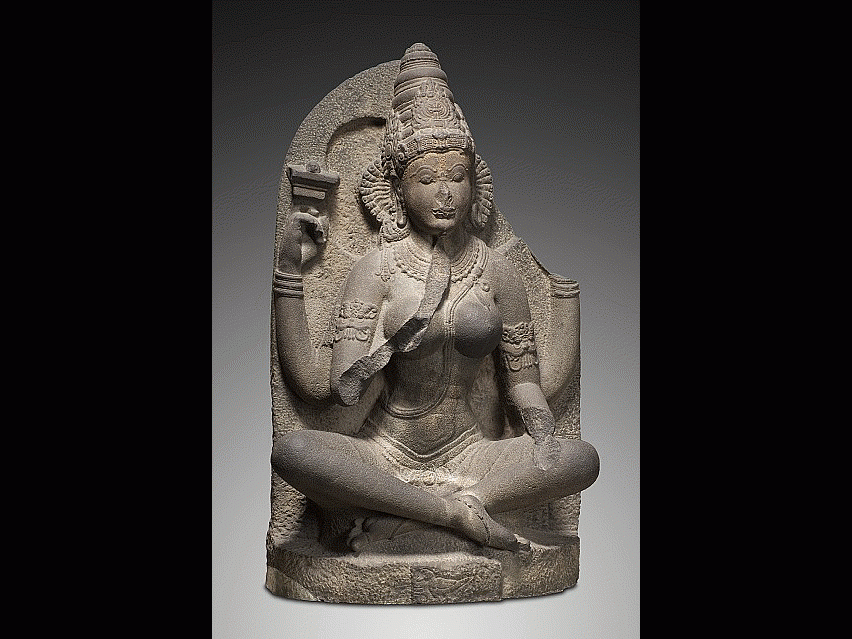
Tamil Yoginis from the Chola period, around 900 CE, have been scattered among the British Museum, the Madras Museum, the Brooklyn Museum, the Minneapolis Institute of Arts, the Detroit Institute of Arts, and the Royal Ontario Museum. Padma Kaimal’s Scattered Goddesses follows the history of these dispersed figures and the transformation of sacred images into objects of collection.
The rites that polite accounts remove
The Yogini temples were not designed for harmless appreciation alone. Dehejia writes that the Kaula ritual circle was probably formed within the temple’s circle, with offerings of matsya, mamsa, mudra, madya, and finally maithuna: fish, meat, gesture, wine, and union.
These are the five makaras. They belong to secret ritual and should not be treated as instructions for personal experimentation.
The earliest Yogini practices were associated with Kapalika mortuary rites and the cremation ground. The Yoginis are fierce precisely because they stand outside ordinary measures of purity. Removing death, bodily substance, transgression, and danger from their worship produces a false picture.
Texts associated with Varanasi describe singing, dancing, offerings, fire oblations, and recitation of the Yoginis’ names. The Kashikhanda says that the Yoginis need daily gifts of fruit, incense, and light. It also describes their arrival in Varanasi in disguise and prescribes a major autumn observance. Those who remain awake through the festival and worship the circle of kulayoginis at daybreak are said to receive Kaula knowledge from them.
Consecration traditions continue in some places. A present-day prana pratishtha may last three days and include purification, the opening of the image’s eyes, invocation of protectors, and the preparation of a yantra containing a Yogini mandala and sixty-four areca nuts representing the goddesses. Active worship continues at Hirapur and elsewhere.
What remains uncertain
The temples are often connected with the Kaula school, but the absence of explicit erotic imagery has led scholars to propose that they may reflect several localized traditions, including Kashmiri Shaiva influences. The evidence supports a coherent ritual structure, but not a single centralized cult with one doctrine, one pantheon, and one liturgy.
Anyone who claims to know exactly what was performed at Hirapur in the tenth century is guessing.
The modern disappearance of the Yoginis has also been physical. In 2013, the tenth-century buffalo-headed Vrishanana Yogini was returned to India after being stolen from a museum in Uttar Pradesh and smuggled to France. Her identity was established through comparison with photographs published in Dehejia’s catalogue. She is now held by the National Museum in Delhi.
The wider history, examined by Kaimal, is one of sacred images removed from temples, sold through the art market, and dispersed into collections far from their original ritual communities. Some figures remain in museums. Others have vanished entirely.
The sixty-four Yoginis are therefore not a decorative sisterhood. They are a ritually constituted circle of mantra-goddesses surrounding Shiva or Bhairava, worshipped in open-air shrines built between the ninth and twelfth centuries, described in texts whose lists disagree, and approached through practices that were secret, transgressive, and demanding.
Four things remain: the texts, which differ; the temples, of which eleven are known and many more are lost; the images, many now far from their original homes; and living worship in a few places.
What does not remain is one authoritative list of names.
That may be the most truthful conclusion. The Yoginis were never simply one pantheon. They were a circle, and the circle was made by practice, not names.

