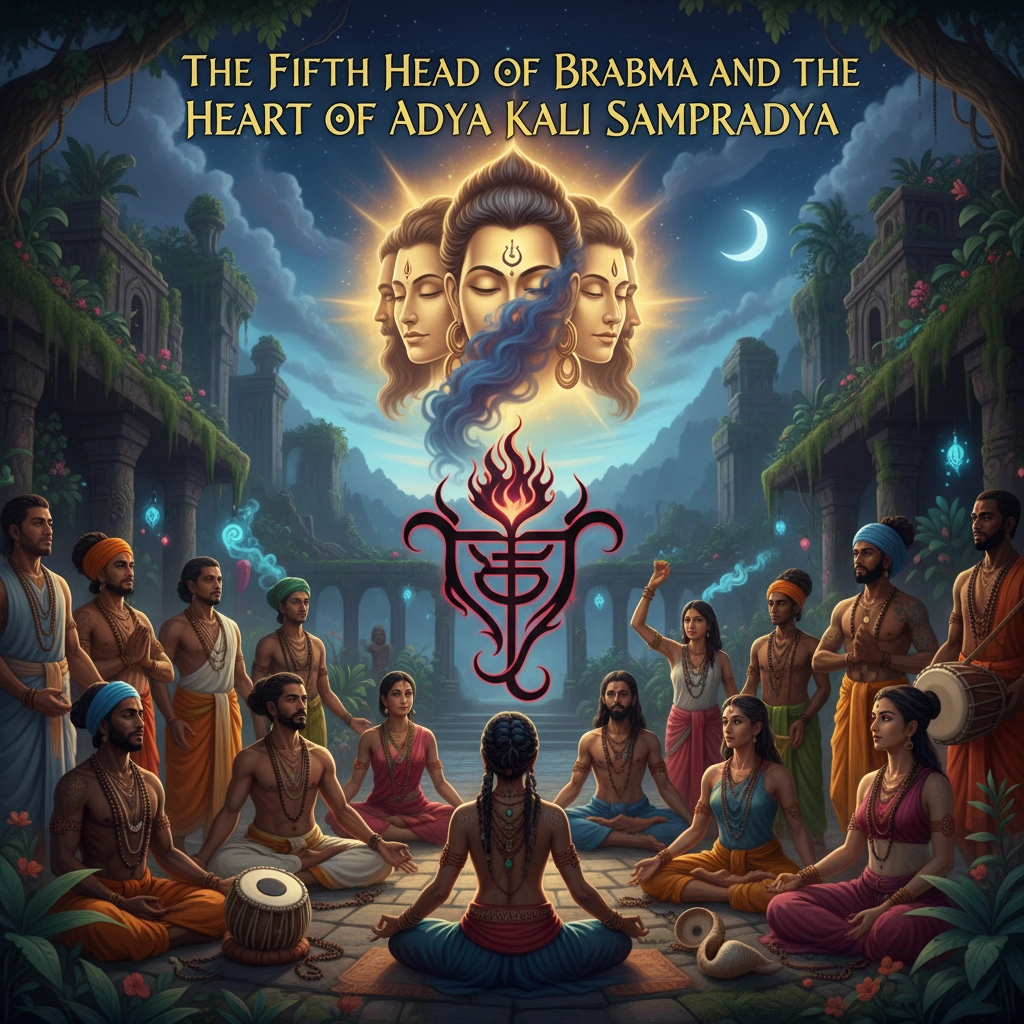
Have you ever wondered why there are so many gods in the Hindu tradition? Why does one text say Shiva is supreme, while another insists it's Vishnu? And then there's the Devi: the Divine Mother: who, in her own scriptures, is called the source of everything.
It can be confusing. It can even feel contradictory.
But here's the secret that the ancient sages embedded within these texts: every Purana leads to the same destination. The names change. The stories shift. The deities wear different faces. But at the center of it all is one singular, eternal truth: Brahman.
Let's unpack this.
What Are the Puranas, Really?
The Puranas are a collection of ancient Indian texts: 18 major ones and many more minor ones. They cover everything from the creation of the universe to the genealogies of gods, kings, and sages. They tell stories of divine incarnations, cosmic battles, sacred places, and the cycles of time.
But more than anything, they are manuals for living.

Unlike the Vedas, which are dense, abstract, and require years of study to understand, the Puranas were designed to be accessible. They use narrative. Myth. Emotion. They meet us where we are: as humans who learn through story.
The sage Vyasa is credited with compiling these texts. His intention? To take the complex, esoteric wisdom of the Vedas and translate it into something the common person could grasp. Because let's face it: most of us aren't going to sit in a cave for twelve years decoding Sanskrit hymns. The Puranas give us another doorway in.
The Illusion of Separation
Here's where it gets interesting.
If you read the Shiva Purana, you'll walk away convinced that Shiva is the ultimate reality. Everything emerges from him. Everything returns to him. He is Mahakal: the great Time itself.
Pick up the Vishnu Purana, and suddenly Vishnu is the supreme being. He is the preserver, the one who maintains the cosmic order, the source from which all avatars descend.
Turn to the Devi Bhagavata, and the Divine Mother takes center stage. She is Shakti: the primordial energy without which nothing can exist.
So who's right?
They all are.

The Puranas weren't written to create division or competition between deities. They were written to show that the Absolute can be approached through many forms. Shiva, Vishnu, Devi: these are not separate beings fighting for supremacy. They are different faces of the same infinite consciousness.
In Sanskrit, this is captured beautifully: Ekam sat viprā bahudhā vadanti: "Truth is one; the wise call it by many names."
Kalpas and Cosmic Cycles
One concept that helps explain this apparent contradiction is the idea of kalpas: cosmic cycles of creation and dissolution.
According to the Puranic worldview, the universe goes through endless cycles. In each kalpa, a different aspect of the divine may take prominence. In one age, Shiva may be emphasized. In another, Vishnu. In yet another, the Goddess.
This isn't inconsistency. It's cosmic choreography.
The sages understood that different times call for different teachings. Different souls resonate with different forms. A devotee drawn to stillness and asceticism may find Shiva. One drawn to love and surrender may find Vishnu. One seeking power and transformation may find the Devi.
The Puranas honor this diversity. They give each seeker a path suited to their nature: while quietly pointing them all toward the same summit.
Brahman: The Nameless Behind All Names
At the heart of every Purana is Brahman: the formless, infinite, unchanging reality that underlies all existence.
Brahman has no gender, no shape, no personality. It simply is. It is pure consciousness. Pure being. The ground from which all forms arise and into which all forms dissolve.

Shiva, Vishnu, Devi: these are saguna forms of Brahman. "Saguna" means "with qualities." They have names, stories, attributes, and relationships. They are Brahman made accessible to the human mind.
But behind them all is nirguna Brahman: Brahman without qualities. Beyond thought. Beyond description. The silent witness to everything.
The Puranas are skillful. They use the saguna forms to draw us in, to create devotion, to make the divine feel personal and close. But embedded within the stories is always a reminder: don't mistake the finger for the moon.
The deity you worship is a doorway. Walk through it.
Why This Matters for Your Spiritual Journey
You might be wondering: why does any of this matter to me, today, in my life?
Here's why.
We live in a world full of spiritual options. Yoga studios on every corner. Meditation apps on every phone. Teachers and traditions from every lineage imaginable. It's easy to feel overwhelmed. It's easy to wonder if you're on the "right" path.
The Puranas offer a liberating truth: there is no wrong door.
If your heart opens through chanting to Shiva, that's your path. If you feel peace meditating on Vishnu, that's your path. If the fierce grace of Kali calls to you, that's your path.
What matters is not the name you call. What matters is the sincerity of your seeking. The depth of your surrender. The willingness to go beyond the form into the formless.
This is the essence of authentic spiritual practice.
The Puranas as Mirrors
There's another layer here worth exploring.
The Puranas aren't just about gods "out there." They're about you.

Every deity represents an aspect of consciousness that exists within you. Shiva is your capacity for stillness and transcendence. Vishnu is your ability to sustain, to love, to protect. The Devi is your creative power, your energy, your fierce ability to transform.
When you read the Puranas with this understanding, they become mirrors. They show you who you already are: and who you are becoming.
This is why these texts have endured for thousands of years. They speak to something timeless in the human soul. Something that longs to remember its own divinity.
A Unified Vision for Divided Times
We live in an age of division. Political. Religious. Social. It seems like everyone is fighting over whose truth is the "real" truth.
The Puranas offer a radical alternative: hold your truth lightly.
Not because it doesn't matter: but because it's not the whole picture. Your perspective is one facet of an infinite diamond. So is everyone else's.
The sages who composed these texts understood this deeply. That's why they wrote multiple Puranas, each with its own emphasis. Not to confuse us. But to remind us that unity doesn't require uniformity.
You can love your path without hating another's. You can be devoted to your form of the divine while honoring all forms. This is spiritual maturity.
Coming Home
At the end of the day, the Puranas are love letters.
Love letters from the infinite to the finite. From the timeless to the time-bound. From Brahman to you.
They say: "I have taken many forms so that you might find me. I have told many stories so that you might hear me. I have appeared as many gods so that you might love me."
And behind all the forms, all the stories, all the names: there is just One.
One consciousness. One reality. One truth wearing a thousand masks.
The Puranas invite you to look behind the mask. To see the One in the many. And ultimately, to see that the One you've been seeking… has been looking out through your own eyes all along.
Curious to explore more ancient wisdom for your modern life? Visit our blog for more teachings, or reach out to begin your own tantric journey.