Most seekers approach the path of Tantra looking for power, for expansion, or for a more "vibrant" version of themselves. They encounter the figure of Bhairava: the terrifying, the howling, the one draped in snakes and carrying a severed head: and they assume they are looking at the ultimate expression of masculine aggression. They see a warrior. They see a guard.
They are fundamentally mistaken.
Bhairava is not the peak of masculine force. He is the Great Collapse. He represents the moment when Shiva, the ultimate witness, becomes so saturated with the power of the Mother that he ceases to function as a separate, detached entity. To look at Bhairava is to look at Shiva at 100% femininity. He is the embodiment of Kali manifesting through the frame of the Destroyer. He is the masterclass in Shakti because he is the first and most perfect example of what happens when a being finally, irrevocably surrenders to the Adi Shakti.
The Decapitation of Brahma: Ending Your History
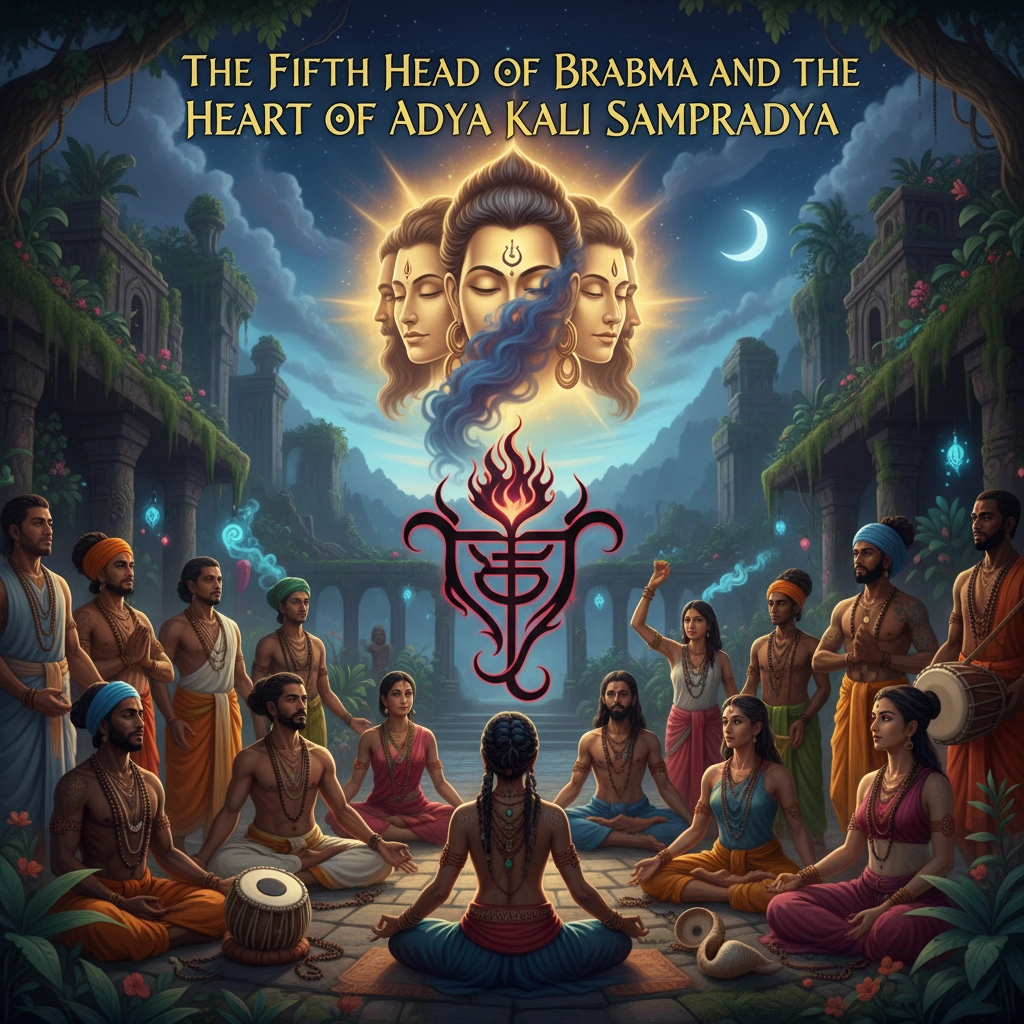
The central myth of Bhairava’s emergence begins with the decapitation of Brahma’s fifth head. In the traditional narrative, Brahma: the creator: became arrogant, caught in the delusion that he was the supreme source of all existence. To humble him, Shiva manifested as Bhairava and tore off Brahma’s fifth head with the nail of his left thumb.
But we must look past the literal gore to the metaphysical surgery being performed. Brahma’s fifth head represents the "ego of the creator." It is the part of the mind that believes it owns its history, its achievements, and its identity. It is the "I" that says, "I have built this, I have realized this, I am this."
When Bhairava takes that head, he is not just punishing a god; he is destroying the concept of pre-identified history. For the sadhaka (practitioner), the path to the Mother is blocked by the weight of who they think they are. You cannot approach the infinite while clinging to your small, curated story. Bhairava is the force that severs the connection to your "old history." He creates a vacuum where the "me" used to be. This is the first lesson of the collapse: before you can hold the Mother, you must be emptied of yourself.

Shiva at 100% Femininity: The Kali-Bhairava Identity
In the Adya Kali Sampradaya, there is a profound understanding that Bhairava is not "with" Shakti as a consort in the way we usually think. Instead, he is the vessel that has been completely overtaken. If Shiva is the still mirror, Bhairava is that same mirror when it has been shattered by the sheer weight of the Goddess’s dance.
We often hear the phrase Shiva Shava: without Shakti, Shiva is a corpse. But Bhairava is the intermediate state. He is the living corpse, the one who has allowed the feminine principle to occupy every cell of his being. This is why Bhairava is often depicted as dark, fierce, and unpredictable: qualities we usually associate with Kali.
This shift is crucial. In most spiritual circles, Shakti is treated as a "power" that the practitioner (usually framed as masculine) tries to harness or "raise." This is a fundamental misunderstanding that leads to spiritual stagnation. In authentic practice, you do not use Shakti; you are consumed by Her. Bhairava is the Masterclass because he shows us the end result of that consumption. He is the "Great Collapse" of the masculine witness into the feminine movement. He proves that the highest state of Shiva is to become the perfect instrument for Kali.
You can read more about this transition in our guide on The Fifth Head of Brahma and the Heart of Adya Kali Sampradaya.
The Disappointed Guru: The Pointer to the Mother
There is a tradition that views Bhairava as the "disappointed guru." This is not because he is lacking, but because he is the ultimate teacher who refuses to let you stop at him.
Many practitioners get "stuck" on the guru or the deity. They fall in love with the form, the ritual, and the feeling of protection. Bhairava, in his fierce compassion, destroys this attachment. He stands at the threshold of the cremation ground and points away from himself toward the dark, unmanifested source: the Mother.
He is "disappointed" in any seeker who tries to make him the destination. His role is to prepare the sadhaka for the "Great Collapse" into Adi Shakti. He is the one who initiates you into the reality that your "I" must turn to ashes. He doesn't offer you a better life; he offers you a beautiful death: the death of the ego that thinks it can "practice" Tantra. This is why we tell seekers to stop wasting time on superficial workshops and instead face the raw reality of the tradition.

Shunyata: The Goal of the Ashes
Bhairava is the Lord of the Smashana (the cremation ground). In the internal landscape of the sadhaka, the cremation ground is the heart where all desires, identities, and attachments are burnt. The goal of this fire is Shunyata: emptiness.
In the state of Bhairava, there is no "thinker" left. There is only the vibration (Spanda) of the Mother’s will. The ashes that Bhairava wears are the remains of the universe he has already dissolved within himself. When a practitioner smears ashes or meditates on the void, they are practicing the art of becoming nothing.
This emptiness is not a "cold" or "nihilistic" void. It is a pregnant silence. It is the only state in which the Mother can truly manifest. If you are full of your own ideas, your own "spirituality," and your own "attainments," there is no room for Her. Bhairava is the master of making room. He clears the stage. He is the silence that follows the roar.
Ghar Ghar Kali: Bringing the Fierce into the Home
There is a growing movement, often described as "Ghar Ghar Kali" (Kali in every house), which signifies the return of the fierce feminine into the modern consciousness. But this cannot happen through soft, aesthetic devotion alone. It requires the "Bhairava element."
To bring Kali into the "house" (the body and the home), one must be willing to let Bhairava dismantle the furniture of the old life. You cannot have the Mother’s grace without the Father’s destruction of your limitations. This means shifting your view of Shakti from a "consort" who supports your ego to the "source" that demands your total surrender.
True Adya Kali worship is not about asking for favors; it is about asking to be made into a Bhairava: a vessel capable of holding the full, uncompromising weight of the Divine Feminine without breaking.

The Uncompromising Path
The path of Bhairava is not for the faint of heart, nor is it for those who wish to remain "themselves" while gaining spiritual insights. It is a path of total ontological collapse. It is the realization that the "creator" (Brahma) within you must be decapitated so that the "Destroyer" (Bhairava) can lead you back to the "Source" (Kali).
When you stop fighting the collapse, you find that the "fearful" nature of Bhairava is actually the highest form of love. It is the love that refuses to let you live in a lie. It is the love that burns away the dross so that only the pure gold of consciousness remains.
If you are ready to stop "studying" the path and start being consumed by it, you must move beyond the images and the theories. You must enter the cremation ground of your own heart and wait for the Guru who points to the Mother.
The Great Collapse is not the end of the journey. It is the beginning of the only journey that matters.
Are you ready to move beyond the surface and encounter the raw power of the tradition?
Explore our deep-dive resources and authentic practices to begin your transformation.