The Mahabharata isn't just an epic about war and duty. Strip away the surface narrative, and you'll find something darker, older, and infinitely more potent: a map of Kali's play on earth. At the center of this hidden story stands Panchali, the woman born from fire, and Bhima, the brother who drank blood without shame.
Most people miss this completely. They see Draupadi as a wronged wife and Bhima as a hot-headed warrior with anger issues. But those who understand the esoteric mechanics of the Mother's work see something else entirely: Panchali is Kali herself, walking among men. And Bhima? He's the only one who truly understood what she required.
Panchali: The Name That Reveals Everything
Draupadi has many names, but "Panchali" carries weight that most scholars gloss over. Born from the sacrificial fire of King Drupada, she emerged not as a typical princess but as Yajnaseni: born of the ritual, born of the flame. This wasn't a normal birth. Fire doesn't produce flesh without reason.

The texts say she was dark-skinned, with the fragrance of blue lotus emanating from her body at a distance of two miles. That's not poetic license: it's code. The blue lotus is sacred to Kali. The dark skin isn't about human melanin; it's about Shyama, the Dark Mother who devours time itself.
When you say "Panchali," you're not just naming a woman from the Panchala kingdom. You're invoking the fivefold nature of the Goddess: the same five elements, the same five faces of Shiva, the same five pranas that keep the universe breathing. Panchali represents the Mother who sits at the center of the cosmic mandala, while five brothers orbit her like planets around a black sun.
The Fifth Brother and the Fifth Head
Here's where it gets heavy. Bhima was the second-born Pandava, but in the esoteric count, he represents the fifth principle: the one that was severed, the one that was hidden, the one that establishment religion rejected.
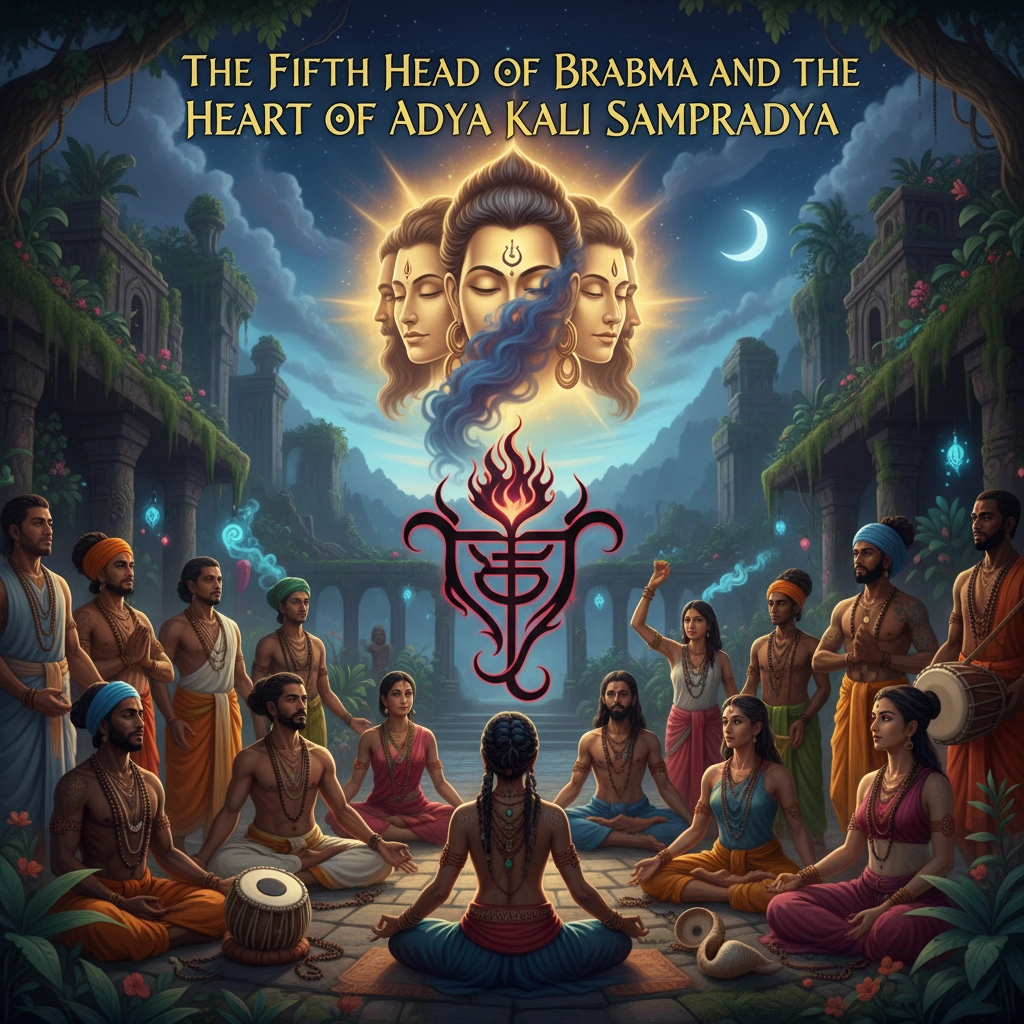
You know the story of Brahma's fifth head, right? Shiva cut it off because it spoke the forbidden truth, the Veda that couldn't be domesticated into temples and rituals. That severed head became the Kapala that Bhairava carries: the skull cup that holds the blood offering.
Bhima is that fifth head walking in human form. While his brothers played politics and philosophy, Bhima dealt in raw force, unchecked appetite, and unfiltered rage. Yudhishthira represented dharma through law. Arjuna embodied dharma through skill. But Bhima? He channeled dharma through destruction: the kind that makes civilized people uncomfortable.
The Mother doesn't need pretty prayers. She needs someone willing to get blood on their hands to establish truth in a world that has forgotten it.

The Blood That Isn't Dirty
Let's talk about what most people find disturbing: Bhima drinking blood. After Dushasana is killed: the man who tried to strip Panchali naked in front of the entire court: Bhima fulfills his oath. He tears open Dushasana's chest and drinks his blood while Draupadi unties her hair, which she'd kept bound since her humiliation.
Religious scholars get squeamish here. They call it barbaric. Some even edit it out of sanitized versions. But they're missing the entire point.
Bhima wasn't acting out of mere revenge. He was performing Rakta-Priya: the blood offering to the Mother. Kali is called the drinker of blood not because she's cruel, but because blood represents life force, the essence of existence itself. When blood is offered consciously, with full awareness and zero hesitation, it becomes the highest ahuti (offering) to the Dark Mother.
Think about it. Panchali was dragged by her hair during her menstrual cycle: when her blood was already flowing. The violation wasn't just social; it was a metaphysical assault on the Goddess herself. Dushasana's blood wasn't payment for an insult. It was the universe restoring balance through the only currency that mattered.
Bhima drinking that blood wasn't cannibalism. It was prasad: divine communion with the Mother's wrath. He became the instrument through which Kali's vengeance moved on earth.

Why Bhima Is the Mother's Favorite
The Mother has favorites, and Bhima tops that list. Not because he was perfect: he absolutely wasn't. But because he owned his darkness completely.
Look at Yudhishthira. Righteous, noble, always following the rules: and because of his gambling addiction and pride, he lost everything, including his own wife in a game of dice. Look at Arjuna, the great warrior, who needed Krishna to deliver the entire Bhagavad Gita just to get him to fight his own relatives.
But Bhima? He never hesitated. When his wife Hidimbi (a rakshasi, another form of the Dark Mother) wanted him, he didn't flinch at her "demonic" nature. When his infant son was poisoned and thrown into a river, he survived to become Ghatotkacha: half-human, half-rakshasa, pure bridge between worlds.
Bhima understood something the others didn't: rage isn't the enemy of dharma. Unowned rage is. Bhima took all his trauma: being poisoned as a child, watching his wife humiliated, enduring thirteen years of exile: and transformed it into divine fury. He didn't suppress it with meditation or philosophy. He weaponized it for truth.
That's what makes him Kali's favorite. The Mother doesn't want you to be "nice." She wants you to be real. She wants you to feel the full weight of your anger, your lust, your hunger, and then offer it back to her as fuel for destroying adharma.
The Fifth Veda and the Reclamation of Power
The establishment fears the fifth principle because it can't be controlled. The four Vedas: Rig, Yajur, Sama, Atharva: were systematized, ritualized, made safe for temple commerce. But the fifth? It's the tantric path, the left-hand way, the one that says blood and sex and death aren't obstacles to divinity: they're doorways.
Bhima embodies this. He eats like a rakshasa. He fights like a demon. He loves like a storm. And through all of it, he serves the Mother more faithfully than any priest ever could.
When Bhima drank Dushasana's blood, he wasn't breaking dharma: he was establishing it. Because real dharma isn't about following rules written by the comfortable. It's about restoring cosmic balance when those rules have been used to protect abusers.

What This Means for the Sadhaka
If you're walking a tantric path, you need to understand this story in your bones. The Mahabharata isn't entertainment. It's instruction.
Panchali wasn't saved by proper behavior or patient forgiveness. She was avenged by someone willing to become monstrous in service of truth. Bhima didn't meditate his way to righteousness. He bled for it.
Your rage isn't a problem to solve. Your hunger isn't a demon to starve. Your darkness isn't dirt to wash away. These are offerings. When you own them completely, when you stop pretending you're "above" your own shadow, you become useful to the Mother.
She doesn't need more devotees who light incense and whisper prayers while their blood stays cold. She needs warriors willing to drink the poison of this age and transform it into medicine. She needs people who understand that sometimes love looks like fury, and sometimes compassion requires a sword.
Bhima is the proof that you don't have to be perfect to serve the Goddess. You just have to be honest about what you are: and then offer all of it back to her, even the parts that scare you.
That's the path of the fifth head. That's the way of the blood-drinker. That's the secret the Mahabharata has been screaming for three thousand years, and almost everyone is still covering their ears.
The Mother is waiting. The question is whether you're ready to stop pretending she wants you sanitized.