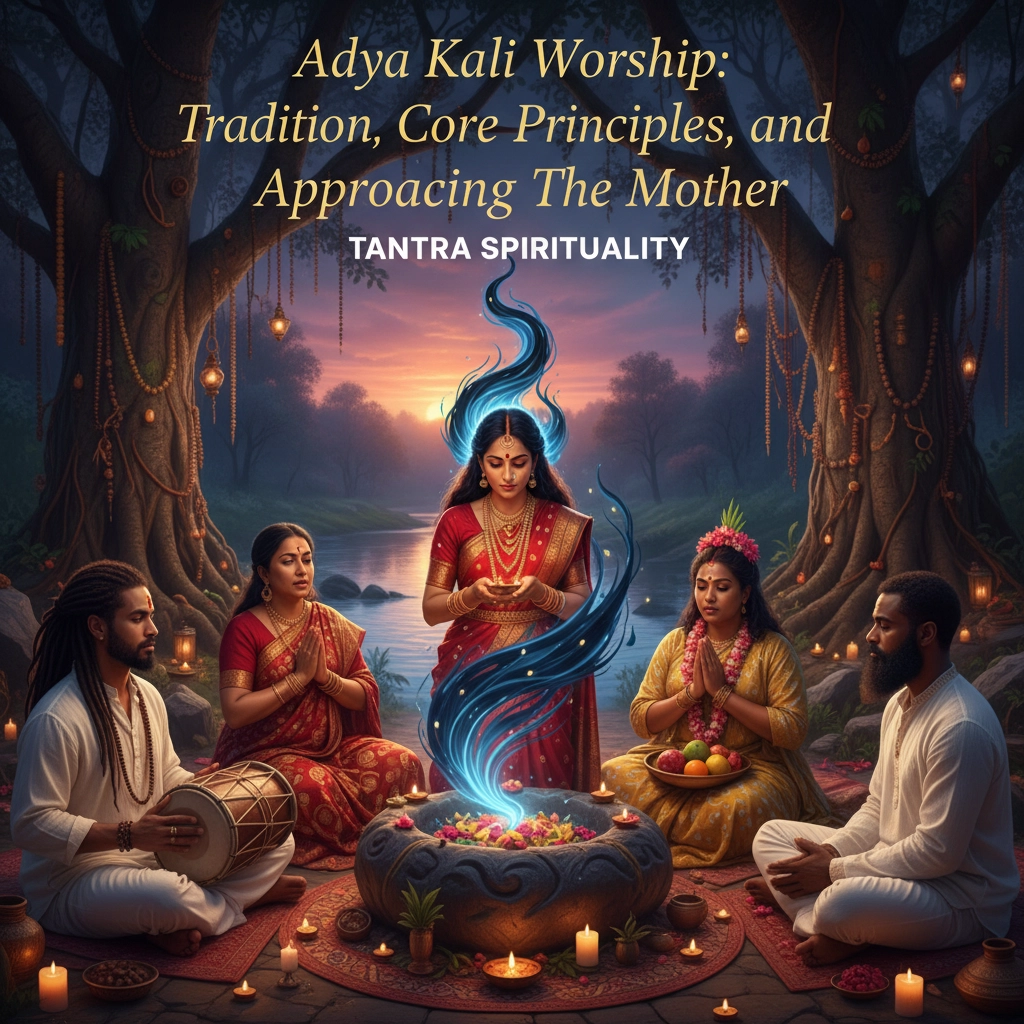
Most people think the Ramayana is Rama's story. But here's the truth that's been hiding in plain sight for thousands of years: Ma Sita is the architect of the entire epic. She's not just a character in the drama: she's the director, the playwright, and the stage itself.
And she's not who you think she is.
The Name That Has No Origin
When you look at Ma Sita's origin story, something strange emerges. She appears from the earth, found in a furrow by King Janaka. No mother. No conventional birth. Just… appearance.
Sound familiar?
This is exactly how Adya Kali is described: as the primordial force that has no origin because she is the origin. Both Sita and Adya Kali share this quality of being fundamentally unknowable in their beginnings. Sita's name appears in the Sahasranama, but her true nature remains veiled to those who see only the surface narrative.

The parallel isn't accidental. Ma Sita is Adya Kali: the first, the primordial, the Mother of the Trimurti itself. She doesn't just participate in the Ramayana; she authors it from behind the scenes, moving pieces on the cosmic chessboard with a precision that only the Divine Mother could orchestrate.
The Power Behind the Name "Rama"
Here's something that rarely gets discussed: the name "Rama" itself is empowered by Sita's own Tapasya.
Think about that for a moment. We chant "Rama, Rama, Rama" as if the power is inherent in the syllables alone. But the esoteric truth is that Sita's austerities, her devotion, her conscious sacrifice gave that name its spiritual potency. Without her Tapasya, the entire narrative collapses.
This is the hallmark of Adya Kali: she is the Shakti, the power that animates everything. Shiva without Shakti is Shava, a corpse. Similarly, Rama without Sita is incomplete. But it goes deeper than partnership. Sita is the active force that creates the conditions for Rama's divinity to manifest and be recognized.
She's not the supporting actress. She's the producer who decided there would even be a play.
Why Sita Refused Hanuman's Rescue
Let's talk about one of the most misunderstood moments in the Ramayana: when Hanuman finds Sita in Lanka and offers to carry her back to Rama. The conventional explanation is that she refused out of honor: that only her husband should rescue her, not a servant.
That's not the whole story.

Sita's refusal to be rescued by Hanuman reveals a profound spiritual teaching about the nature of Adya Kali and the path to her. Hanuman represents Siddhis: spiritual powers, miraculous abilities, the heights of yogic achievement. He can shrink to the size of an atom, leap across oceans, and carry mountains. He's the embodiment of what a perfected yogi can accomplish.
But here's the lesson: even with all the Siddhis in the universe, you cannot attain Madya (Adya Kali) without the pure heart of the Bhakta.
Rama is the Bhakta. Rama is pure devotion, pure love, pure surrender. Hanuman is capability and power. And Sita: as Adya Kali: is making a statement: "You don't reach me through power. You reach me through love."
This is why she insists on waiting for Rama. She's not being passive or stubborn. She's teaching the universe that the Mother responds to Bhakti, not to accomplishment. You can have every Siddhi, every mantra, every initiation: but without genuine devotion, without that quality of total surrender that Rama embodies, you're not crossing the threshold.
The Questions She Plants
One of the most revealing aspects of Sita's role as the architect comes from understanding how she manipulates events: not with force, but with subtlety. She plants questions in people's minds. She creates the conditions for certain outcomes to unfold.
According to esoteric interpretations, Sita purposely plants the idea in Rama's mind to send her to Valmiki's ashrama. Why? Because that's where the Ramayana itself will be written. That's where Valmiki will compose the epic, and where Lava and Kusha (Sita's sons) will sing it.

She's literally engineering the narrative framework through which her own story will be told. That's not the behavior of a victim or a passive participant. That's the behavior of Adya Kali: the cosmic intelligence that weaves creation itself, ensuring that every thread serves the larger tapestry.
When Brahma Bows
Here's a moment that should stop everyone in their tracks: in Valmiki's ashram, Brahma: the creator of the universe: bows to Sita.
Not to Rama. Not to Vishnu. To Sita.
Why would the creator of all things bow to a supposedly "mortal" woman living in exile?
Because he recognizes what most don't: Sita is the Mother of the Trimurti. She is the force from which Brahma himself emerged. She is Adya Kali, the primordial Shakti that existed before creation, that holds creation in her womb, and that will remain after dissolution.
Brahma's bow is an acknowledgment of ultimate reality. He's not bowing to a character in a story. He's bowing to the author of all stories, including his own.
The Boundless Power Beyond Illusion
One of Adya Kali's defining characteristics is that she leads seekers beyond illusion, beyond the veil of Maya that keeps us trapped in limited perception. Ma Sita embodies this same quality throughout the Ramayana.

Every trial she faces: the fire test, the exile, the separation from Rama: is not about her suffering. It's about demonstrating what lies beyond surface appearances. When she enters the fire and emerges unscathed, she's not proving her purity to Rama or to society. She's teaching that the Divine Feminine cannot be burned by judgment, by accusation, by the petty concerns of conditional reality.
When she finally returns to the earth at the end of her story, entering back into the ground from which she came, it's not a tragedy. It's a return to source. Adya Kali dissolves back into the primordial state, having completed the cosmic play she set in motion.
The Lesson for Today
So what does this mean for those of us walking the spiritual path now?
It means that when you invoke Ma Sita, you're not just calling on a historical or mythological figure. You're invoking Adya Kali herself: the force of creation, destruction, and transformation. You're reaching for the architect, not just a character.
It means that Bhakti Marga, the path of devotion, isn't a "lesser" path compared to the yogic pursuit of Siddhis. Sita chose devotion over power, and in doing so, she revealed which currency the Mother actually values.
It means that the Ramayana isn't just ancient history or moral instruction. It's a living blueprint, coded by the Divine Mother herself, showing us how to navigate existence, how to recognize the hidden architect behind events, and how to remember that love: not accomplishment: is the way home.

The next time you hear "Rama," remember who gave that name its power. The next time you read the Ramayana, ask yourself: who's really telling this story? The answer isn't Valmiki. It's not even Rama.
It's Ma Sita: Adya Kali: the Mother who architects everything, including your own journey back to her.
And she's been waiting for you to recognize her all along.