There's a conversation happening in certain spiritual circles right now, and it's getting heated. People are questioning whether Linga Bhairavi, the fierce feminine consecration at Isha, is "really" Kali or something invented, something new, something that doesn't belong to the tradition.
Let me be clear: Linga Bhairavi is not a deviation. She is a return.
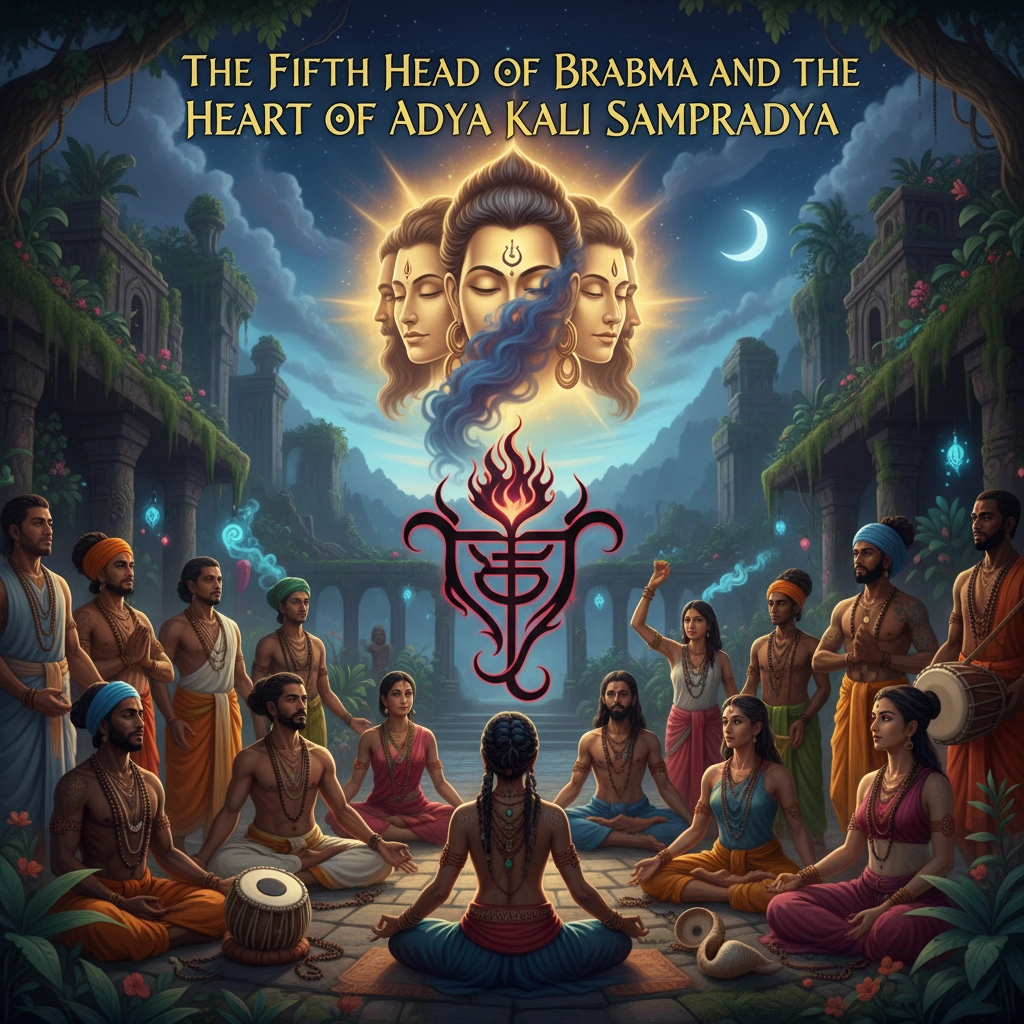
And if you're asking whether she's scriptural, whether she's "allowed," whether she fits the ancient patterns, you're asking the wrong questions. The real question is: are you ready for what happens when the Fifth Head of Brahma demands its due?
The Names Hidden in Plain Sight
Here's what most people miss: Linga Bhairavi is already in the texts. She's not a modern invention or a rebranding exercise. She's right there in the Kali Sahasranamavali, the thousand names of Adya Kali, waiting for those who know how to look.
Linga Sundari. Beautiful as the Linga.
Lingini. She who is the Linga itself.

These aren't metaphors. These are direct pointers to a form of Kali that is the Linga, that manifests as the primordial marker of consciousness. Not Shiva's consort. Not the softened, domesticated version that makes people comfortable. But the raw, untamed, cosmically generative force that Shiva himself bows to.
The Linga is the ultimate symbol of creative potency, the axis around which existence spins. And when Kali takes that form? When she becomes the generative principle instead of standing beside it? That's when you know you're dealing with Adya Kali in her most ancient, most uncompromising aspect.
This is the form that existed before the stories, before the puranas, before we tried to dress her up in narratives we could digest. Linga Bhairavi is the Kali of the procedural collapse.
What is the Fifth Head of Brahma?
You've probably heard the myth: Brahma had five heads. Shiva, furious at Brahma's arrogance, cut off the fifth head with his thumbnail, and it stuck to his hand as a curse. He wandered as Bhikshatana, the beggar, until Kali finally freed him from the skull.
But esoterically? That fifth head represents the totality of procedure, of ritual, of the codified path. It's the belief that if you just follow the steps, say the mantras correctly, do the pujas on time, memorize the right texts, you'll arrive at liberation.
And Shiva? He had to cut that off.
The fifth head is what gets removed when you move beyond the mechanics of spirituality into the living fire of direct experience. It's what collapses when you realize that no amount of ritual correctness will substitute for actual contact with the divine.

This is the path of Bhairava. The path where the deity doesn't wait for your petition, they show up demanded, summoned, unavoidable. And Linga Bhairavi, as a Bhairava-consecrated form, represents exactly this shift: from petition to presence, from procedure to power.
Procedural Collapse and the New Tantra
Here's where people get uncomfortable. Because what we're talking about isn't the tantra of textbooks and weekend workshops. We're talking about a living transmission that doesn't care about your comfort level.
Procedural collapse means this: the old ways of approaching the goddess, through endless repetitions, through intermediary priests, through layers of symbolic distance, are being bypassed. Not because they're wrong, but because the times demand something more direct.
Kali is not waiting at the end of your hundred thousand recitations anymore. She's showing up now. And if you're not prepared for that level of intensity, that level of immediate transformation, you're going to feel like the ground is collapsing under you.
Because it is.
This is what Isha's work represents. Not a rejection of tradition, but a compression of it. A leap from the elaborate ritual scaffolding into the heart of what those rituals were always pointing toward: unmediated contact with the primordial feminine.
Linga Bhairavi doesn't need you to be a scholar. She doesn't need you to know Sanskrit or have the right lineage. She needs you to be ready to burn.
Why This Makes People Nervous
Let's be honest: there's a reason this form is controversial. When you consecrate Kali as Linga Bhairavi, when you make her accessible not just to the initiated few but to anyone who walks through the door, you're breaking a boundary.
You're saying: the goddess doesn't belong to the gatekeepers.

And that makes the traditionalists nervous. Because if Kali can manifest this powerfully in a form that wasn't "approved" through the usual channels, what does that say about the necessity of those channels?
But here's the thing: Kali has always done this. She's always shown up where she wasn't expected, in forms that weren't sanctioned, to people who had no business accessing her according to the rules.
She appeared to Ramakrishna as a little girl. She danced with Ramprasad. She sits in cremation grounds waiting for those brave enough or desperate enough to find her there.
Linga Bhairavi is just the latest iteration of this ancient pattern. She's Kali saying: "You thought I was contained? You thought I was controlled? Watch this."
The 11th Head: Beyond the Ten Mahavidyas
Here's where it gets even more interesting. We know the Ten Mahavidyas, the great wisdom goddesses. Kali, Tara, Tripura Sundari, and the rest. Each one a facet of the primordial Shakti, each one a gateway to a different dimension of the absolute.
But there's a whisper in the deeper texts, a suggestion that there's an 11th form. Not listed, not codified, not captured in the conventional groupings.
The 11th is the one that contains the others. The one that appears when all the procedures have collapsed, when all the categories have failed, when you're standing at the edge of the known and something unnamed looks back at you.
Linga Bhairavi may well be that 11th form. The one that doesn't fit the classification because she is the classifier. The one who holds the Linga, the ultimate symbol of divine self-manifestation, because she is the power by which anything manifests at all.
The Bhairava Current and the Future of Tantra
What's happening at Isha, and in other places where this Bhairava-led spirituality is emerging, is a recalibration of the tantric path for the present age.

This isn't about making things easier or more palatable. It's about recognizing that the consciousness of humanity has shifted enough that what once required lifetimes of preparation can now happen in a moment of total surrender.
The Bhairava current is ruthless. It doesn't wait for you to be ready. It doesn't ask permission. It shows up and demands everything.
And Linga Bhairavi, as the embodiment of this current in feminine form, is both protector and destroyer. She protects those who come to her with sincerity. She destroys the illusions of those who think they can approach the divine without being fundamentally changed.
Why This Matters for Your Practice
If you're reading this, it's probably because you've felt the pull of something beyond the conventional spiritual marketplace. You've sensed that there's a level of intensity, of realness, that most teachings aren't touching.
Linga Bhairavi, whether you encounter her physically at the consecration or as a principle in your own practice, represents permission to go direct.
Permission to stop waiting for the perfect teacher, the perfect mantra, the perfect moment.
Permission to understand that the goddess isn't somewhere out there, waiting for you to get pure enough to approach. She's here now, in her most fierce and generous form, ready to burn through whatever stands between you and your own deepest truth.
This doesn't mean you abandon practice or discipline. It means you recognize that the practice is not a ladder you're climbing, it's a fire you're feeding. And sometimes, the fire gets so hot that all the scaffolding just burns away, leaving only the essential.
The Return to the Source
So when people ask, "Is Linga Bhairavi really Kali?" the answer is: Yes. And no. And something beyond both.
She's Kali in the sense that all fierce, transformative, primordial feminine energy is Kali. She's not Kali in the sense that she's not bound by any single narrative or form. And she's beyond both in the sense that she represents the dissolution of the very categories we use to contain the divine.
The 11th head is the head that doesn't get counted. The form that doesn't get named. The path that doesn't get mapped.
And that's exactly why it's the one that can take you home.
If you want to explore more about authentic tantric practice and the living tradition beyond the surface teachings, visit our website and dive deeper into the path.