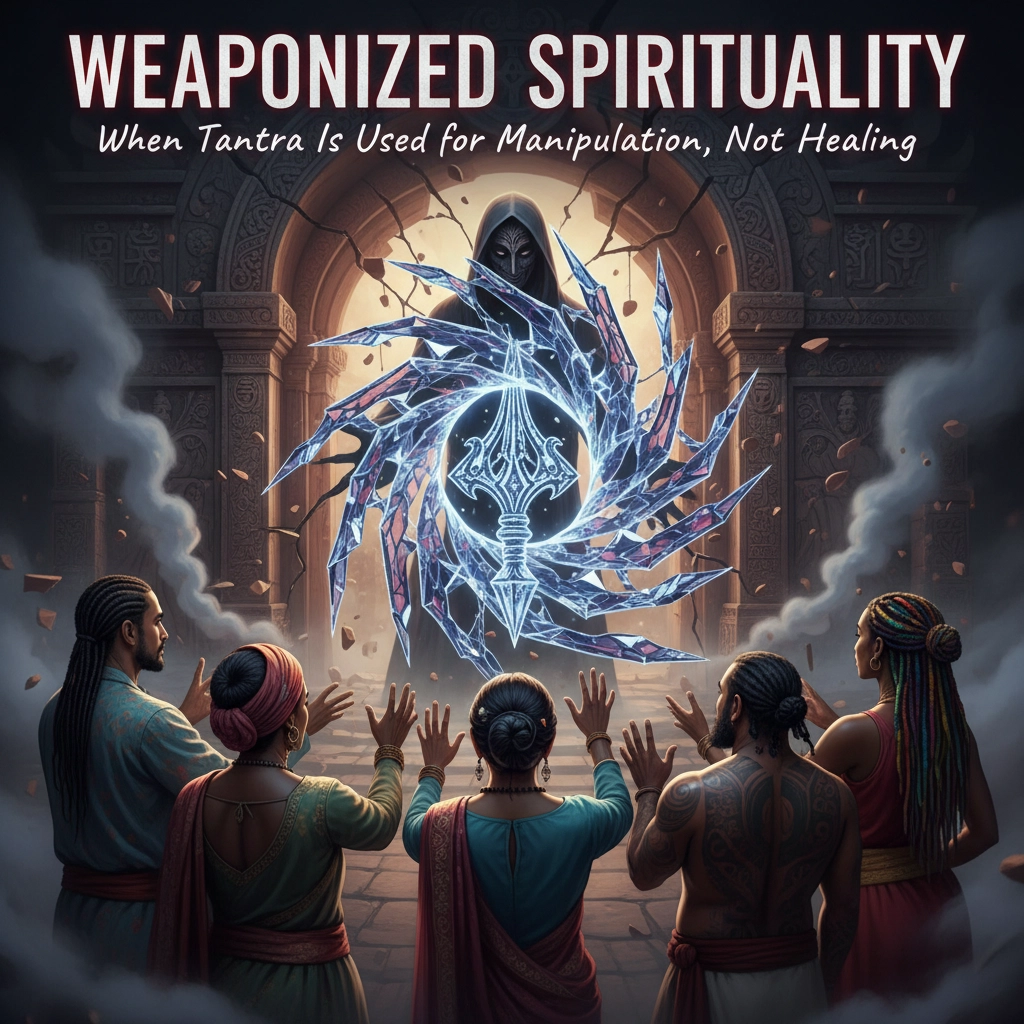
If you’ve ever fallen down a late-night internet rabbit hole, you’ve probably seen the words "tantra" and "black magic" thrown around in the same breath. Usually, it’s accompanied by spooky music and a lot of talk about curses or mysterious powers. It’s a bit like watching a high-budget horror movie: entertaining, sure, but how much of it is actually real?
In the world of authentic Tantra, the reality is far more grounded and, frankly, a lot more interesting than any Hollywood script. Tantra isn’t a dark art practiced in the shadows; it’s a sophisticated system of rituals and kriyas designed to achieve specific results. Think of it as a spiritual toolkit. Just like a hammer can be used to build a beautiful home or to break something down, the tools of Tantra are neutral. It’s the hand that holds them: and the intention behind that hand: that makes all the difference.
Today, we’re going to demystify the "Shat-karmas" or the six basic kriyas of Tantra. We’ll look at why these practices exist, how they work, and why finding a genuine guide is more about common sense than chasing mystical clouds.
The Six Tools in the Tantric Kit
In Tantra, there is a category of rituals known as Abhichara Kriya. This is what people often mislabel as "black magic." But in Sanskrit, Vichara simply means the application of rituals. These rituals are categorized into six different types of actions, each designed to shift the energy of a situation in a specific way.
1. Shanti Karma: The Breath of Peace
The first kriya is Shanti Karma. As the name suggests, this is all about creating peace. Whether it’s internal turmoil or a chaotic environment, these rituals are meant to settle the dust. It’s like clearing the air after a storm. It’s the practice of bringing harmony back to a space or a person’s consciousness.
2. Vidveshana: Stirring the Pot
On the flip side, we have Vidveshana. This kriya is used to create disturbance or conflict. Now, you might wonder, “Why would anyone want to do that?” Tantra doesn’t make a moral judgment on the technique itself. Historically, these practices were sometimes used in times of conflict or when two negative forces needed to be separated for the greater good. Imagine two people who are causing immense harm together; Vidveshana might be the tool used to break that alliance.
3. Uchchatan: The Sudden Shift
Uchchatan is one of the most fascinating kriyas because it deals with "displacement." It’s the energy that makes someone feel like they simply cannot stay where they are.
There’s a classic story about a seeker in Kashi who asked a senior sadhu, “What exactly is Uchchatan?” Instead of giving a long-winded philosophical lecture, the sadhu suddenly unleashed a barrage of raw, intense insults in Hindi. The seeker was so shocked and uncomfortable that he immediately stood up and ran out of the room. The sadhu later explained: That was Uchchatan. A sudden shock to the consciousness that forces you to move. In a ritual sense, this can be amplified to make an unwanted presence leave a home or a city.
4. Vashikaran & Sammohan: The Power of Attraction
Vashikaran and Sammohan are perhaps the most famous (and misunderstood) kriyas. These are tools of attraction. They are used to influence the consciousness of another or to draw something: or someone: toward you. In a spiritual sense, this was often about aligning one’s energy to be magnetic, though it is frequently misused in the modern world for personal gain.
5. Stambhan: The Art of Stillness
While often grouped together, Stambhan is the kriya of "immobilization." It is the power to freeze a situation, a person, or even a natural force in its tracks. It’s about creating a state of complete paralysis or blockage.
6. Marana: The Final Action
Finally, there is Marana. This is the most intense of the kriyas, designed for destruction or the ending of a life force. In ancient times, these were considered the ultimate weapons of a practitioner, used only under the most extreme circumstances where no other path was left.

Power is Neutral: The Electricity Analogy
The biggest question people have is: Is this good or bad?
Think about lightning. If a bolt of lightning falls on your head, it’s a tragedy. You’re finished. But if we harness that same raw power, we call it electricity. We use it to light our homes, cook our food, and run our hospitals. The power itself: the Shakti: doesn't care about your morals. It is just energy.
Tantra is the science of channelizing that power. Whether you use it for something positive or negative depends entirely on the circumstances and the practitioner. But here is the catch: Tantra is very clear about the law of consequences. If you misuse these tools to cause harm out of petty greed or malice, there is a karmic repercussion. There is no escaping that. Just because the tool is neutral doesn't mean the user is exempt from the results of their actions.
Shabar Mantras: The "Non-Sanskrit" Path
If traditional Sanskrit mantras are the "fine dining" of the spiritual world: elegant, precise, and requiring a lot of preparation: then Shabar Mantras are the "home-cooked meals."
Originating from the traditions of the Nath Yogis like Matsyendranath and Gorakshanath, Shabar Mantras are often written in local languages like Hindi or Bengali. They don't follow the strict grammatical rules of Sanskrit. In fact, they can sound quite blunt or even demanding.
Many of these mantras contain a specific phrase: “Meri bhakti, Guru ki shakti” (My devotion, the Guru’s power).

Do they work? Absolutely. In fact, they often work faster than Sanskrit mantras because they speak directly to the human consciousness. However, there is a catch. You can’t just pick a Shabar Mantra out of a book and expect it to work. For these to "ignite," they must be given to you by someone who has already activated them. Without that "spark" from a teacher, you might only get 10-20% of the result. It’s like trying to start a car with a flat battery; you need a jump-start from someone whose engine is already running.
Finding Your Way: Gurus and Common Sense
Finding a guide in today’s world can feel like navigating a minefield. For every genuine teacher, there are five people who are either half-frauds or just a bit confused themselves. So, how do you find the right path?
The first rule is: Don't lose your common sense.
We often have a romanticized idea that a guru will descend from the Himalayas, tap us on the forehead, and solve all our problems. Real life doesn't work that way. You have to work hard to find a teacher, just as you work hard at your practice.
Here’s a simple step-by-step approach if you're feeling the pull toward Tantra:
- Don't Rush: Don't take an initiation (diksha) on day one. Spend a year meeting different people and exploring different traditions (sampradayas). Whether you are drawn to the North Indian Shabar traditions or the South Indian Sri Kula or Kali Kula paths, take your time to see if the energy feels right.
- Start with "Open" Practices: You don't need a guru to start building your foundation. Focus on Namavalis (the names of a deity) or Stotras (hymns). These are open to everyone.
- Check Your Nature: If you are a naturally soft-natured, peaceful person, jumping into the practice of an aggressive deity like Rakta Chamunda might cause a massive internal disturbance. Choose a deity that "gels" with your own nature.
- Practice Consistently: If you think five minutes of meditation will change your life, you might be living in a fool’s paradise. Aim for at least one hour of dedicated practice every day.
- Be Open to Multiple Guides: Tantra doesn't always demand that you have only one teacher for your whole life. As your consciousness evolves, you might find different guides for different stages of your journey.

The Journey Inward
At the end of the day, Tantra is about transformation. Whether we are dealing with the shadow of "black magic" or the light of "shanti," the goal is to refine our consciousness. When you start your sadhana, you aren't just reciting words; you are changing the frequency of your internal world.
If your internal world is full of chaos and disturbance, you will naturally attract a teacher who reflects that. But if you put in the work: if you stay present, stay grounded, and stay curious: you will eventually find the guide you need.
Tantra isn't something to be feared or treated as a parlor trick. It is a profound path of integration. It invites you to look at the whole of life: the light, the dark, and everything in between: and see it as a single, vibrant expression of power.

Are you ready to stop looking at the shadows and start working with the light? Your path doesn't require a mystical mountain: it just requires your presence and a little bit of common sense.
Take your first step today by choosing one practice: perhaps a simple Namavali: and sticking with it for an hour. See how your consciousness shifts when you give it your full attention.