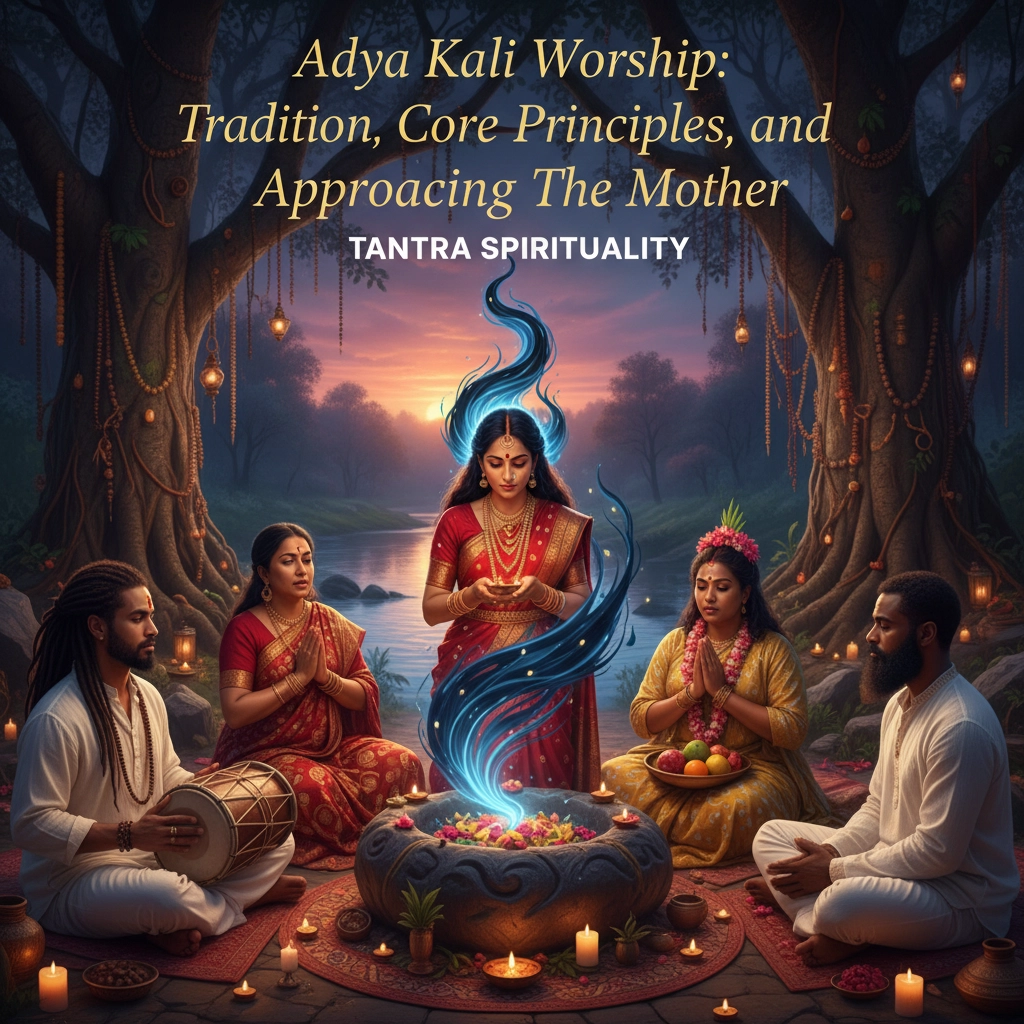
There's a festival that takes place every year in Assam, India, that flips everything we've been taught about menstruation on its head. Instead of hiding it, hushing it, or treating it as something shameful, thousands of devotees gather to celebrate the menstrual cycle of the Divine Mother herself.
This is Ambubachi, and understanding it might just transform how you relate to the sacred feminine, both in your spiritual practice and in your everyday life.
What Exactly Is Ambubachi?
Ambubachi marks the annual menstrual cycle of Goddess Kamakhya, celebrated at the famous Kamakhya Temple in Guwahati, Assam. But let's go deeper than the Wikipedia definition here.
In the Shakta tradition, the path of worshipping the Divine Feminine, Ambubachi represents the cosmic cycle of Devi. Think of it as the moment when the entire "womb of creation" goes into rest. The universe itself is taking a pause. The creative force that births all of existence is in her own natural rhythm of renewal.
The Kamakhya Temple is considered one of the 51 Shakti Peethas, sacred sites where parts of Goddess Sati's body fell to Earth. Kamakhya specifically marks where her yoni (womb) landed, making it one of the most powerful centers of divine feminine energy on the planet.
During Ambubachi, which typically falls in June and lasts four days, the temple doors close completely. No rituals, no pujas, no visitors. The goddess is resting, rejuvenating, renewing herself. And when the doors finally reopen on the fourth day, devotees receive prasad in the form of a red cloth, symbolizing her divine blessing.

The Invitation to Practice Differently
Here's where things get interesting for those of us on a spiritual path.
During Ambubachi, the traditional approach isn't to bombard Devi with requests. This isn't the time to ask for more money, better health, or that promotion you've been eyeing. Instead, this is an invitation to focus on something deeper, spiritual enlightenment.
Think about it this way: if your mother or sister was resting, perhaps feeling under the weather or simply needing space, would you walk in and start demanding things from her? Would you hand her a list of everything you need her to do for you?
Of course not. You'd bring her tea. You'd keep the house quiet. You'd ask what she needs.
This is the energy we're invited to bring during Ambubachi. Treat Devi with the same tenderness and consideration you'd offer any woman in your life who's in her cycle. Instead of asking, try listening. Instead of demanding, try serving.
The practice becomes less about what you can get and more about how you can honor.
Becoming the Adhara: The Lesson of Shiva
There's a beautiful concept in the Shakta path called becoming the "adhara" of Shiva. In sacred imagery, you've probably seen depictions of Kali standing or dancing on Shiva's body. This isn't a scene of domination or defeat, it's something far more profound.
Shiva serves as the adhara, the foundation, the support, the steady ground upon which Devi can fully express herself.

A true Shakta, a genuine devotee of the Divine Feminine, aims to embody this quality of Shiva. And here's where it gets real: Shiva doesn't just support Devi when she's being sweet and nurturing. He supports her in all her forms, including the wild, fierce, unpredictable, and yes, sometimes "unreasonable" expressions of Kali.
What does this mean for us practically?
It means developing the capacity to hold space for the full range of feminine energy: in ourselves, in our partners, in the world around us. It means not running away when emotions get big or when things don't make logical sense. It means learning to be a steady, loving presence even when the feminine is in her most powerful, untamed expression.
This isn't about becoming a doormat. It's about becoming a sanctuary.
Honoring the Women in Your Life
Here's where the rubber meets the road: and honestly, this might be the most powerful practice you take away from learning about Ambubachi.
The speaker in the teaching suggests that the very best way to honor Devi isn't necessarily through elaborate rituals or expensive offerings at a temple. It's far simpler and far more direct:
Honor the women in your life.
Try this: ask the women around you: your partner, your mother, your sister, your close friends: what they crave or need during their cycles. What makes them feel supported? What do they wish someone would offer them without having to ask?
Maybe it's chocolate. Maybe it's solitude. Maybe it's a heating pad and their favorite movie. Maybe it's being held without being talked to. Maybe it's taking the kids for an afternoon.
Whatever it is: take that offering and place it at your altar.

This is embodied devotion. This is tantra in action. You're not just worshipping an abstract concept of the Divine Feminine: you're recognizing her living presence in the real women who share your life, and you're actively serving that presence.
The cosmic and the intimate become one.
Practical Taboos: When the Earth Rests
There's another layer to Ambubachi that connects to our relationship with the Earth herself.
In this tradition, Devi isn't only the cosmic mother: she's also Bhumi, the Earth. And during Ambubachi, the Earth too is considered to be in her cycle, in her time of rest.
Because of this, traditional practices suggest avoiding certain activities during these four days:
- No digging the earth (gardening, planting)
- No heavy construction
- No plowing or major agricultural work
The logic is beautifully simple: if the Earth is resting, don't disturb her.
In our modern lives, this might translate to taking a gentler approach with our environment during this time. Perhaps it's an invitation to slow down our own productivity, to recognize that constant doing isn't sustainable: not for us, not for the planet.
Rest isn't laziness. Rest is part of the creative cycle itself.
The Hidden Training of Arjuna
There's a fascinating story from the Mahabharata that offers another window into understanding the divine feminine.
The great warrior Arjuna, one of the most skilled fighters in all of Hindu mythology, spent an entire year living as a woman named Brihannala. During this time in exile, he taught music and dance in the court of King Virata, fully embodying feminine form and experience.

This wasn't a punishment or a curse. It was training.
For Arjuna to truly master his power, to become the complete warrior and human being he was meant to be, he needed direct experience of the feminine. He needed to live it from the inside out.
The message here is profound: understanding the divine feminine isn't just an intellectual exercise. It's not enough to read about it or think about it. At some point, the path asks us to embody it: to feel it in our bones, to know it through direct experience.
Whether you're a man, a woman, or identify outside that binary, there's an invitation here to explore and integrate the feminine within yourself.
Bringing It Home
Ambubachi reminds us that there's nothing shameful about cycles: whether they're happening in our bodies, in nature, or in the cosmos itself. These rhythms of activity and rest, creation and renewal, are sacred. They're the very pulse of existence.
So as you continue on your path of spiritual growth and embodied healing, consider how you might honor these cycles more consciously:
- When the women in your life are in their time of rest, how can you support them?
- When you yourself need rest, can you take it without guilt?
- Can you become a steady, loving foundation for the full expression of feminine energy: the gentle and the wild?
The Divine Mother isn't somewhere far away, waiting to be found in a distant temple. She's right here: in the earth beneath your feet, in the women you love, in the creative force that moves through your own body.
And sometimes, the most profound devotion is simply learning to let her rest.