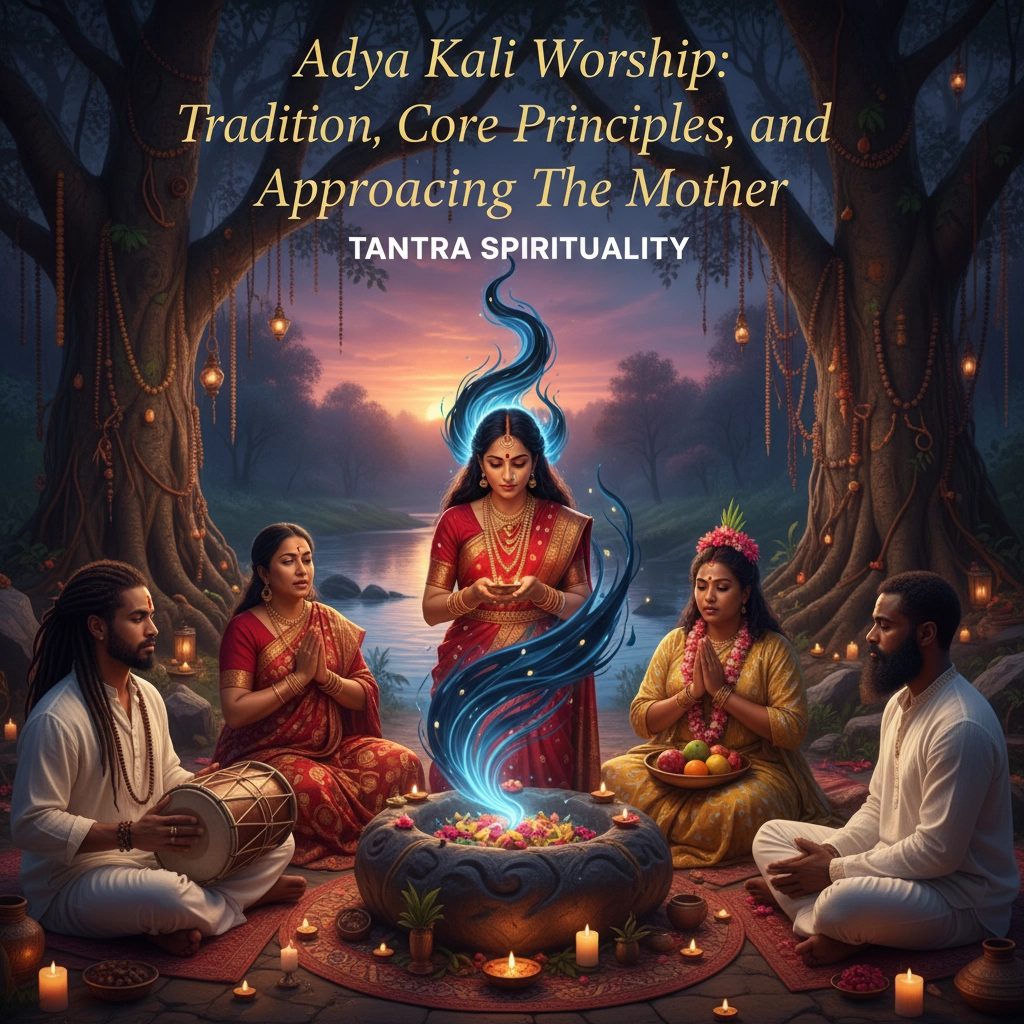
Before the goddess appears in vision, she arrives as sound. Before the image takes form in the mind's eye, the mantra carves her shape into the space between breaths. This is the secret the old tantrikas knew: sound is not just a tool to reach the deity: sound is the deity's first body.
The Adya Kali Dhyanam, that ancient meditation verse beginning with "Om Pratipada Ghoram," is not a description of the goddess. It's her phonetic architecture. Each syllable is a bone in her skeleton. Each word, a muscle that moves through the dark.
The First Body Is Made of Sound
In the tantric worldview, everything begins with vibration. The universe itself is said to be a crystallization of sound: Nada Brahman, the sonic absolute. Before matter, before light, before even the concept of "before," there was only the hum of pure potential.

The goddess Adya Kali: the Primordial One, she who existed before time learned to count: is that hum given consciousness. And when practitioners chant her Dhyanam, they're not calling to her from a distance. They're assembling her body, syllable by syllable, in the chamber of their own awareness.
"Om Pratipada Ghoram" translates roughly to "the terrible one of the first day," but this translation barely scratches the surface. "Ghoram" doesn't just mean terrible: it means that which shakes you to your foundation, that which refuses to let you remain comfortable in your illusions. It's the terror of transformation itself.
The Imagery: Beauty in the Brutal
The Dhyanam paints Adya Kali with fierce precision. She wears a garland of skulls. Her tongue lolls out, tasting the air. Her eyes are wild. Her form is dark as the void before creation. She stands on the chest of Shiva himself: the ultimate consciousness rendered inert without her dynamic power.
This isn't symbolic decoration. This is a map.
The garland of skulls? Those are your former selves. Every identity you've clung to, every version of "you" that thought it was permanent: they're all there, strung around her neck. She doesn't destroy them out of cruelty. She collects them because that's what needs to happen for you to become what you actually are beneath all the costumes.

Her lolling tongue represents the active work of consuming negativity: the poisons of existence that most spiritual paths try to transcend or avoid. Kali drinks them down. She processes them through her fierce digestive fire. Nothing is rejected. Everything is transformed.
Her dark form is the pregnant void, the space where all possibilities live before they choose to manifest. To meditate on her darkness is to learn to sit in the uncertainty without grasping for the light switch.
Sound as the First Step
Here's where it gets practical: you don't need to see the goddess to work with her. In fact, trying to visualize her before you've built her sound-body is like trying to hang pictures on a wall that hasn't been constructed yet.
The mantra comes first. The sound-form establishes the energetic structure. Only after you've chanted the Dhyanam hundreds or thousands of times: when the syllables have worn grooves into your nervous system: does the vision naturally arise.
This is radically different from most Western approaches to meditation, where visualization often leads. In the tantric method, phonetics precede optics. You speak the deity into being before you see her.

The Adya Kali Dhyanam is particularly potent because it doesn't ask permission. It doesn't soften her edges or make her palatable. It presents the full force of primordial energy in all its raw, uncomfortable, transformative glory. And when you chant it, you're agreeing to be unmade.
Connection to Transformative Power
Most people want transformation to feel good. They want the spiritual path to be all light and bliss and gentle unfoldment. Adya Kali laughs at this delusion: and her laugh sounds like thunder.
Real transformation is not gentle. It's not supposed to be. You can't birth a new version of yourself without the old version dying. You can't break through to deeper truth without the comfortable lies cracking apart. This is the domain of the Primordial Mother.
When you sit with the Adya Kali Dhyanam, when you let those sounds move through you repeatedly, something starts to shift. The parts of you that are already dead but still pretending to be alive: they start to loosen. The identities you've been clutching out of fear: they start to feel less solid.
This isn't comfortable. But it's necessary.
The skulls in her garland aren't a threat. They're a promise: you will survive your own transformations. You've died a thousand deaths already: every time you've let go of something you thought you needed, every time you've moved through grief or loss or radical change. Those skulls are proof that you're still here.
The Practice: Building the Sound-Body
So how do you actually work with this? How do you use the Adya Kali Dhyanam to connect with transformative power?
Start simple. Find a quiet space where you won't be interrupted. Sit comfortably: this doesn't need to be elaborate. Light a candle if it helps you focus, but don't get lost in ritual for ritual's sake.
Begin by chanting the Dhyanam slowly. Let each word form completely in your mouth before moving to the next. Don't worry about perfect pronunciation at first: the sound will teach you as you practice. What matters more is your attention. Are you present with each syllable? Or are you already three words ahead, mentally rushing through?

After you've chanted through it three to seven times, sit in silence. This is where the real work happens. The sound has created a structure. Now notice what moves through that structure. Thoughts, emotions, sensations: let them arise and pass without grabbing onto them. The goddess's garland has room for all of it.
Do this daily if you can. Or as often as your life allows. Consistency matters more than intensity. Better to chant for five minutes every day than to do an hour-long session once a month and then forget about it.
Over time, you'll notice shifts. Maybe small ones at first: a dream that feels significant, a sudden clarity about something you've been avoiding, an unexpected release of old anger. These are signs that the sound-body is taking form. The Primordial Mother is moving through you, beginning her work of fierce grace.
The Sound That Remains
Eventually, if you practice long enough, something strange happens. The mantra starts to chant itself. You'll catch yourself humming it while doing dishes. You'll wake up with it already playing in your mind. The sound-body you've been building externally has taken root internally.
This is when you know the connection is established. The deity is no longer something you're reaching toward: she's become a resonance you carry. And from that resonance, real transformation becomes possible.
The Adya Kali Dhyanam isn't about becoming a better person or achieving some lofty spiritual state. It's about becoming real. Stripping away the false. Standing naked in the dark with the Primordial Mother and letting her decide what stays and what gets added to the garland.
It's not easy. It's not always pleasant. But it's true. And in a world drowning in spiritual bypassing and comfortable delusions, truth: even fierce truth: is exactly what we need.
The sound-body awaits. All you have to do is speak.