
If you’ve been following this series, you know we’ve already laid the foundation. In the first half of this exploration, we looked at the first five Mahavidyas: Kali, Tara, Tripurasundari, Bhuvaneshwari, and Bhairavi. They represent the macrocosm: the container of Time, the power of the Word, the geometry of Beauty, and the infinite Space in which everything exists.
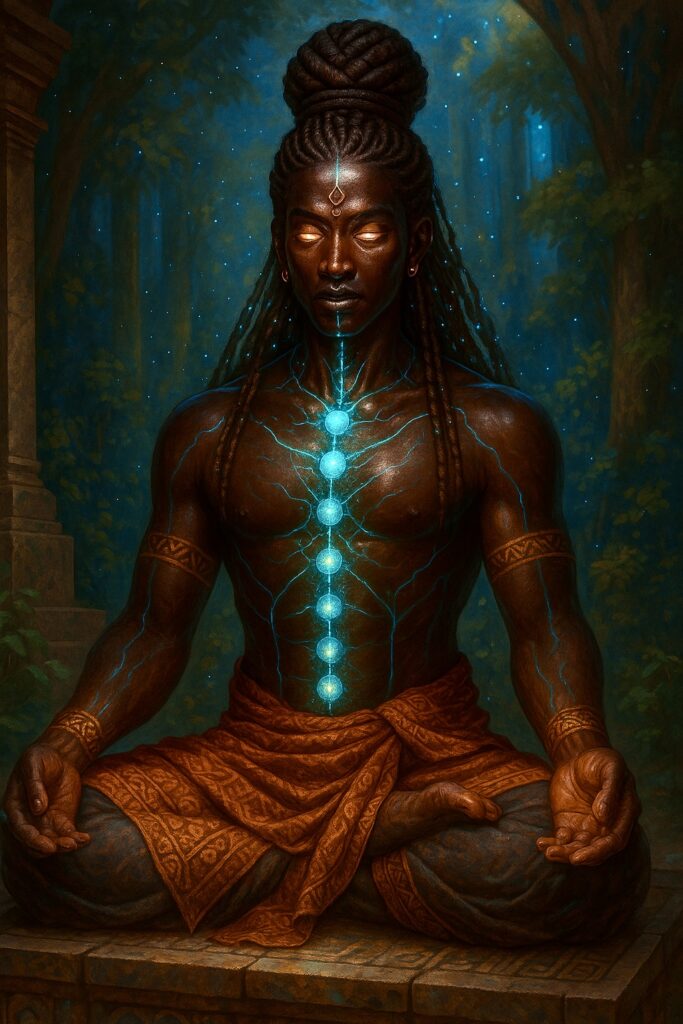
But now, we’re moving from the cosmic stage into the laboratory of the self. The final five Mahavidyas: Chhinnamasta, Dhumavati, Bagalamukhi, Matangi, and Kamalatmika: are about the internal work. This is where the Vira (the heroic practitioner) stops looking at the stars and starts looking at the wiring. These deities represent the internal mechanics of transformation, the raw power of the sushumna, the necessity of the void, and the final manifestation of spiritual fullness.
If the first five were the architecture of the temple, the final five are the high-voltage electricity running through the walls.
Chhinnamasta: The Electric Surge of the Sushumna
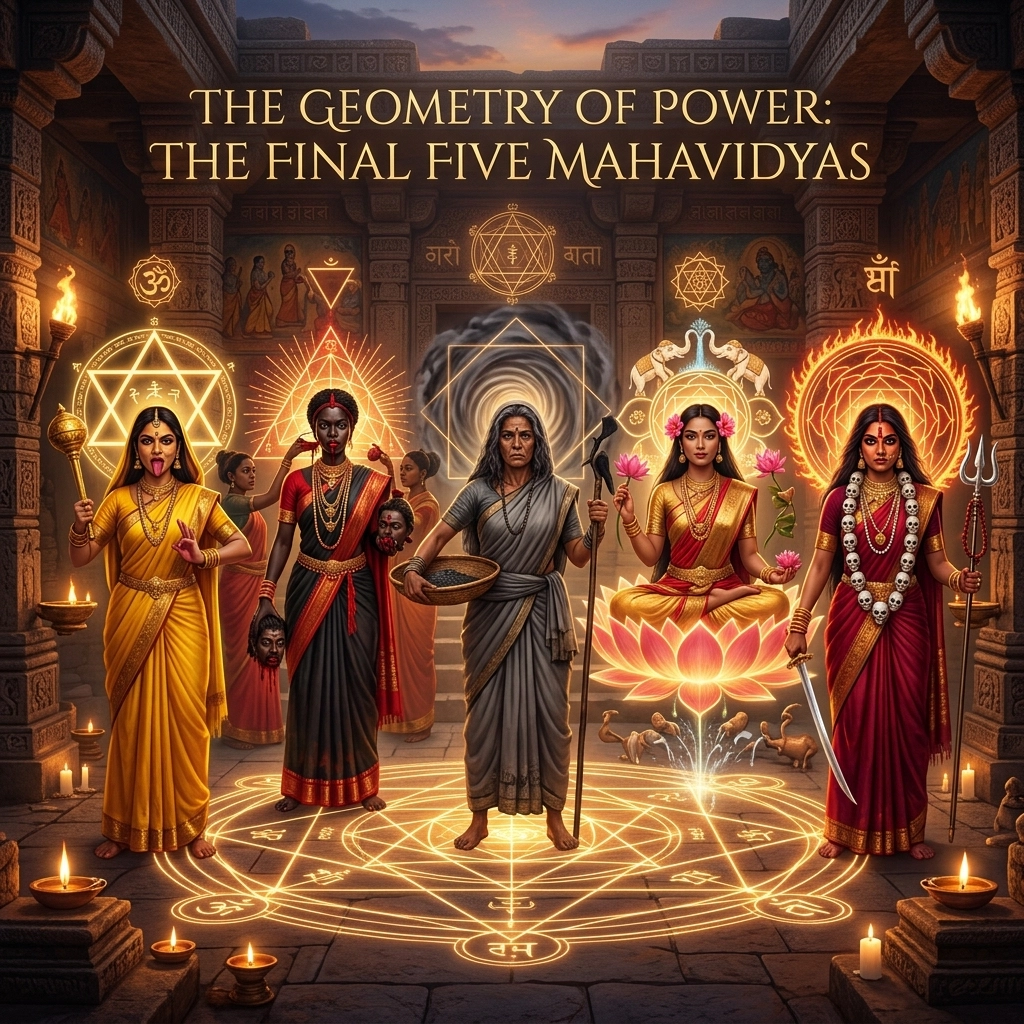
Chhinnamasta is often the one that makes people uncomfortable. She is depicted standing on a copulating couple, holding her own severed head in her hand, while three jets of blood spurt from her neck. One stream enters her own mouth, while the other two feed her flanking attendants, Jaya and Vijaya.
Let’s get past the gore. In the geometry of power, Chhinnamasta represents the radical severing of the ego-mind. The "head" is the seat of the discursive, chattering intellect that keeps us trapped in duality. By severing it, the energy is no longer leaked through the senses. Instead, it is redirected.
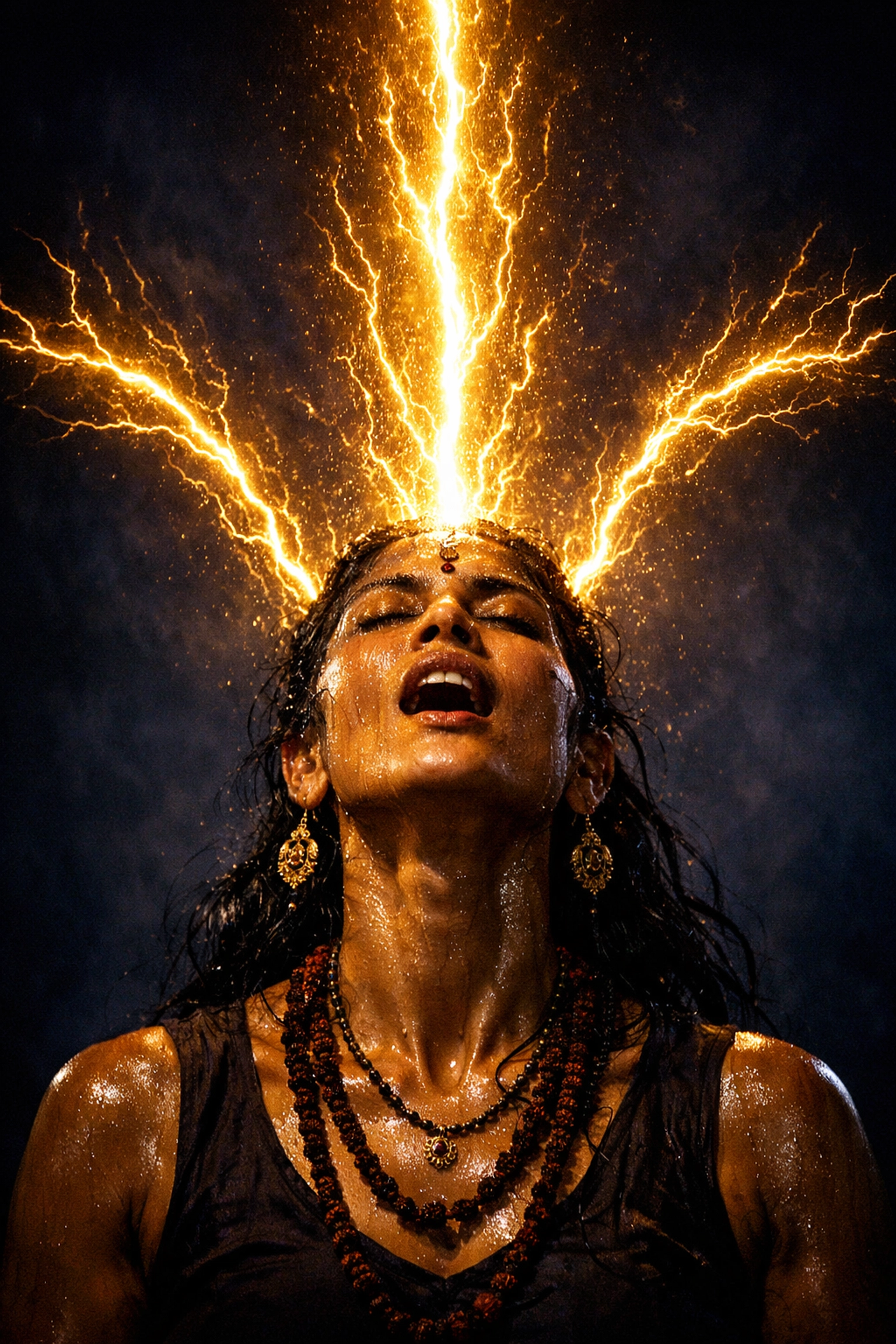
The three streams of blood are the Ida, Pingala, and Sushumna. In a normal human state, our energy is constantly bouncing between the polarities of Ida (lunar/passive) and Pingala (solar/active). Chhinnamasta represents the moment of tapas where the energy is forced into the central channel, the sushumna. It is an electric, lightning-fast ascent. She is the goddess of the Vajra (the thunderbolt). She represents the "great sacrifice" where the practitioner realizes that the only way to feed the divine consciousness is to offer up their own limited identity.
Dhumavati: The Power of the Smoke and the Void
After the lightning strike of Chhinnamasta comes the smoke. Dhumavati is unique among the Mahavidyas because she has no consort. She is the widow. She is depicted as old, ugly, and riding a crow in a chariot with a winnowing basket.
In a world obsessed with "light and love," Dhumavati is the necessary reality check. She represents the void: the state that remains when everything else has been burnt away. She is the smoke that stays after the fire of desire is extinguished.

Practicing with Dhumavati is about finding the "hidden" light in the darkness. She is the patron of the marginalized and the forgotten. In the spiritual path, she represents the state of Pratyahara (withdrawal of senses). When you sit in meditation and the world feels empty, grey, or meaningless, you are in Dhumavati's territory. She teaches us that there is a profound power in "what remains." She is the ultimate teacher of non-attachment. If you can find the divine in the "ugly" and the "empty," you have mastered the bhava of the Mahavidyas.
Bagalamukhi: The Weapon of Silence (Stambhana)
If you’ve ever wished you could just shut your mind up, you were looking for Bagalamukhi. Known as the "Yellow Goddess" or Pitambari, she is the goddess of Stambhana: the power to paralyze or immobilize.
In her iconography, she is seen pulling the tongue of a demon with one hand while striking him with a club in the other. This isn't about physical violence against others; it’s about the internal demon of the "wrong word." The tongue represents the beginning of all movement and manifestation. By seizing the tongue, Bagalamukhi stops the momentum of the ego.

In the geometry of power, she is the "point of stillness." She represents the gap between two thoughts. When you use her energy, you are freezing the "enemy": which is usually your own doubt, your own habituated speech patterns, and your own internal narrative. She is the force that turns a chaotic mind into a silent, golden ocean. This is the height of tapas: the ability to hold the mind in absolute, paralyzed focus until the truth reveals itself.
Matangi: The Tantric Saraswati and the Outcaste
Matangi is often called the "Outcaste Goddess." While the mainstream Saraswati represents the pure, Vedic, "civilized" arts, Matangi is the goddess of raw, unrefined expression. She is traditionally offered Uchista: leftover or partially eaten food: which is a huge taboo in orthodox Hindu practice.
Why? Because Matangi represents the vibration of the word (Vak) in its most primordial form. She doesn't care about social hierarchies or "purity." She is the emerald-green goddess who resides in the throat chakra, turning the "leftovers" of our life experiences: the pain, the grit, the raw emotions: into art and wisdom.
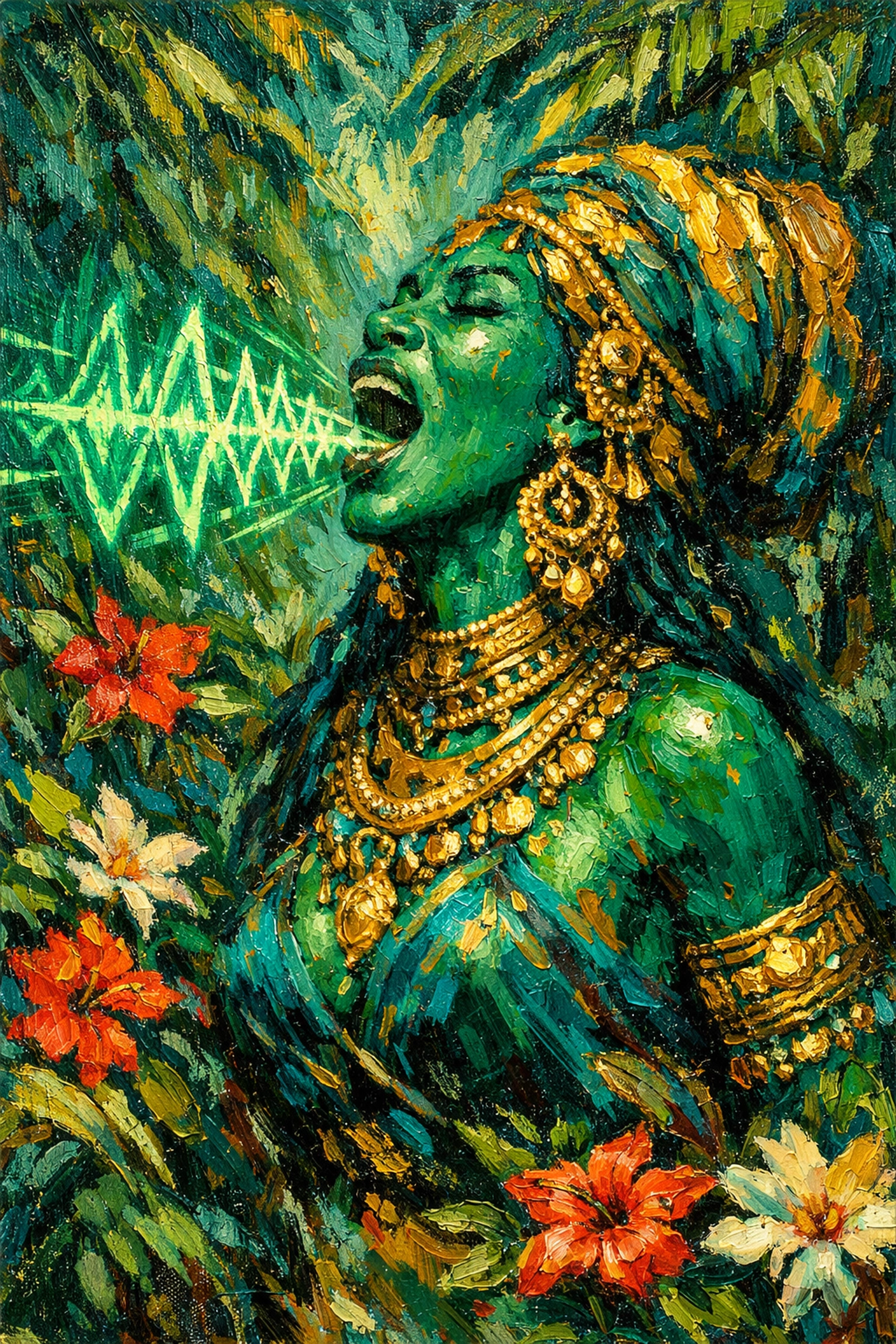
Matangi is the power of the Vira who has moved beyond the need for external validation. She is the goddess of the spoken word that has the power to change reality. When your internal work (the silence of Bagalamukhi and the void of Dhumavati) begins to manifest as external wisdom, that is Matangi. She is the bridge between the internal laboratory and the external world.
Kamalatmika: The Lotus of Infinite Fullness
We end with Kamalatmika. She is often identified with Lakshmi, the goddess of wealth, but in the context of the Mahavidyas, her "wealth" is of a different order. She is the "Lotus Goddess" of the Tantric path, representing the final blossoming of consciousness.
If Kali is the beginning (the seed/the void), Kamalatmika is the end (the full flower). She represents the state of a Siddha: someone who has integrated all the previous nine Mahavidyas and now lives in a state of perpetual abundance. This isn't just about having money in the bank; it’s about the spiritual realization that the entire universe is a manifestation of beauty and fullness.

Kamalatmika teaches us that the end goal of Tantra isn't to escape the world, but to live in it with a "Golden Bhava." She is the recognition that the "Geometry of Power" is ultimately a geometry of Love. She brings the practitioner back to the earth, but this time, the earth is seen for what it truly is: a sacred ground of infinite light.
Integrating the Ten
The Ten Mahavidyas are not separate entities; they are a map of the human psyche and the cosmic process. The first five built the structure, and these final five gave us the tools to navigate our internal landscape. From the radical sacrifice of Chhinnamasta to the golden abundance of Kamalatmika, the journey is one of total transformation.
Most people fail at Tantra because they want the "gold" of Kamalatmika without the "severing" of Chhinnamasta or the "void" of Dhumavati. But the Geometry of Power is a complete circuit. You cannot have the light without the smoke, and you cannot have the speech without the silence.
If you are serious about moving past the superficial and actually doing the work, you have to embrace the whole spectrum. Stop looking for the "easy" path and start looking for the authentic one.
Learn how to integrate these ancient practices into your modern life without the fluff.