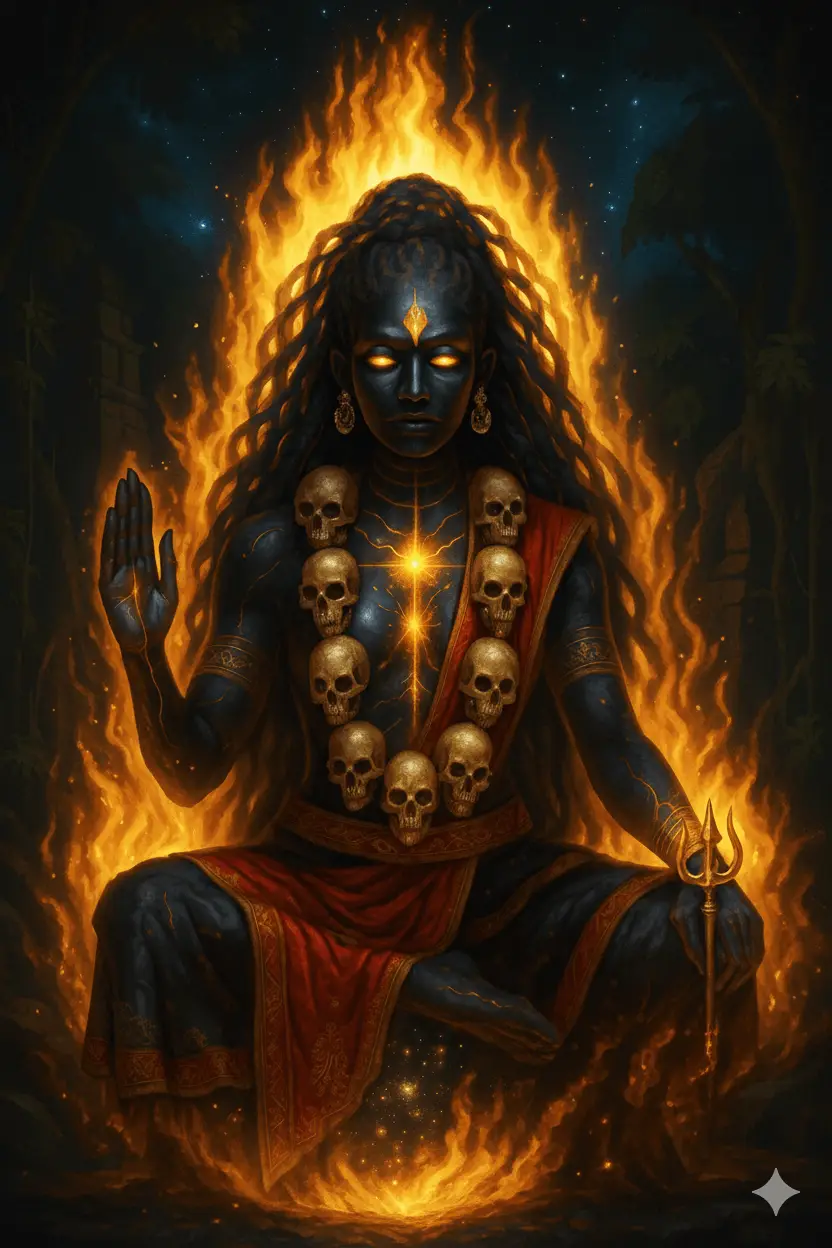


In the sacred halls of ancient temples across South India, you'll find a remarkable figure carved in stone: always facing south, always silent, always teaching. This is Dakshinamurti, one of the most profound aspects of Lord Shiva, embodying the ultimate guru who transmits the highest wisdom not through words, but through the power of pure presence.
Unlike the dancing Nataraja or the fierce Bhairava, Dakshinamurti represents Shiva in his most contemplative form: the Adi Guru, the first and supreme teacher of all knowledge. Here, the wild-haired destroyer becomes the serene sage, the cosmic dancer becomes the still point of wisdom, and the lord of transformation becomes the gentle guide toward self-realization.
The Sacred Direction: Why South?
The name Dakshinamurti literally means "the one who faces south": dakshina (south) and murti (form or embodiment). But this isn't just about geography. In Vedic tradition, south represents the direction of death and dissolution, not as something to fear, but as the ultimate teacher.
Think about it: what dies when we face south with Dakshinamurti? Our ignorance. Our limited sense of self. Our attachment to the temporary. By facing the direction associated with endings, this divine teacher shows us that true wisdom comes from understanding what is eternal versus what is merely passing through.

This southern orientation also connects to the ancient practice of receiving teachings. Students traditionally sat facing north while their guru faced south, creating a sacred energy circuit where wisdom could flow from teacher to student. Dakshinamurti eternally maintains this position, always available to those ready to receive.
The Teaching of Silence
Here's where Dakshinamurti becomes truly extraordinary among divine teachers. While other deities might teach through scriptures, miracles, or dramatic interventions, Dakshinamurti teaches through mauna: profound, pregnant silence.
This isn't the silence of absence, but the silence of fullness. It's the kind of silence that contains everything, the way the space in a room contains all the furniture without being diminished by it. In tantric understanding, this silence represents para vak: the supreme speech that communicates directly from consciousness to consciousness.
Imagine sitting with a teacher who never speaks a word, yet in their presence, all your questions dissolve. Not because they're answered, but because the questioner itself is transformed. This is the teaching method of Dakshinamurti: the direct transmission of awareness itself.
The Iconography of Wisdom
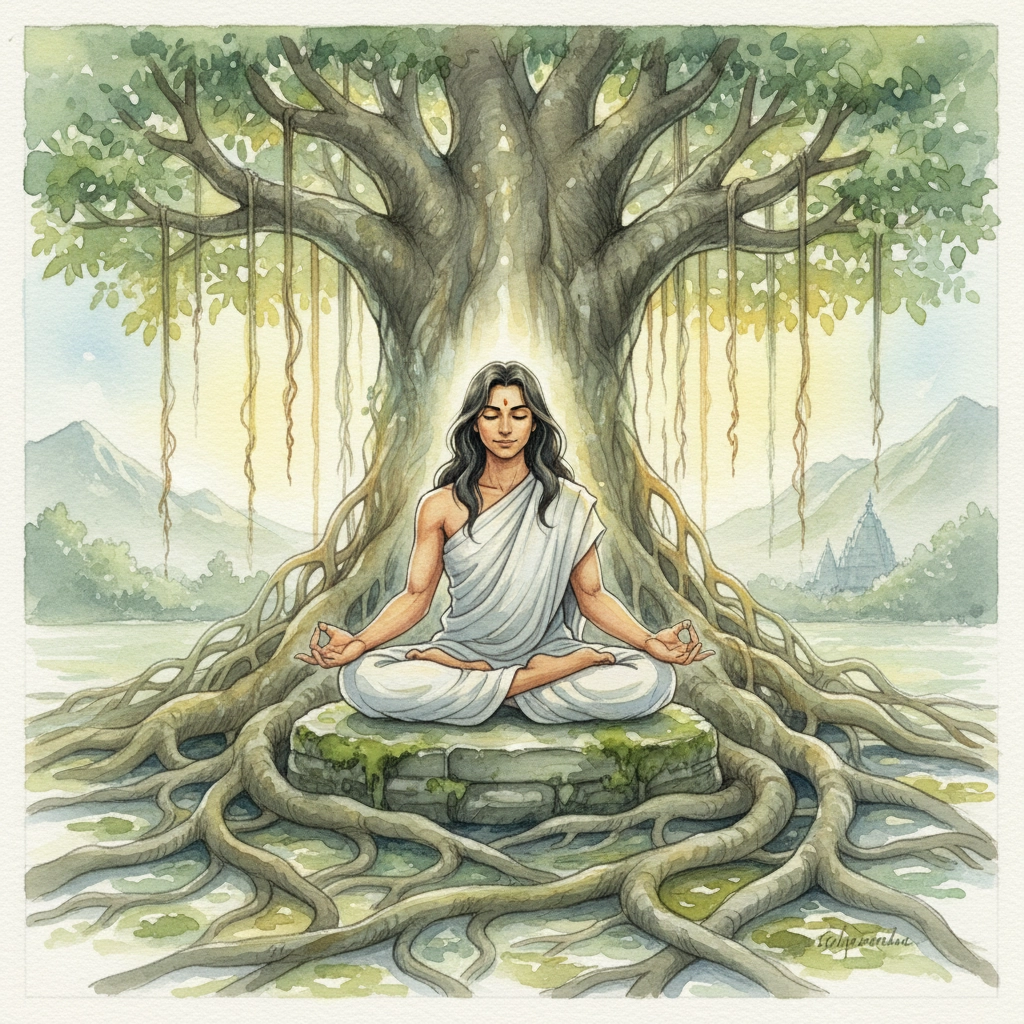
When you see Dakshinamurti depicted in traditional art, every detail carries meaning. He's typically shown as a young man: wisdom embodied in eternal youth: sitting beneath a banyan tree, the sacred fig tree that represents the interconnectedness of all existence.
His right hand displays the Abhaya Mudra (gesture of fearlessness) or the Chin Mudra (gesture of consciousness), while his left hand might hold a palm leaf manuscript representing knowledge, or make the Vyakhya Mudra (teaching gesture). But notice: even his gestures are subtle, almost imperceptible. He's not dramatically proclaiming; he's gently indicating.
The four old sages sitting at his feet represent the four directions of space and the four Vedas, but they also represent something more personal: the different aspects of our own seeking mind that must eventually be stilled to receive true teaching. These sages, despite their great learning, are depicted as students, reminding us that in the presence of ultimate wisdom, we are all beginners.
The Banyan Tree Connection
The banyan tree under which Dakshinamurti sits isn't random scenery. This tree, with its aerial roots that drop down to create new trunks, represents the infinite expansion of consciousness. Like awareness itself, the banyan tree seems to grow both up toward the sky and down into the earth simultaneously.
In tantric philosophy, this tree symbolizes the Kalpa Vriksha: the wish-fulfilling tree that grants what the seeker truly needs, not necessarily what they think they want. Sitting under this tree, Dakshinamurti embodies the fulfillment of all seeking: the realization that what we've been searching for has always been here, in this moment, in this awareness.
Beyond Gender, Beyond Form
While often referred to with masculine pronouns due to Sanskrit grammar, Dakshinamurti transcends gender categories entirely. This aspect of divine teaching embodies both Shiva and Shakti: consciousness and its creative power: in perfect union. The silence contains both the masculine principle of witness-consciousness and the feminine principle of intuitive knowing.
This is why Dakshinamurti can appear in our Goddess/Yogini series. The ultimate guru principle isn't bound by gender: it's the place where all dualities dissolve into pure teaching presence. Whether we approach this energy as masculine Shiva or feminine Shakti, we're met by the same silence, the same transmission of wisdom.

The Tantric Connection
In tantric traditions, Dakshinamurti holds special significance as the source of Sri Vidya: the sacred knowledge that reveals the divine feminine principle within all existence. This teaching lineage traces its origins back to this silent guru, making Dakshinamurti not just a Hindu deity, but a living principle within tantric practice.
The silence of Dakshinamurti becomes a tantric practice itself. By cultivating the ability to receive teaching through presence rather than words, practitioners develop what tantrics call shabda brahman: the experience of sound as consciousness itself. In deep meditation, the chattering mind gives way to this profound silence that teaches.
Meeting Dakshinamurti Today
You don't need to travel to South Indian temples to encounter Dakshinamurti, though such pilgrimages can be powerful. This teaching presence can be met anywhere you're willing to sit quietly and listen beneath the surface of thoughts.
Try this: Find a quiet space and simply sit facing south. Don't try to meditate or achieve anything. Just sit and notice what happens when you stop trying to learn something new and instead become available to what's already here. This is the beginning of Dakshinamurti's teaching method.
In our noisy world of constant information, podcasts, and spiritual content, Dakshinamurti offers a radical alternative: learning through deep listening, understanding through presence, and wisdom through the courage to be still.
The Ultimate Teaching
Perhaps the most beautiful aspect of Dakshinamurti is that the teaching never ends and yet is always complete. Like the banyan tree's endless growth, like the south-facing position that never changes, this divine guru represents the eternal availability of wisdom to those ready to receive it.
The ultimate teaching isn't information you can grasp with your mind: it's a transformation that happens when you become still enough to let your true nature reveal itself. In the presence of Dakshinamurti, whether as stone statue or living principle, we discover that the teacher we've been seeking and the self that's been seeking are the same eternal consciousness, just playing hide and seek with itself.
This is the profound simplicity of Dakshinamurti: not teaching us anything new, but helping us remember what we've never actually forgotten. In the sacred silence, in the eternal south-facing posture, in the gentle gesture of the hand, we find not just a deity to worship, but the very source of our own deepest knowing.

