


Hey there, beautiful souls. Let's talk about something that's been weighing on my heart lately, the well-intentioned but sometimes misguided attempts to "decolonize" tantra.
I see so many sincere practitioners trying to do the right thing, wanting to honor these ancient traditions while avoiding cultural appropriation. But here's the thing: good intentions aren't always enough. Sometimes we end up making mistakes that actually distance us further from authentic practice.
Don't worry, I'm not here to shame anyone. We've all been there, myself included. Instead, let's explore these common pitfalls together and find a more grounded, respectful path forward.
Mistake #1: The Spiritual Shopping Cart Approach
One of the biggest mistakes I see is what I call the "boutique approach" to tantra. You know what I mean, mixing and matching practices like items in a spiritual shopping cart. A little Kali worship here, some chakra work there, maybe throw in some crystal meditation for good measure.
Here's the reality: authentic tantric traditions aren't meant to be deconstructed and reassembled according to our preferences. These practices developed within specific cultural, philosophical, and cosmological frameworks that took centuries to refine.

When we extract techniques without understanding their context, we're essentially trying to use a key without knowing what door it opens. The practice loses its power, and we miss the profound transformation it's designed to create.
A better approach: Choose one tradition or lineage and commit to understanding it deeply before branching out. If you're drawn to Kashmir Shaivism, for example, spend time really studying its philosophical foundations, not just collecting its techniques.
Mistake #2: Skipping the Boring Stuff (AKA the Foundation)
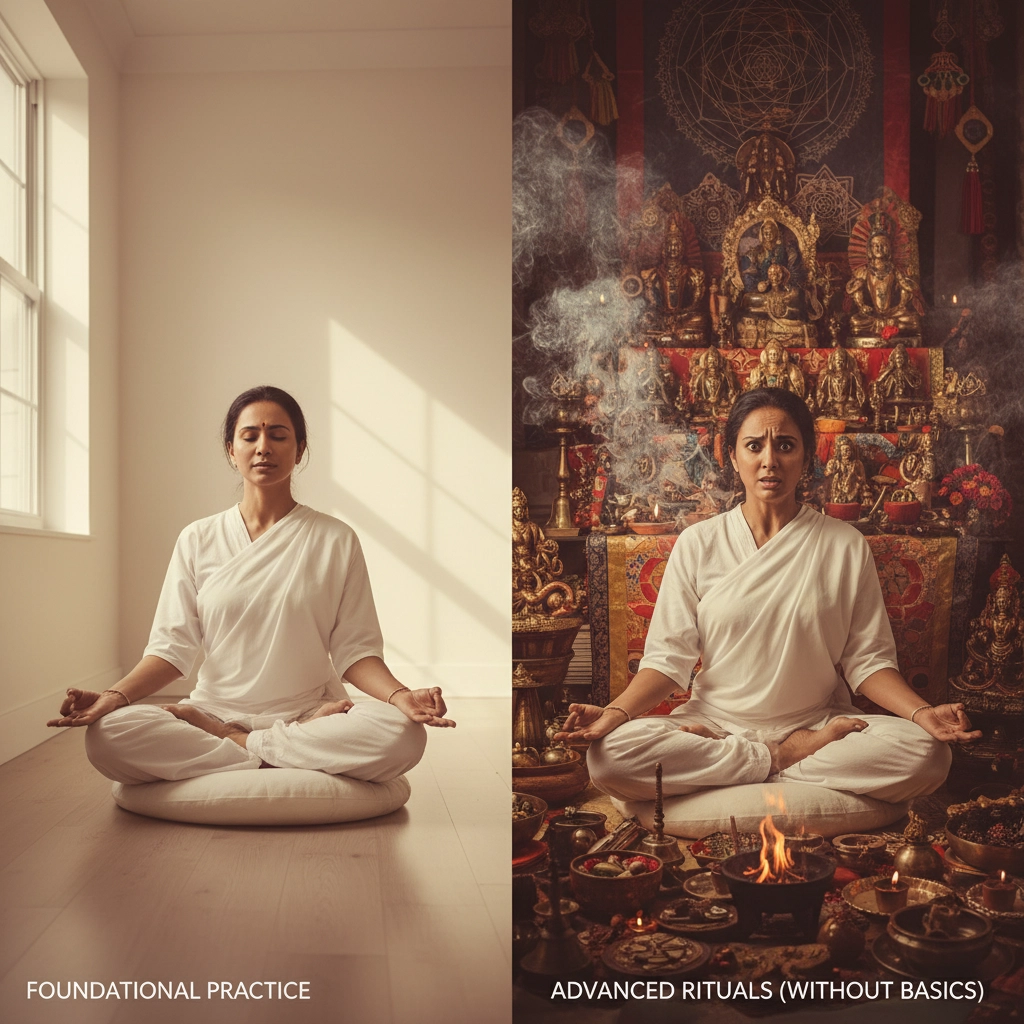
I get it, nobody wants to spend months on foundational practices when there are exciting deity visualizations and advanced mantras calling your name. But here's what most Western practitioners don't realize: jumping straight to the "advanced" stuff is like trying to build the third floor of a house without laying the foundation.
Traditional tantra is built on three essential pillars: renunciation (letting go of ordinary appearances and ego-clinging), bodhichitta (genuine compassion for all beings), and understanding emptiness. Without these, all the visualization work in the world becomes just elaborate daydreaming.
I've seen practitioners obsessing over whether a particular deity has a belly button while completely ignoring the core teachings about selflessness and compassion. That's missing the forest for the trees.
A better approach: Start with ethics, meditation, and study of the philosophical foundations. Yes, it's less glamorous than working with fierce deities, but it's what makes everything else meaningful and safe.
Mistake #3: Treating Tantra as Spiritual Self-Help
This one's huge, and it touches on some deep colonial patterns we might not even be aware of. Many of us approach tantra with a very Western, individualistic mindset: what can this do for me? How will this improve my life, my relationships, my career?
While tantric traditions do acknowledge material benefits (wealth, health, relationships), they're always in service of a greater goal: liberation from suffering for all beings. When we flip this around and make liberation secondary to personal gain, we've fundamentally misunderstood the path.
This utilitarian approach is actually a form of spiritual colonialism: taking sacred practices and reducing them to tools for personal optimization while ignoring their deeper purpose.
A better approach: Ask yourself why you're really drawn to these practices. Are you seeking genuine transformation, or just a more exotic form of self-improvement? There's no shame in honest self-reflection here: it's the first step toward authentic practice.
Mistake #4: The DIY Spiritual Path
Here's a hard truth: you can't authentically practice tantra from YouTube videos and Instagram posts. I know that sounds gatekeepy, but hear me out.
Tantric practices were designed to be transmitted through direct relationship with qualified teachers within unbroken lineages. This isn't about creating exclusive spiritual clubs: it's about safety and effectiveness.
Think of it like learning to perform surgery. You wouldn't want to learn that from a book, right? You'd want mentorship, supervision, and guidance from someone who's actually done it successfully. The same applies to practices that work with subtle energies and consciousness itself.
The guru-disciple relationship in authentic tantra isn't about blind obedience or cult-like devotion. It's about transmission of living wisdom and having someone who can spot your blind spots and guide you through the inevitable challenges that arise.
A better approach: If you're serious about tantric practice, invest in finding authentic teachers. This might mean traveling, paying for teachings, or waiting until the right teacher appears. Quality over convenience always.
Mistake #5: All Ritual, No Heart
I see a lot of practitioners who get really good at the external forms: they know all the mantras, can visualize deities in perfect detail, and have beautiful altars. But they're missing the most crucial element: genuine feeling and devotion (what's called "bhava" in Sanskrit).
Tantra without genuine feeling is like a beautiful shell with nothing inside. The external forms are meant to awaken and focus our inner transformation, not become ends in themselves.

This mechanical approach often stems from our cultural discomfort with devotion and surrender. We want to maintain control and treat spiritual practice like a skill we can master rather than a relationship we enter into.
A better approach: Focus less on getting the technique perfect and more on cultivating genuine love, devotion, and surrender. Let your practice be messy and heartfelt rather than perfect and empty.
How to Actually Honor True Lineage
So what does genuine respect for tantric lineage look like? Here are some practical guidelines:
Study the complete framework: Don't just learn techniques: understand the philosophy, cosmology, and ethics that give them meaning. Read traditional texts, not just modern interpretations.
Support living traditions: If you're benefiting from these practices, find ways to support the communities and teachers who preserved them. This might mean donating to monasteries, supporting indigenous practitioners, or advocating for religious freedom.
Examine your privilege: Honestly look at how your racial, economic, or cultural privilege enables you to access these teachings. Use that awareness to practice with greater humility and responsibility.
Go slow and deep: Rather than collecting practices, choose one path and commit to it fully. Depth over breadth always leads to more authentic transformation.
Find authentic teachers: Seek out teachers who have genuine lineage authorization and who embody the qualities you want to develop. Be willing to be a real student, not just a spiritual consumer.
The Path Forward
Look, I know this all might sound daunting. But here's the beautiful thing: when we approach these practices with genuine respect and commitment, they transform us in ways we never imagined possible. The depth and power available through authentic tantric practice is worth whatever extra effort it requires.
You don't need to be perfect. You don't need to have it all figured out before you start. But you do need to approach this path with sincerity, respect, and a willingness to be changed by it.
The goal isn't to become some idealized spiritual practitioner. It's to become more genuinely yourself: free from the patterns and conditioning that keep you suffering and separate from the profound love and wisdom that's your true nature.
That's the real gift these ancient traditions offer us. Not spiritual bypassing or exotic techniques to impress our friends, but genuine liberation. And that's worth doing right.
Remember, every authentic practitioner started where you are now: with questions, confusion, and a sincere desire to grow. The path itself will teach you what you need to know. Your job is just to show up with an open heart and genuine respect for the profound gift you're receiving.
Ready to dive deeper? Check out our other posts on authentic tantra practices and how to choose a qualified teacher. The journey awaits.

